
Terbinafine — How Dangerous Are the Tablets, Side Effects and Effects on the Liver
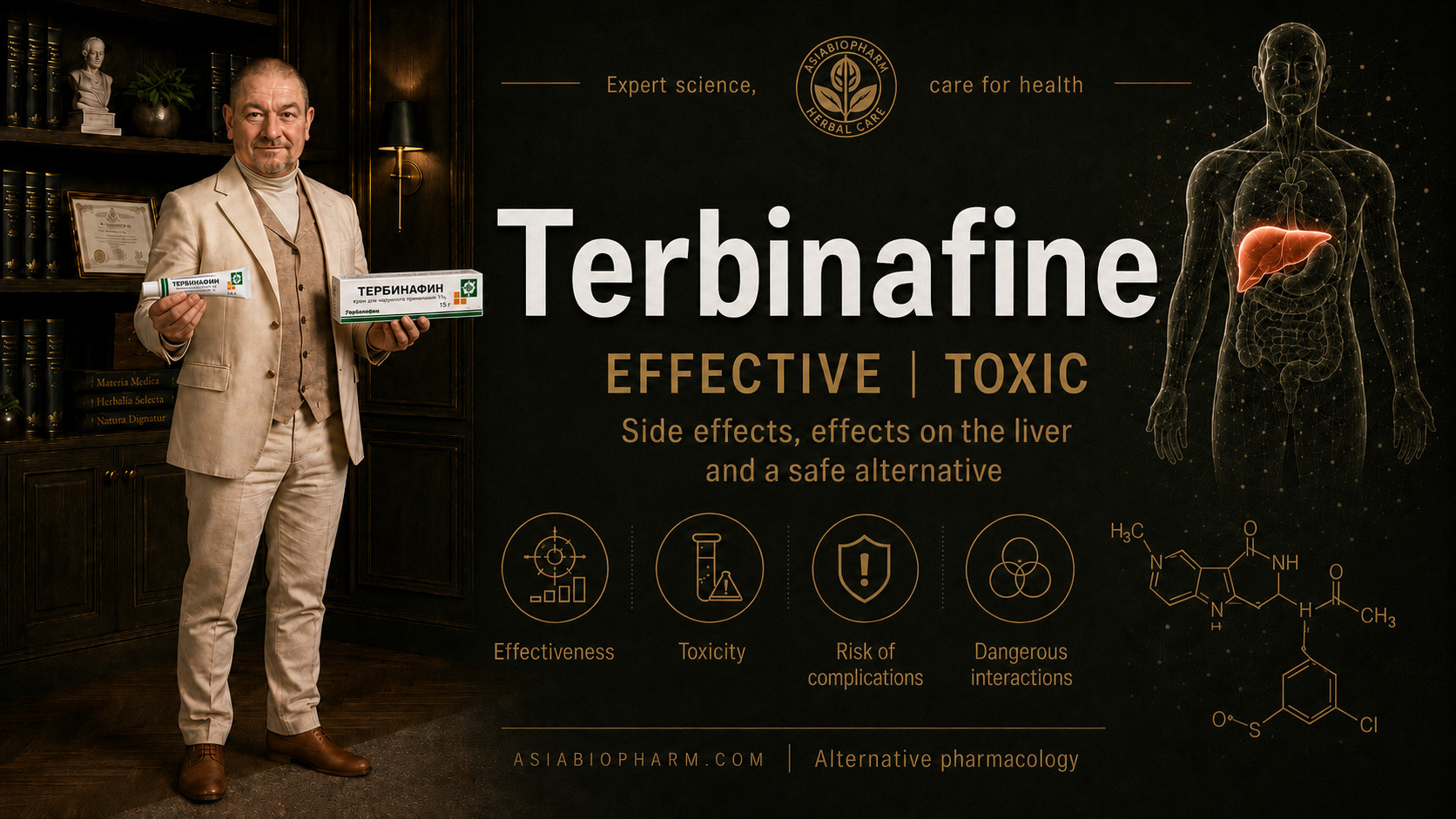
EFFECTIVE | TOXIC
What names is terbinafine available under: the international nonproprietary name is terbinafine, the Latin name is Terbinafine; tablets usually contain terbinafine hydrochloride — Terbinafine hydrochloride, the amount of which is calculated as terbinafine. The main dosage forms are tablets, cream, gel, solution, and spray for external use. Common brand names for tablets include Lamisil, Exifine, Thermicon, Terbizil, Atifin, Exiter, Binafin, Onyhon, Terbinafine-Vertex, and products marketed under the name “Terbinafine” with the manufacturer specified. Topical forms may be sold under the names Lamisil, Lamisil Uno, Thermicon, Fungoterbin, Exifine, Exiter, and others. Tablets and topical products contain the same active substance; however, systemic toxicity is determined primarily by oral administration. On the Russian market, terbinafine is available as numerous single-ingredient products; there are no widely used registered fixed-dose tablet combinations containing terbinafine. Using a cream at the same time as tablets usually does not create a clinically significant hidden doubling of the systemic dose, but the patient should inform the physician about all forms of the drug being used.
Why the tablets are considered harmless and where the real risk begins: terbinafine is often perceived as an ordinary remedy “for nail fungus” that can be taken for months without serious consequences. This perception is dangerous. The oral drug is metabolized in the liver and can cause drug-induced liver injury in a person with no previously diagnosed liver disease. Cases of liver failure, liver transplantation, and death have been reported. Early manifestations may be nonspecific: weakness, loss of appetite, nausea, itching, or abdominal discomfort, so the patient often continues treatment until dark urine and jaundice appear. Additional risks arise from repeated courses without confirmation of a fungal infection, the absence of baseline liver tests, combination with other hepatotoxic substances, and simultaneous use of drugs whose metabolism depends on CYP2D6.
Side effects during the first hours, days, and weeks of treatment: the most common reactions are headache, nausea, diarrhea, dyspepsia, abdominal pain or discomfort, decreased appetite, rash, and itching. More clinically significant effects include elevated liver enzyme activity, altered or lost sense of taste, impaired sense of smell, and severe skin reactions. Taste disturbance may lead to food avoidance, weight loss, and secondary depressive symptoms; it may sometimes persist after discontinuation and, in rare cases, become prolonged or permanent. Life-threatening complications include anaphylaxis, angioedema, Stevens–Johnson syndrome, toxic epidermal necrolysis, DRESS syndrome, severe drug-induced liver injury, and marked abnormalities in blood cell counts. If fever, widespread rash, blisters, mucosal involvement, facial swelling, difficulty breathing, jaundice, or dark urine develop, the drug should be stopped immediately.
Side effects with prolonged and repeated use: treatment of onychomycosis usually lasts for weeks or months, so the absence of a reaction after the first tablets does not prove that the entire course is safe. Idiosyncratic liver injury most often develops within the first six weeks, but the cholestatic component can progress even after the drug is discontinued; recovery sometimes takes several months. Persistent disturbances of taste and smell, reduced food intake and body weight, depressive symptoms, neutropenia, agranulocytosis, thrombocytopenia, and pancytopenia may occur. Drug-induced lupus erythematosus, exacerbation of cutaneous lupus, severe skin reactions, and vasculitis have been reported. Terbinafine does not cause pharmacological dependence or a classic withdrawal syndrome, but repeated courses increase the total duration of exposure and the likelihood of encountering a rare idiosyncratic reaction. If the nail lesion was not initially confirmed mycologically, a prolonged course creates a toxicological burden without any guarantee of therapeutic benefit.
Dangerous drug interactions: terbinafine inhibits CYP2D6 and may increase concentrations of tricyclic antidepressants, certain SSRIs, β-blockers, class 1C antiarrhythmic drugs, and other CYP2D6 substrates with a narrow therapeutic range. The consequences depend on the specific drug and may include increased hypotension and bradycardia, anticholinergic reactions, neurological toxicity, or cardiac conduction disturbances. Combination with tamoxifen is particularly undesirable because CYP2D6 inhibition may reduce formation of its active metabolite endoxifen and potentially decrease antitumor efficacy. Fluconazole and other inhibitors of the enzymes involved may increase terbinafine exposure; rifampicin accelerates its elimination and may reduce efficacy, whereas cimetidine slows its clearance. Terbinafine reduces caffeine clearance, so palpitations, tremor, and insomnia may occur with the usual amount of coffee. Changes in INR have been reported with warfarin, although a causal relationship has not been established in every case, so monitoring is required. Alcohol does not produce a specific “disulfiram-like” interaction, but drinking alcohol while taking a drug with a confirmed risk of liver injury creates an unjustified additional burden on the liver. Potentially hepatotoxic medicines, dietary supplements, and concentrated plant extracts require individual assessment rather than being added to the course automatically.
Patient mistakes that turn a course of treatment into a toxicological experiment: the most common mistake is starting a multiweek course because the nail has changed color or thickness without microscopy, culture, or another form of confirmation of fungal infection. Nail psoriasis, traumatic onychodystrophy, eczema, and other disorders may resemble onychomycosis, but terbinafine does not treat them. It is dangerous to extend the course independently until the nail has fully grown out, repeat the course immediately after treatment failure, increase the dose, or take tablets irregularly and then attempt to “make up” missed doses. Decreased appetite, persistent nausea, itching, taste disturbance, unusual weakness, pale stools, or darkening of the urine should not be ignored. It is also a mistake to assume that normal baseline test results guarantee that drug-induced liver injury will not develop later: hepatotoxicity can occur in a patient whose values were normal before treatment. A topical cream does not replace systemic diagnostic evaluation, and the absence of an immediate reaction after the first doses does not confirm that the course is safe.
Terbinafine overdose and poisoning: a reliable toxic single dose for humans has not been established, and clinical experience with overdose is limited. Official information describes ingestion of up to 5 g, which is approximately twenty standard 250 mg tablets, without severe reactions in some patients, but this is not a safe threshold: individual susceptibility, liver and kidney disease, and concomitant medications can radically alter the consequences. Reported overdose symptoms include nausea, vomiting, abdominal pain, headache, dizziness, rash, and increased urination. There is no specific antidote. In the event of accidental or intentional ingestion of an excessive number of tablets, it is unsafe to wait for jaundice or severe weakness to appear: immediate toxicological assessment is required, including clarification of the dose taken, the time of ingestion, concomitant substances, and monitoring of liver and kidney function and vital signs. Inducing vomiting at home or attempting to “neutralize” the drug with alcohol, sorbents, or herbs may delay necessary medical care.
A safe integrative alternative to terbinafine: there is no single herbal replacement that can equally treat fungal infection of the nail, skin, external auditory canal, paranasal sinuses, and oral mucosa. An alternative must be selected according to the location of the infection, depth of involvement, and identified pathogen. In limited superficial skin mycoses, systemic terbinafine tablets can often be replaced with local therapy, which creates a high concentration of active substances directly at the affected site and practically avoids the systemic hepatic burden characteristic of an oral antifungal drug. The main topical option for dermatophytosis of glabrous skin, athlete’s foot, tinea cruris, candidiasis of skin folds, fungal intertrigo, and pityriasis versicolor is Antifungal Spray. Its composition includes Zingiber cassumunar, Citrus hystrix, Cuscuta reflexa, a mineral component derived from cuttlefish shell, and other plant ingredients. The combination provides direct antifungal activity, drying of macerated skin, and reduction of inflammation, odor, itching, and the risk of secondary bacterial infection. Such therapy is particularly justified for superficial lesions where a systemic drug would create a disproportionately high toxicological burden.
For recurrent skin mycosis, seborrheic dermatitis with fungal colonization, chronic candidiasis, inflammation, and impaired skin barrier function, Indian neem — Azadirachta indica in an appropriate topical form may be added to the local spray. The pharmacological rationale for its use is associated with a combination of antifungal, antimicrobial, anti-inflammatory, and antipruritic effects. Azadirachta should not automatically be declared a complete replacement for tablets in deep, extensive, or complicated mycosis, but in superficial infection and recurrent inflammatory processes it makes it possible to act simultaneously on the fungal flora and damaged tissues without systemic exposure to terbinafine. The most likely adverse reactions to topical herbal products are local burning, irritation, or contact allergy rather than drug-induced liver injury.
For onychomycosis, the main local treatment is Nail Fungus Treatment. This is not an exclusively herbal product but a combined topical solution containing ketoconazole, miconazole nitrate, extracts of Phellodendron amurense and Vitex negundo, as well as a low concentration of nitric acid. Ketoconazole and miconazole block ergosterol synthesis in the fungal cell membrane, the plant components enhance antifungal, antibacterial, and anti-inflammatory effects, and the keratolytic component improves penetration into the altered nail plate. In early distal onychomycosis affecting a small number of nails and without matrix involvement, such local therapy may be used instead of systemic terbinafine. In total dystrophic, proximal, rapidly progressing onychomycosis, pronounced matrix involvement, or immunodeficiency, the decision to completely avoid systemic treatment should be made by a specialist after mycological confirmation of the pathogen.
In fungal diseases of the external auditory canal, nose, paranasal sinuses, and pharyngeal mucosa, the use of terbinafine tablets often does not correspond to the location or spectrum of the suspected pathogens. In such cases, ABP-153 may be used intranasally, in the external auditory canal, and for application to the throat mucosa. The product is considered for otomycosis, candidal and mixed infections of the external ear, fungal rhinitis, rhinosinusitis, nasopharyngeal involvement, and other localized inflammatory-infectious processes. The product may be introduced into the ear only after perforation of the tympanic membrane and middle-ear involvement have been excluded. In invasive fungal sinusitis, mucosal necrosis, high fever, facial swelling, severe unilateral pain, reduced vision, or neurological symptoms, local therapy does not replace urgent specialized medical care.
For candidiasis of the oral cavity and oropharynx, the targeted dosage form is an oral gel that remains on the mucosa and provides prolonged local contact between its components and the affected area. In the presence of erosions, aphthae, ulcers, bleeding, soreness, and pronounced mucositis, Thai FD oral powder with drying, astringent, antiseptic, and reparative effects may additionally be used. For chronic infiltrated, poorly healing, and mixed fungal-inflammatory skin lesions, ABP-153D may be considered. Thus, a comprehensive integrative replacement for terbinafine is not built around a single “herbal tablet,” but around local therapy selected according to the anatomical area: Antifungal Spray and Azadirachta indica for the skin, Nail Fungus Treatment for the nails, ABP-153 for the nose, external ear, and throat, gel and powder for the oral cavity, and ABP-153D for chronic complex skin lesions.
The real effectiveness of terbinafine and medical errors: terbinafine is genuinely effective against susceptible dermatophytes and remains one of the most effective systemic drugs for confirmed dermatophyte onychomycosis, extensive dermatophytosis of the scalp, and severe forms of dermatomycosis in which topical treatment cannot reach the site of infection. It inhibits squalene epoxidase in the fungal cell, disrupts ergosterol formation, and causes accumulation of squalene, which is toxic to the fungus. Its effect is not manifested by immediate restoration of the nail but by cessation of pathogen growth; a visibly normal nail plate appears only as the nail grows out over several months. Terbinafine does not treat nail psoriasis, traumatic onychodystrophy, eczema, lichen planus, bacterial paronychia, or nail changes caused by vascular or endocrine disorders. It is also not a universal treatment for all yeast and mold mycoses. Prescribing tablets solely on the basis of the nail’s appearance turns a proven effective antifungal into an expensive way of treating a disease the patient may not actually have.
Typical medical errors include prescribing a course lasting several months without microscopy, culture, or molecular confirmation of fungal infection, failure to identify the pathogen, ignoring the extent of the lesion and matrix involvement, failure to assess liver function at baseline, underestimating CYP2D6-mediated interactions, and prescribing a systemic drug for a limited superficial lesion that can be treated locally. It is also an error to assess the result after several weeks solely by the appearance of the old nail plate: the drug may already have suppressed the fungus, but a damaged nail cannot instantly become normal. It is equally incorrect to automatically repeat the course because the nail is growing out slowly without confirming persistence of a viable pathogen. Terbinafine is effective, but its effectiveness applies to a specific infection, not to everything that visually resembles a fungal infection.
Safety monitoring during treatment: before starting the tablets, ALT, AST, and bilirubin should be assessed, the presence of chronic or active liver disease should be clarified, and concomitant drug therapy should be reviewed. During a prolonged course, it is advisable to repeat liver tests after approximately four to six weeks because drug-induced liver injury often develops during this period. Elevation of liver enzymes, especially when accompanied by clinical symptoms, requires immediate discontinuation of the drug and additional evaluation. Oral terbinafine is not recommended in chronic or active liver disease; hepatotoxicity can also occur when baseline test results are normal.
Persistent nausea, loss of appetite, unusual weakness, vomiting, pain or heaviness in the right upper quadrant, generalized itching, jaundice, dark urine, and pale stools require immediate discontinuation. There is no need to wait until jaundice becomes pronounced: continuing treatment at the first signs of drug-induced liver injury may increase the severity of the damage and prolong cholestasis. Disturbance of taste or smell is also a reason to discontinue the tablets because it can lead to inadequate nutrition, weight loss, and depressive symptoms, and may sometimes persist for more than a year or become permanent.
A complete blood count is required if fever, sore throat, mouth ulcers, unusual infections, petechiae, or bleeding develop because rare complications include neutropenia, agranulocytosis, thrombocytopenia, and pancytopenia. Widespread rash, blisters, epidermal detachment, painful mucosal erosions, facial swelling, enlarged lymph nodes, shortness of breath, or fever may indicate a severe cutaneous or systemic allergic reaction. In these situations, self-treatment with antihistamines without discontinuing the causative drug may mask the beginning of a dangerous process.
Correct discontinuation of terbinafine: gradual dose reduction is not required because terbinafine does not cause physiological dependence or a classic withdrawal syndrome. If signs of liver injury, severe rash, disturbance of taste or smell, a pronounced allergic reaction, or pathological changes in blood counts develop, the drug should be stopped immediately. Attempting to “finish a few more days” so as not to interrupt the course is pharmacologically unjustified in the presence of a toxic reaction and may increase the severity of the complication.
Stopping treatment independently in the absence of a toxic reaction does not cause a rebound syndrome, but it may allow viable fungus to persist, resulting in recurrence and further spread of infection. A double dose of tablets should not be taken after a missed dose. If treatment was stopped because hepatotoxicity was suspected, self-restarting terbinafine is unacceptable even after laboratory values have normalized. If the drug is discontinued because of lack of effect, the diagnosis, pathogen susceptibility, adherence to the course, and rate of nail growth should first be checked rather than automatically replacing one systemic antifungal with another.
A rational approach to treatment: terbinafine tablets are justified for a laboratory-confirmed susceptible fungal infection when the lesion is extensive, involves the nail matrix, hair, or a substantial area of skin, and when topical therapy objectively cannot provide a sufficient concentration at the site of infection. In such situations, the drug’s high antifungal activity may outweigh its toxicological risk, but only with preliminary evaluation, monitoring of interactions, and surveillance of liver function.
In limited skin mycosis, early nail involvement, mucosal candidiasis, otomycosis, and localized fungal inflammation of the nasopharynx, a systemic drug is often not the only possible solution. A topical antifungal spray, nail solution, Azadirachta indica, ABP-153, oral gel, and oral powder make it possible to act directly at the affected site and reduce the systemic drug burden. Combined use of local and systemic therapy is possible in severe forms, but it should have a clear purpose: to increase local effectiveness, reduce the area of active infection, and lower the likelihood of recurrence rather than simply increase the number of medications.
Rational pharmacology does not mean rejecting synthetic medicines; it means rejecting their unjustified use. Terbinafine should be used where its systemic action is genuinely necessary. Where a comparable therapeutic objective can be achieved with local phytotherapy or a combined topical product without the risk of drug-induced liver injury, the safer strategy has an obvious toxicological advantage.
If you have questions about the topic of this article, you can ask a clinical pharmacologist in the comments or book an appointment using this link: https://asiabiopharm.com/konsultaciii/
0 комментариев