
Nystatin — What It Helps With, Side Effects and Contraindications
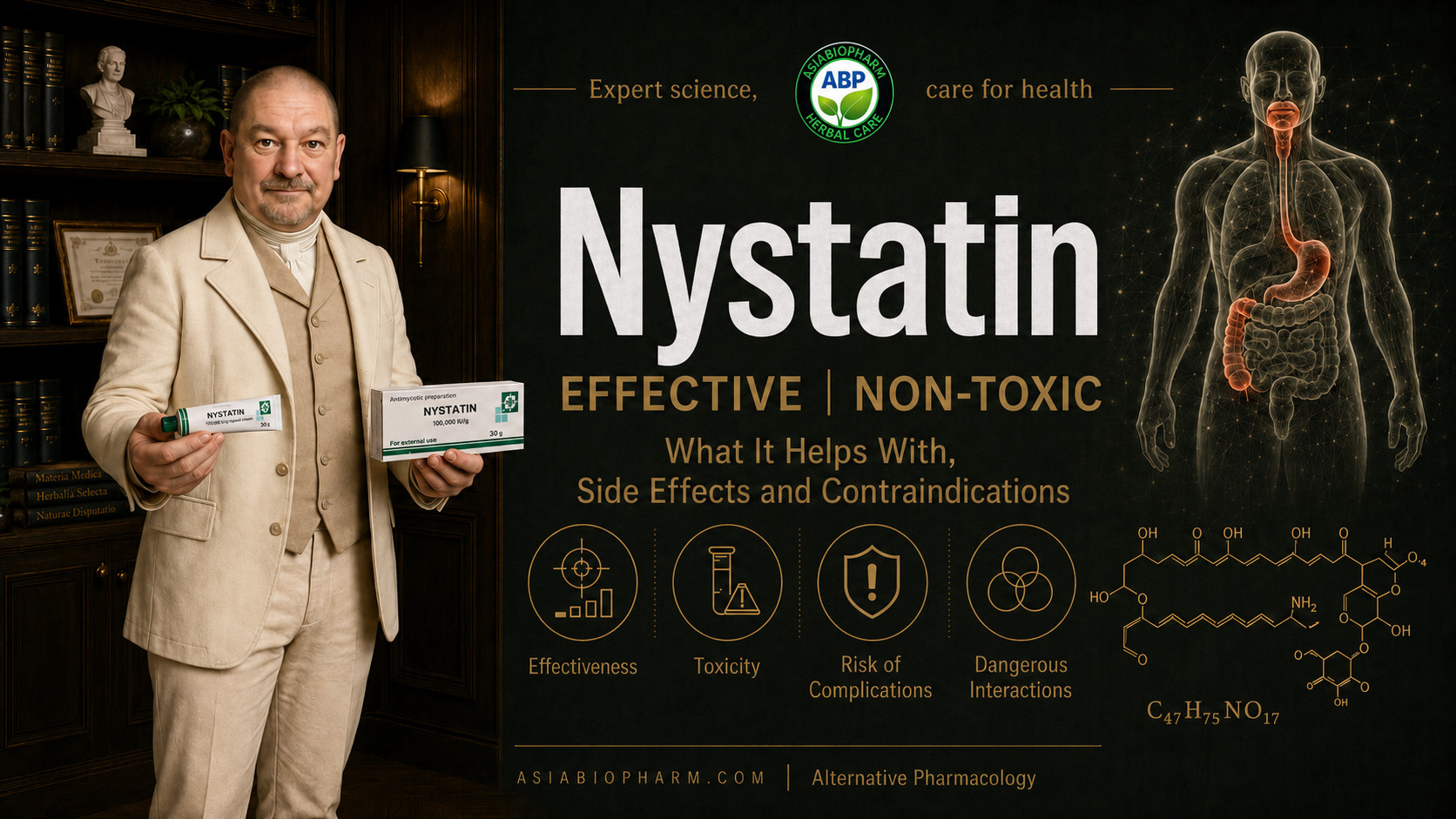
EFFECTIVE | NON-TOXIC
What Names Nystatin Is Sold Under
The international nonproprietary name is nystatin, the Latin spelling is Nystatin, and common variants include Nystatinum, nystatin suspension, nystatin tablets, vaginal tablets or suppositories, and nystatin cream and ointment. Trade names used in different countries include Nystatin, Nystan, Mycostatin, Nilstat, Bio-Statin, as well as the generic products Nystatin Oral Suspension, Nystatin Cream and Nystatin Ointment. Nystatin is also included in combination products: nystatin with triamcinolone acetonide, nystatin with chlorhexidine, nystatin with chlorhexidine and hydrocortisone, as well as topical combinations with neomycin and potent glucocorticosteroids. Well-known multi-component products include Tergynan, Polygynax and Macmiror Complex. They should not be regarded as ordinary nystatin: the additional antibiotics, antiseptics and hormonal components have their own contraindications and toxicity.
Why Nystatin Is Considered Harmless and Where the Real Risk Begins
Nystatin is indeed considered a relatively safe antifungal medication: when taken orally, it is practically not absorbed from the gastrointestinal tract, while when applied to intact skin and mucous membranes, it acts predominantly locally. Therefore, liver and kidney damage and the numerous drug interactions characteristic of systemic antifungals are generally not typical of nystatin. However, low systemic toxicity does not mean that the medication can be used for any discharge, coating, itching or discomfort. The main risk of home use is treatment without confirmed candidiasis. Nystatin acts mainly against susceptible fungi of the genus Candida, but it does not treat bacterial infections, dermatophytosis, viral lesions or systemic mycoses. If the diagnosis is incorrect, symptoms may persist or worsen, while necessary treatment is delayed.
Side Effects During Short-Term Use
When taken orally, the most characteristic adverse effects are nausea, abdominal discomfort and pain, loose stools, diarrhea, vomiting and a burning sensation in the mouth. These reactions may occur during the first days of treatment and are usually associated with the local irritant effect of the medication or components of the suspension. Irritation of the oral mucosa and drug sensitization have been reported. With topical use, burning, itching, redness, soreness, rash, an eczematous reaction and contact dermatitis may occur. With topical cream, such reactions are reported rarely — in fewer than 0.1% of patients; however, continuing application when irritation is increasing may worsen inflammation.
Clinically significant reactions include severe diarrhea, including exceptionally rare reports of bloody diarrhea, widespread urticaria and swelling. Life-threatening reactions are extremely rare, but an anaphylactoid reaction and a severe skin reaction such as Stevens — Johnson syndrome are possible. The appearance of blisters, skin detachment, mouth ulcers, facial swelling or difficulty breathing requires immediate discontinuation of the medication and emergency medical care.
Side Effects During Long-Term or Repeated Use
Nystatin does not have the typical cumulative hepato-, nephro- or cardiotoxicity because its systemic absorption is minimal. Clinically significant drug-induced liver injury is considered unlikely. Therefore, long-term nystatin use should not be assessed according to the same toxicological criteria as treatment with fluconazole, ketoconazole or other systemic antifungal medications.
The real risk of repeated courses lies elsewhere. Constant recurrence of “thrush” may indicate an incorrect diagnosis, uncontrolled diabetes mellitus, immune disorders, the effects of antibiotics, local irritation, a mixed infection or a resistant Candida strain. Repeated use without microscopy or culture masks the problem and delays diagnosis. Prolonged topical use may lead to sensitization and contact dermatitis. Nystatin does not cause physical dependence or a withdrawal syndrome; however, stopping an ineffective or excessively short course may be followed by a return of symptoms because the infection remains undertreated.
Contraindications and High-Risk Groups
A direct contraindication is established hypersensitivity to nystatin or to the excipients of the specific dosage form. If irritation, sensitization, urticaria or other signs of allergy occur, the medication should be discontinued.
Nystatin is not intended for the treatment of systemic candidiasis, candidemia or fungal infection of internal organs: it is practically not absorbed into the bloodstream from the intestine and cannot create a therapeutic concentration in tissues. Attempting to treat fever, a severe condition or suspected invasive fungal infection with nystatin is dangerous not because of the toxicity of the medication itself, but because valuable time is lost.
Patients with diabetes mellitus, intolerance to certain sugars and a high risk of dental caries should check the composition of the suspension: some formulations contain a significant amount of sucrose. In the presence of ulcers, erosions and pronounced mucosal inflammation, alcohols, flavorings, preservatives and sweeteners may increase burning. Pregnant and breastfeeding women and children should use only a formulation intended for the appropriate age and site of infection. Combination products require particular caution: the restrictions applicable to nystatin cannot simply be transferred to combinations containing triamcinolone, hydrocortisone, clobetasol, neomycin or chlorhexidine because their risks are determined by all components of the formulation.
Dangerous Interactions
Clinically significant systemic drug interactions are unlikely with pure nystatin because it is practically not absorbed. It generally does not alter hepatic enzyme activity, increase the concentrations of anticoagulants, anticonvulsants or cardiac medications, or create the combination risks typical of systemic azole antifungals. Alcohol does not have a specific toxic interaction with nystatin, but it may worsen nausea, gastric irritation and diarrhea.
The risk of interactions arises primarily with combination products. Nystatin with triamcinolone or another glucocorticosteroid, when used for a prolonged period, applied to large areas, used under an occlusive dressing or applied to damaged skin, may cause steroid-related complications: thinning of the skin, changes in pigmentation, development or masking of infection. Combinations with neomycin may cause contact sensitization and, if significant absorption of the antibiotic occurs, additional systemic risks. Therefore, the presence of the word “nystatin” on the packaging does not mean that the entire product has the safety profile of pure nystatin.
It is undesirable to use several topical products on the same area simultaneously without medical advice: antiseptics, acids, alcohol solutions, essential oils and aggressive cleansers may increase irritation of the mucosa or skin. Nystatin should not be mixed in the same container with other medications unless compatibility of the mixture has been confirmed by the manufacturer.
Patient Mistakes
The most common mistake is to assume that any white coating, itching, redness or discharge is candidiasis. A coating in the mouth may be associated with a bacterial process, leukoplakia, mucosal inflammation, dryness or dental problems. Vaginal itching and discharge occur with bacterial vaginosis, trichomoniasis, contact dermatitis and other conditions. Skin rashes in folds may be caused by dermatophytes, bacteria, eczema or psoriasis. In these situations, nystatin either does not help or creates a false impression that treatment is taking place.
Other mistakes include swallowing the suspension immediately instead of holding it in the mouth when treating oral candidiasis, stopping treatment after the first reduction in the coating, applying the cream irregularly, treating only one family member when shared factors for reinfection are present, applying the medication to the eyes or deep wounds, and using vaginal formulations on the skin or vice versa. Increasing the dose when there is no effect usually does not solve the problem: more often, the diagnosis, site of infection and susceptibility of the pathogen need to be reassessed.
It is particularly dangerous to use a combination “nystatin” cream containing a hormone without medical supervision. A glucocorticosteroid rapidly reduces itching and redness, creating the impression that the treatment is effective, while at the same time it may mask an inappropriate infection and worsen its course. The initial relief in such a situation is caused by suppression of inflammation rather than elimination of the underlying cause.
Overdose and Poisoning
A single toxic dose of nystatin capable of causing severe systemic poisoning has not been established. Because absorption is extremely low, the medication does not cause the typical damage to the liver, kidneys, heart or nervous system even when the usual oral dose is substantially exceeded. Official prescribing information states that when more than 5 million units per day were taken, nausea and gastrointestinal discomfort were the primary effects observed; severe toxic consequences of such an overdose have not been reported.
Overdose usually manifests during the first hours as irritation in the mouth, nausea, abdominal pain or cramps, vomiting and diarrhea. There is no specific antidote and one is generally not required. The medication should be discontinued, the amount and formulation taken should be assessed, fluids should be replenished and the patient’s condition should be monitored. Vomiting should not be induced without medical advice.
Medical care is required for uncontrollable vomiting, severe diarrhea, blood in the stool, signs of dehydration, altered consciousness, widespread rash, blisters, facial swelling or difficulty breathing. If a child accidentally swallows a large amount of suspension, the composition of the product requires additional assessment: the risk may be associated not only with nystatin, but also with sugar, alcohol, flavorings, preservatives or other components of the specific product.
An overdose of a combination topical product cannot be assessed in the same way as an overdose of pure nystatin. If a large amount of cream containing a potent glucocorticosteroid is applied to extensive or damaged skin, the hormonal component becomes toxicologically significant. For this reason, when seeking medical assistance, it is important to provide the full name of the product and show its packaging.
A Safe Integrative Alternative to Nystatin
There is no universal herbal substitute for nystatin for every form of candidiasis because treatment depends on the site of infection, the condition of the mucous membranes, the severity of inflammation, tissue moisture, the presence of erosions and mixed bacterial-fungal colonization. For superficial candidiasis of the skin, skin folds, interdigital spaces, corners of the mouth and areas of maceration, the main topical alternative is Antifungal Spray. Its composition includes Cuscuta reflexa, Citrus hystrix, Zingiber cassumunar and a mineral adsorbent component derived from cuttlefish shell. The complex combines direct antifungal action, suppression of inflammation, reduction of burning and soreness, drying of macerated areas and support for restoration of the skin barrier. This distinguishes it from nystatin, which acts primarily on the membrane of susceptible Candida fungi but does not itself eliminate moisture, epithelial damage or the inflammatory tissue response. The spray is particularly appropriate for cutaneous candidiasis, candidal intertrigo, mixed fungal-bacterial lesions, chronic recurrent candidiasis of skin folds and secondary fungal colonization associated with dermatitis.
For preliminary cleansing of the skin and reduction of the superficial microbial load, Neem Soap based on Azadirachta indica and Care Spa Rose soap may be used. They do not replace antifungal therapy because they are rinse-off products with a limited contact time, but they may be useful for candidiasis of skin folds, increased skin moisture, unpleasant odor and mixed bacterial-fungal colonization. Neem Soap is pharmacologically preferable when the fungal component is pronounced because of the antifungal and anti-inflammatory profile of Azadirachta indica. Care Spa Rose is more appropriately regarded as a hygiene adjunct when a fungal lesion is accompanied by irritation, bacterial colonization and skin inflammation. Both products are intended for the skin only and should not be applied to mucous membranes.
For candidiasis of the oral mucosa, candidal stomatitis, glossitis, gingival inflammation, fungal coating of the tongue, lesions of the inner surface of the cheeks and oropharyngeal candidiasis, the main topical alternative is Mouth Gel KLO for mucous membranes. It contains Terminalia chebula, Glycyrrhiza glabra and Andrographis paniculata. The mucoadhesive gel formulation provides prolonged contact of the active substances with the mucosa, while the combination of plant components has antifungal, anti-inflammatory, antiseptic and reparative effects. Unlike liquid nystatin suspension, which is rapidly removed by saliva and must be held correctly in the mouth, the gel remains on the affected surface for longer. It is particularly appropriate when candidiasis is accompanied by soreness, dryness, inflammation, microcracks and impairment of the protective mucosal barrier.
For oral candidiasis accompanied by aphthae, ulcers, erosions, bleeding, severe stomatitis or localized painful lesions, Relief Mouth Ulcer TFD oral powder may be used. It contains Quercus infectoria, Kaempferia galanga, Chrysopogon zizanioides, Myristica fragrans, Pterocarpus santalinus and other plant components. Its astringent, anti-inflammatory, antiseptic, antifungal and wound-healing effects make the powder particularly useful for localized mucosal damage. It should not mechanically replace the gel when candidal coating is widespread, but it may complement it in the presence of ulcerative and erosive changes.
Punica granatum pomegranate peel extract is appropriate for inclusion in therapeutic regimens for candidiasis of the mucous membranes and skin. Punicalagins, ellagitannins and other polyphenolic compounds provide astringent, antimicrobial, anti-inflammatory and antibiofilm effects. The extract is particularly appropriate for loose, inflamed mucosa, weeping lesions, unpleasant odor, erosions and mixed microbial colonization. In oral candidiasis, it may enhance the action of Mouth Gel KLO or Relief Mouth Ulcer TFD powder, while in cutaneous candidiasis it may complement the antifungal spray. However, excessively concentrated formulations may cause dryness and burning, so pomegranate should not be used as an uncontrolled cauterizing agent.
Azadirachta indica has antifungal, antibacterial, anti-inflammatory and antibiofilm activity. Azadirachta extracts may be useful for recurrent candidiasis of the skin, mucous membranes, oral cavity and external genitalia, particularly when fungal infection is accompanied by inflammation and bacterial colonization. However, oral use of Azadirachta should not automatically be regarded as safer than topical nystatin. The dose, extract formulation, duration of treatment and liver condition should be considered individually. Therefore, Azadirachta is more appropriately used as a systemic or topical adjunct to local therapy rather than as an unconditional standalone replacement in severe or widespread candidiasis.
A special role belongs to ABP-153 — an oil-based phytomixture for the skin and mucous membranes with pronounced antifungal, antiseptic, anti-inflammatory and reparative effects. The product may be used in a nasal formulation and in a formulation for topical treatment of the oral mucosa. In this context, the oral formulation means local application in the oral cavity rather than swallowing the product as a systemic treatment. In oral candidiasis, ABP-153 may be used for fungal coating, candidal stomatitis, glossitis, gingival inflammation, lesions of the tonsils and posterior pharyngeal wall, and oropharyngeal candidiasis. The oil base reduces dryness, protects damaged epithelium, prolongs contact of the plant components with the mucosa and promotes restoration of its barrier function.
The nasal formulation of ABP-153 is relevant for fungal lesions of the nasal mucosa and diseases of the upper respiratory tract associated with a fungal etiology or persistent fungal colonization. Such conditions include fungal rhinitis, candidiasis of the nasal mucosa, chronic rhinosinusitis with a fungal component, non-invasive fungal rhinosinusitis, mixed bacterial-fungal inflammation, chronic crust formation, dryness, microcracks and epithelial damage after repeated courses of antibiotics, vasoconstrictors or topical glucocorticosteroids. The antifungal activity of ABP-153 is combined with reduction of inflammation and restoration of the mucosa, so the product may be particularly useful in situations where it is necessary not only to suppress fungal colonization but also to restore the damaged mucociliary barrier.
In diseases of the paranasal sinuses, superficial fungal colonization, allergic fungal rhinosinusitis, a fungal ball of the sinus and invasive fungal sinusitis must be clearly distinguished. Topical herbal preparations may be used as part of combination therapy for non-invasive and chronic forms after diagnosis and restoration of sinus drainage, but they do not replace endoscopic examination, computed tomography, mycological testing or surgical debridement in the presence of a fungal ball or obstruction. In invasive fungal sinusitis, particularly in patients with diabetes mellitus, neutropenia, cancer or immunosuppression, topical treatment is unacceptable as the sole therapy: urgent systemic antifungal treatment and surgical care are required.
Nail Fungus Treatment is suitable for candidiasis of the nails and periungual tissues, but it is not a completely herbal alternative to nystatin because it contains synthetic antifungal components. It should not be applied to the mucous membranes of the mouth, nose or vagina, or to extensive areas of damaged skin. Its role is the local treatment of onychomycosis and candidal involvement of the nail plates.
Thus, an integrative replacement for nystatin should be selected according to the site of infection. For candidiasis of the skin and skin folds, Antifungal Spray is the main product, while Neem Soap or Care Spa Rose is used for hygienic preparation of the skin. For oral candidiasis, Mouth Gel KLO becomes the main product; in the presence of ulcers and erosions, Relief Mouth Ulcer TFD, Punica granatum or ABP-153 may be added. For fungal lesions of the nasal mucosa and chronic rhinitis and rhinosinusitis with a confirmed fungal component, the nasal formulation of ABP-153 is given priority. Azadirachta indica may be used as an additional component in recurrent disease. In severe, invasive, systemic or immunodeficiency-associated candidiasis, the products listed above do not replace systemic antifungal therapy and specialized diagnostic evaluation.
The Actual Effectiveness of Nystatin
Nystatin is genuinely effective for superficial infections caused by susceptible fungi of the genus Candida. It binds to sterols in the fungal cell membrane, disrupts its permeability and causes loss of intracellular components. The medication works predominantly at the site of direct contact: in the oral cavity, intestine, on the skin, mucous membranes and in the vagina. When the site is appropriate and the pathogen is susceptible, burning, itching, coating and inflammation may begin to decrease during the first days, although complete disappearance of symptoms does not always mean that the infection has been eradicated.
Nystatin is not absorbed in therapeutically significant amounts and therefore does not treat candidemia, invasive candidiasis, fungal infection of internal organs, or deep infections of the lungs, sinuses, bones, brain or urinary tract. It is also ineffective against most dermatophytes, bacteria and viruses. In fungal rhinosinusitis, a fungal ball of the sinus or invasive mycosis, prescribing nystatin tablets is pharmacologically meaningless: the medication does not create the necessary concentration in sinus tissues or the bloodstream.
The main medical error is prescribing nystatin on the basis of a single symptom without microscopy, culture or assessment of the site of infection. A white coating in the mouth, vaginal discharge, skin itching and inflammation of skin folds are not specific signs of candidiasis. Repeated courses without confirmation of the causative organism turn treatment into a ritual: the medication is taken, symptoms persist, and the true cause of the disease remains undiagnosed.
Other mistakes include use for systemic infection, an excessively short course, an inappropriate dosage form, failure to address factors contributing to recurrence, and ignoring diabetes mellitus, immunodeficiency, dental prostheses, antibiotic therapy, inhaled glucocorticosteroids and chronic mucosal damage. If treatment is ineffective, increasing the dose is not the answer; the diagnosis should be reconsidered and Candida susceptibility assessed.
Safety Monitoring During Treatment
During a short topical course of nystatin, laboratory monitoring of liver and kidney function is generally not required because the medication is practically not absorbed. The main parameter to monitor is clinical progress: reduction of coating, itching, burning, soreness, hyperemia and abnormal discharge. Lack of improvement within several days, worsening of symptoms or rapid recurrence of candidiasis after the course requires repeat diagnostic evaluation.
In oral candidiasis, the mucosa of the tongue, cheeks, palate, gums and pharynx should be assessed, along with the condition of dental prostheses, the presence of dry mouth and the use of inhaled hormonal medications. For vaginal symptoms, microscopy, pH measurement and exclusion of bacterial vaginosis, trichomoniasis and dermatitis are important. In skin lesions, candidiasis should be distinguished from dermatophytosis, erythrasma, psoriasis and contact eczema.
The medication must be discontinued immediately if widespread urticaria, increasing swelling, difficulty breathing, blisters, skin detachment, ulcers on the mucous membranes or signs of a severe allergic reaction occur. Severe vomiting, diarrhea, blood in the stool and signs of dehydration also require medical assessment. If fungal sinusitis is suspected, emergency warning signs include high fever, severe unilateral facial pain, swelling around the eye, visual impairment, blackening of the nasal mucosa, severe headache, neurological symptoms and rapid deterioration.
How to Stop Nystatin Correctly
Nystatin does not cause dependence, hormonal rebound or a pharmacological withdrawal syndrome. After a standard course, it can be stopped immediately; gradual dose reduction is not required. However, stopping treatment early after the first improvement may allow fungal colonization to persist and symptoms to return rapidly.
Recurrence of coating, itching or discharge after stopping nystatin is not a withdrawal syndrome. It more often indicates an undertreated infection, an incorrect diagnosis, resistance of the pathogen, reinfection or persistence of risk factors. Courses should not be repeated indefinitely without medical guidance. In recurrent candidiasis, blood glucose levels, immune system status, microbiota, medication burden and local causes of mucosal damage should be investigated.
If a combination product containing nystatin and a glucocorticosteroid was used, the rules for discontinuation depend not on nystatin but on the hormonal component, the area of application and the duration of treatment. After prolonged use of a potent topical corticosteroid, rebound inflammation, burning, redness and exacerbation of a concealed infection are possible.
A Rational Approach to Treatment
Nystatin is appropriate for confirmed superficial candidiasis when the causative organism is susceptible and the dosage form corresponds to the site of infection. Its advantages include low systemic absorption, absence of characteristic hepatotoxicity and a small number of systemic interactions. It may be particularly useful in patients for whom systemic azole antifungals are undesirable.
However, nystatin is not a universal medication for every fungal infection. It does not treat systemic or invasive mycoses, eliminate the causes of recurrent candidiasis, restore a damaged skin or mucosal barrier, and is not always effective against biofilms or mixed infections. In mild and localized cases, the therapeutic objective may be addressed with herbal products that combine antifungal, anti-inflammatory, antiseptic and reparative effects.
For cutaneous candidiasis, it is reasonable to use Antifungal Spray with hygienic support from Neem Soap or Care Spa Rose. For oral candidiasis, Mouth Gel KLO, Relief Mouth Ulcer TFD, Punica granatum and the topical formulation of ABP-153 may be used depending on the condition of the mucosa. For fungal lesions of the nose and upper respiratory tract, chronic rhinitis and non-invasive rhinosinusitis with a fungal component, the nasal formulation of ABP-153 may be used after diagnostic evaluation and exclusion of dangerous forms of mycosis. In severe, systemic, invasive or rapidly progressive disease, synthetic systemic antifungals and specialized medical care are necessary because topical products cannot provide the required concentration in tissues and blood.
If you have questions about the subject of this article, you can ask a clinical pharmacologist in the comments or book an appointment using the following link: https://asiabiopharm.com/konsultaciii/
0 comments