
Itraconazole — How Dangerous It Is, Side Effects and Contraindications
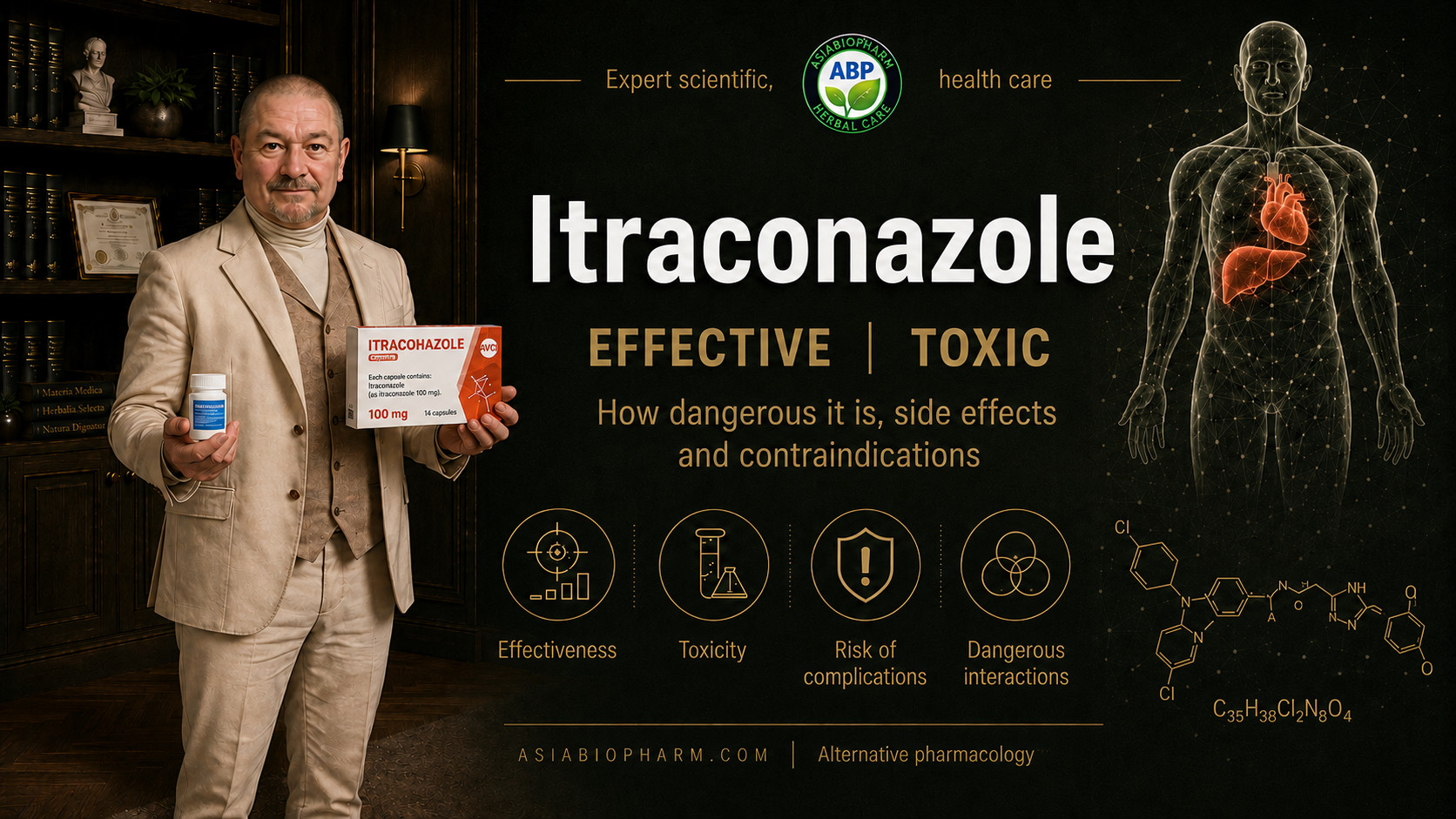
EFFECTIVE | TOXIC
What names itraconazole is known by: the international nonproprietary name is itraconazole; medical instructions, clinical documents, and search queries may also use the variants Itraconazol, Itraconazole, and the abbreviation ITZ. Clinically used products contain itraconazole itself as the active substance, without a separate pharmacologically active salt designation. The main systemic dosage forms are conventional capsules, capsules with enhanced bioavailability, and oral solution. These forms are not interchangeable: systemic exposure from the solution is higher than from conventional capsules, while formulations with modified bioavailability have their own dosing rules. The main brand names include Sporanox, Орунгал, Orungal, Итразол, Ирунин, Румикоз, Орунгамин, Кандитрал, Итраконазол, and Tolsura. Conventional capsules are taken with a full meal, whereas the solution is better absorbed on an empty stomach; the solution is specifically used for oropharyngeal and esophageal candidiasis. In some markets, topical combination products are available that contain itraconazole together with other antifungals, antibiotics, or glucocorticosteroids. Therefore, before using several “antifungal” products at the same time, the composition of each product should be checked rather than relying solely on its brand name.
Why itraconazole is considered harmless and where the real risk begins: the drug is often perceived as simply a set of capsules for nail fungus, although it can cause drug-induced liver injury, fluid retention, peripheral and pulmonary edema, and can trigger or worsen heart failure. Early manifestations of toxicity are nonspecific: weakness, loss of appetite, nausea, weight gain, edema, and shortness of breath may mistakenly be attributed to infection, age, or fatigue. The absence of an immediate reaction after the first capsules creates a false sense of safety, but severe liver injury can develop within the first weeks of treatment. Additional risks arise from repeated courses without proper diagnosis, alcohol use, self-directed switching between dosage forms, and concomitant use of medications whose concentrations itraconazole can sharply increase through CYP3A4 inhibition.
Side effects during short-term use: common reactions in the first hours and days include nausea, abdominal pain or discomfort, dyspepsia, diarrhea or constipation, headache, dizziness, and skin rash. Clinically significant complications include elevated liver enzyme activity, cholestatic or mixed liver injury, fluid retention, peripheral edema, arterial hypertension, hypokalemia, paresthesia, and peripheral neuropathy. A hypersensitivity reaction may occur after the first doses, while drug-induced hepatitis may develop within several days or weeks. Early signs include unusual weakness, loss of appetite, nausea, itching, dark urine, pale stools, and pain in the right upper quadrant; jaundice may subsequently appear and acute liver failure may develop. The negative inotropic effect of itraconazole may present as progressively worsening shortness of breath, reduced exercise tolerance, nighttime attacks of breathlessness, swelling of the lower legs, and sudden weight gain. Life-threatening reactions include severe cardiac decompensation, acute liver failure, anaphylaxis, Stevens–Johnson syndrome, and toxic epidermal necrolysis.
Side effects during long-term or repeated use: when treating onychomycosis and chronic mycoses, exposure continues for weeks or months, and itraconazole together with its active hydroxy metabolite accumulates in tissues. The absence of a pronounced reaction at the beginning of treatment does not rule out a gradual increase in transaminases, cholestasis, persistent edema, hypokalemia, peripheral neuropathy, or deterioration of cardiac function. Clinically apparent drug-induced liver injury often develops within the first months, but it may occur earlier. Recovery after discontinuation may take several weeks or months; rare severe cases result in acute liver failure, liver transplantation, or death. Neuropathy after prolonged exposure does not always resolve immediately. Re-exposure after a suspected drug-related reaction may cause more rapid and more severe recurrent injury. Tolerance, drug dependence, and a classic withdrawal syndrome are not characteristic of itraconazole, but repeated incomplete courses can mask an incorrect diagnosis, temporarily suppress the infection, and create conditions for relapse.
Contraindications and high-risk groups: itraconazole is contraindicated in patients with hypersensitivity to the active substance and when used concomitantly with a number of drugs whose concentrations may rise to dangerous levels as a result of CYP3A4 inhibition. For the treatment of onychomycosis, the drug is contraindicated in patients with heart failure, impaired ventricular function, or a history of heart failure. In systemic mycoses, it may sometimes be used despite cardiac risk, but only when the infection is serious and the expected benefit outweighs the danger. In cardiomyopathy, ischemic heart disease, valvular disease, chronic lung disease, renal failure, and a tendency to develop edema, the risk of decompensation increases. Active liver disease, elevated baseline transaminases, a history of drug-induced hepatotoxicity, and concomitant use of other hepatotoxic agents increase the risk of severe liver injury. During pregnancy, systemic use for the treatment of onychomycosis is contraindicated; women of reproductive age should take into account that the drug remains in the body for a prolonged period after the course has ended. In children, systemic use is limited to situations in which the expected benefit outweighs the uncertainty resulting from insufficient safety data.
Dangerous interactions: combinations with sensitive CYP3A4 substrates are contraindicated when an increase in their concentrations may cause severe arrhythmia, respiratory depression, rhabdomyolysis, ischemia, or other toxicity. These include certain antiarrhythmic drugs, some agents that prolong the QT interval, oral midazolam and triazolam, simvastatin and lovastatin, certain ergot alkaloids, and other drugs listed in the instructions for the specific dosage form. Rifampicin, rifabutin, carbamazepine, phenytoin, phenobarbital, and St John’s wort are highly undesirable: they induce CYP3A4, sharply reduce itraconazole concentrations, and create a risk of therapeutic failure. Combination with certain calcium channel blockers is dangerous because their concentrations may increase and their negative inotropic effects may be additive, potentially resulting in hypotension, edema, and heart failure. Dose adjustment and monitoring are required for certain benzodiazepines, opioids, anticoagulants, immunosuppressants, glucocorticosteroids, and antineoplastic agents. When itraconazole is combined with tacrolimus, cyclosporine, sirolimus, and other drugs with a narrow therapeutic range, concentration monitoring is necessary. Antacids, H₂ blockers, and proton pump inhibitors increase gastric pH and may reduce the absorption of conventional capsules. Alcohol does not cause a specific disulfiram-like reaction, but it increases the hepatotoxic burden and makes early liver injury more difficult to recognize.
Patient errors: a typical mistake is to take itraconazole on the advice of acquaintances for any nail change, white coating in the mouth, skin itching, or discharge without confirming the fungal nature of the condition. Nail psoriasis, traumatic onychodystrophy, eczema, bacterial inflammation, lichen planus, and vascular disorders may resemble a mycosis externally, but itraconazole does not eliminate the underlying cause in these conditions. Increasing the dose and shortening the intervals when there is no rapid cosmetic improvement is particularly dangerous: a nail takes months to grow out, while the systemic toxicological burden increases immediately. Conventional capsules must not be independently replaced with the solution or a formulation with enhanced bioavailability; a double dose must not be taken after a missed dose; treatment must not be extended until the nail has completely regrown; and an old regimen must not be repeated without a new diagnostic assessment. Other mistakes include taking conventional capsules on an empty stomach, taking the solution after meals, using acid-reducing drugs simultaneously without accounting for reduced absorption, consuming alcohol, and failing to inform the physician about statins, antiarrhythmic agents, sleeping pills, immunosuppressants, dietary supplements, and herbal products. Ignoring edema, sudden weight gain, shortness of breath, dark urine, and jaundice can turn an early reversible reaction into severe cardiac or hepatic decompensation.
Overdose and poisoning: no single toxic dose or cumulative dose has been established for itraconazole above which severe poisoning develops in every patient. The danger depends on the amount of the drug, the dosage form, liver function, cardiac reserve, age, and drug interactions. In the first hours after excessive intake, nausea, vomiting, abdominal pain, headache, dizziness, and weakness may occur; these symptoms are nonspecific and do not allow the subsequent severity to be predicted. During the following hours and days, edema, shortness of breath, tachycardia, electrolyte disturbances, and laboratory signs of liver injury may increase. Jaundice, marked cholestasis, liver failure, or decompensation of cardiac function may develop later. A concealed overdose may occur when conventional capsules are mistakenly replaced with a formulation with enhanced bioavailability, dosing intervals are shortened, a double dose is taken after a missed dose, itraconazole is combined with potent CYP3A4 inhibitors, or hepatic clearance is reduced. There is no specific antidote. Itraconazole is extensively bound to plasma proteins, so hemodialysis does not effectively remove it. If a clinically significant overdose is suspected, urgent toxicological assessment, ECG, and monitoring of electrolytes, liver parameters, respiration, and signs of fluid retention are required.
Safe integrative alternative: in localized superficial mycoses of the skin, accessible mucous membranes, and the external auditory canal, systemic itraconazole can in many cases be replaced with a combination of topical agents that act directly on the affected area and do not impose the liver, myocardial, and CYP3A4 burden characteristic of systemic azoles. For dermatophytosis of the skin, involvement of the groin and interdigital folds, cutaneous candidiasis, Malassezia-associated conditions, and secondary fungal colonization, an antifungal spray is used. Its components provide local antifungal, anti-inflammatory, deodorizing, and drying effects; clinical benefit is assessed by reductions in itching, maceration, inflammation, and the area of involvement.
When the nail plate is affected, an antifungal ointment is used. Azadirachta indica may complement topical therapy for recurrent mycoses of the skin and nails because of its antifungal, anti-inflammatory, and antibiofilm pharmacological potential. Such an approach is most justified for distal and superficial involvement of a limited portion of the nail plate. If the matrix is involved, the nail is completely destroyed, marked hyperkeratosis is present, or several nails are affected, topical therapy alone may be insufficient.
For candidiasis of the oral cavity and oropharynx, an oral gel and oral powder are used. These formulations remain in prolonged contact with the mucosa and reduce fungal and mixed microbial burden, inflammation, maceration, soreness, and epithelial damage. The gel is more appropriate for even coverage of the mucosa, whereas the powder is more suitable for localized erosive, ulcerative, and inflamed areas.
ABP-153 is used intranasally, applied to the external auditory canal, and used to lubricate the mucous membranes of the mouth and throat. It may be included in local therapy for fungal and mixed lesions of the nose, nasopharynx, oropharynx, and external ear. Before use in the ear, perforation of the tympanic membrane, middle-ear involvement, and conditions in which oily preparations are contraindicated in the auditory canal must first be ruled out. ABP-153-D is preferable for chronic cutaneous and dermatological lesions in which fungal colonization is combined with inflammation, impaired barrier function, and delayed regeneration.
Complete replacement of systemic itraconazole is possible in confirmed, limited superficial mycoses of mild and some moderate severity when there is no deep invasion, involvement of the nail matrix, severe immunosuppression, or systemic symptoms. In total or proximal onychomycosis, deep sporotrichosis, pulmonary aspergillosis, histoplasmosis, blastomycosis, disseminated candidiasis, and internal-organ involvement, a topical combination is not equivalent to systemic therapy. In such cases, the decision to replace or discontinue itraconazole must be made by a specialist. Confirmed properties of topical agents should be distinguished from pharmacological rationale and practical clinical observations: local activity does not prove equivalence to a systemic azole in invasive infection.
Real effectiveness of itraconazole and physician errors: itraconazole does indeed inhibit ergosterol synthesis and acts against susceptible dermatophytes, Candida, Aspergillus, and the causative agents of several endemic systemic mycoses. Capsules are used for confirmed dermatophyte onychomycosis, blastomycosis, histoplasmosis, and certain forms of aspergillosis; the oral solution is used for oropharyngeal and esophageal candidiasis. When the causative organism is susceptible, the drug acts on the cause of the infection rather than merely reducing symptoms, but its effectiveness depends on the dosage form, absorption, the location of the mycosis, and fungal susceptibility. Itching, inflammation, and coating may decrease before the infection is eliminated; the appearance of the nail is restored only as a new nail plate grows. Itraconazole does not treat nonfungal onychodystrophy, bacterial skin lesions, psoriasis, eczema, or any white coating of unknown origin. Physician errors include prescribing without microscopic or culture confirmation, failure to identify the causative organism in recurrent disease, incorrect selection of the dosage form, ignoring heart failure and liver function, failure to check for drug interactions, and using a systemic drug for a small superficial lesion that is accessible to topical therapy. The antifungal activity of the drug does not make every deformed nail plate an indication for weeks of systemic toxicological exposure.
Safety monitoring during treatment: before starting a systemic course, information should be collected about heart failure, edema, shortness of breath, liver disease, and the complete list of medications, dietary supplements, and herbal products being taken. It is advisable to determine baseline ALT, AST, alkaline phosphatase, and bilirubin levels. In patients with liver disease, during a prolonged course, with repeated treatment, or when symptoms appear, monitoring should be repeated during therapy. There is no single universal monitoring interval for all patients: timing depends on treatment duration and baseline risk, but leaving liver parameters unchecked during a course lasting several weeks is unreasonable. Itraconazole should be discontinued immediately and liver function assessed if unusual weakness, persistent nausea, loss of appetite, vomiting, pain in the right upper quadrant, itching, jaundice, dark urine, or pale stools occur. Rapid weight gain, leg swelling, increasing shortness of breath, orthopnea, nighttime cough, and reduced exercise tolerance require urgent assessment of cardiac function. When medications that affect heart rhythm are used, ECG monitoring and potassium and magnesium measurements are necessary. When immunosuppressants and other drugs with a narrow therapeutic range are prescribed concomitantly, their concentrations should be monitored. Paresthesia, burning, numbness, and sensory disturbances require evaluation for peripheral neuropathy. Emergency warning signs include fainting, pronounced palpitations, difficulty breathing, swelling of the face or larynx, widespread blistering rash, epidermal detachment, jaundice, confusion, and rapidly worsening shortness of breath.
Proper discontinuation of the drug and consequences of stopping treatment: itraconazole does not require gradual dose reduction and may be discontinued immediately. If signs of liver injury, heart failure, a severe allergic or skin reaction, neuropathy, or a dangerous drug interaction occur, the drug should be stopped at once. There is no classic withdrawal syndrome, rebound effect, or physical dependence. However, prematurely stopping treatment on one’s own in a confirmed systemic or deep mycosis may allow viable pathogens to persist, leading to relapse and progression of the infection. After a prolonged course, itraconazole and its active hydroxy metabolite do not disappear from the body immediately; CYP3A4 inhibition and the risk of interactions may persist after the last dose. A missed dose must not be compensated for by taking a double dose. Recurrence of symptoms after treatment has been stopped indicates not a withdrawal syndrome, but persistence of the infection, an incorrect diagnosis, insufficient treatment duration, or unresolved factors contributing to relapse.
A rational approach to treatment: systemic itraconazole is justified in confirmed mycoses when the causative organism is susceptible, the infection involves deep tissues or internal organs, and topical therapy cannot provide the required concentration. In aspergillosis, histoplasmosis, blastomycosis, and other serious systemic infections, the systemic distribution and predictable antifungal activity of the drug may be necessary despite its toxicity. For a small localized mycosis of the skin, accessible mucous membranes, the external auditory canal, or a limited superficial nail lesion, it is preferable to confirm the diagnosis and consider a topical combination: antifungal spray, antifungal ointment, Azadirachta indica, ABP-153, ABP-153-D, oral gel, and oral powder. This approach reduces systemic exposure and the risk of drug-induced liver injury, heart failure, and CYP3A4-mediated interactions. Combined use of topical and systemic agents is acceptable when systemic therapy is genuinely necessary and local products help reduce fungal burden, inflammation, and barrier damage. The goal of rational pharmacotherapy is not to avoid a potent antifungal when it is necessary, but to avoid exposing the entire body to its toxicity when the affected area can be treated more locally and safely.
If you have questions about the topic of this article, you can ask a clinical pharmacologist in the comments or book an appointment using the following link: https://asiabiopharm.com/konsultaciii/
0 comments