
Gentamicin — Why It Is Dangerous, Side Effects and Contraindications
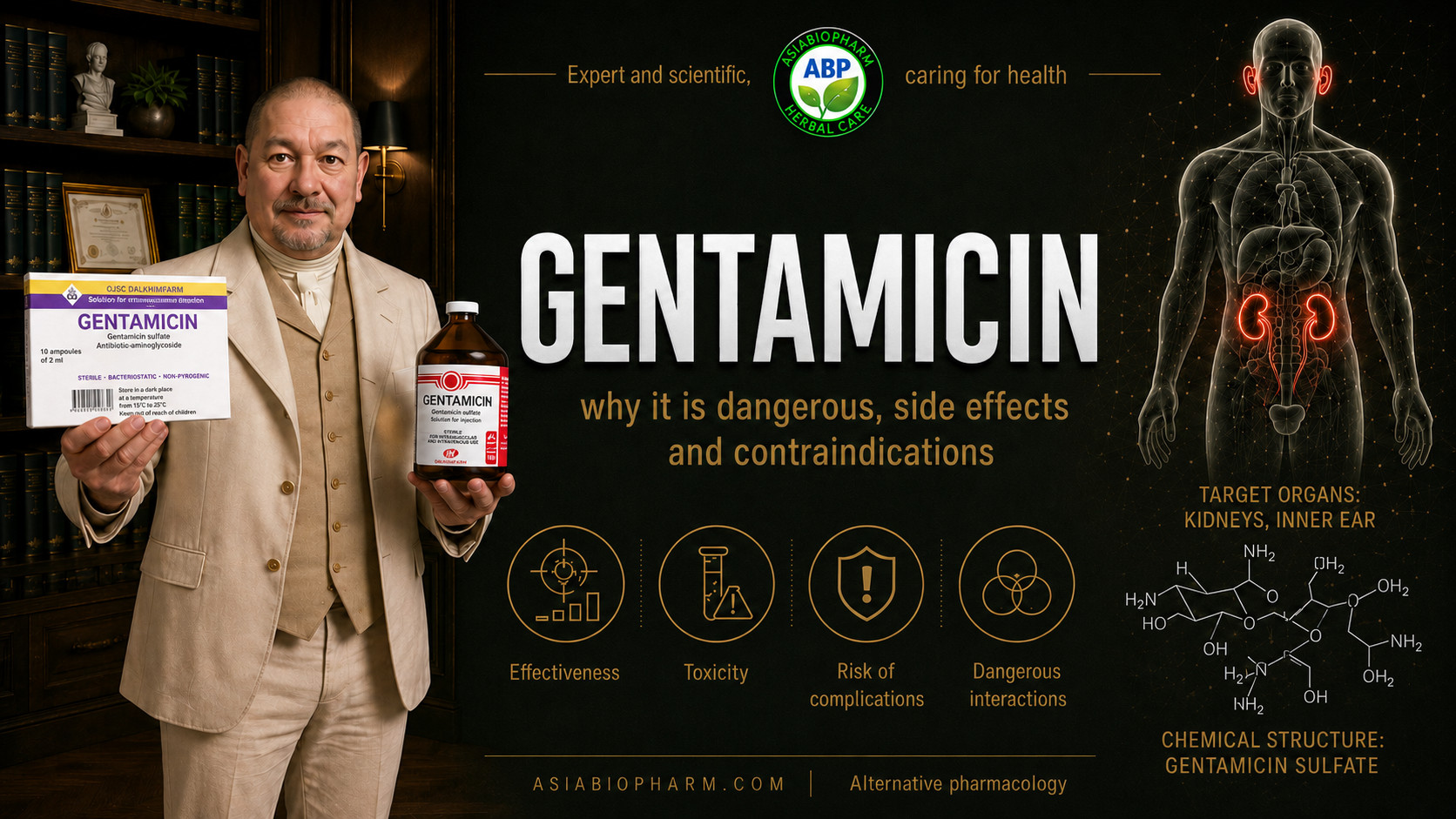
EFFECTIVE | TOXIC
Names Under Which Gentamicin Is Available
The international nonproprietary name is gentamicin, with the Latin spelling Gentamicin and, less commonly, Gentamycin. In medicinal products, the active ingredient is usually present as gentamicin sulfate — Gentamicin sulfate. Dosage forms include solutions for intramuscular and intravenous administration, eye drops, ophthalmic ointment, topical ointment, cream, aerosol and certain topical combination products. Brand names vary by country and manufacturer: Gentamicin, Gentamicin Sulfate, Garamycin, Genticin, Genoptic and other registered equivalents. Gentamicin may also be present in combination topical products together with betamethasone, clotrimazole or other components, for example in products such as Triderm, Akriderm GK, Belogent and Celestoderm-V with Garamycin. The simultaneous use of injectable gentamicin and topical products containing the same antibiotic is particularly important to consider when treating extensive damaged skin surfaces, burns or during prolonged therapy.
Why Gentamicin Is Considered Harmless and Where the Real Risk Begins
Gentamicin can damage the renal tubules and structures of the inner ear. Hearing loss, tinnitus, dizziness or impaired balance may not appear immediately, but toward the end of treatment or even after the course has been completed. Hearing loss and vestibular disorders are often irreversible. A false sense of safety is created by the drug’s low cost, its many years of use, the routine prescribing of “injections for infection” and the availability of ointments or eye drops under the same name. However, systemic gentamicin carries an official warning regarding nephrotoxicity, auditory toxicity and vestibular toxicity and requires clinical and laboratory monitoring. The risk rises sharply with repeated courses, dehydration, impaired kidney function, excessive dosing and the simultaneous use of other nephrotoxic or ototoxic agents.
Side Effects During the First Hours and Days of Treatment
In the short term, pain and irritation at the injection site, nausea, vomiting, loss of appetite, headache, weakness, skin rash, itching and a febrile reaction may occur. Clinically more significant findings include an early rise in creatinine and urea, the appearance of protein, cells or casts in the urine, reduced urine specific gravity and decreased urine output. Early inner-ear damage may present as high-frequency hearing loss that the patient does not yet notice during ordinary conversation, as well as tinnitus, ringing or a humming sensation in the ears, unsteadiness, oscillopsia, dizziness and impaired coordination. Paresthesia, numbness, muscle twitching and encephalopathic reactions may occur. Rare but life-threatening complications include a severe allergic reaction, neuromuscular blockade, marked muscle weakness, respiratory depression and respiratory paralysis.
Consequences of Prolonged and Repeated Use
Gentamicin accumulates mainly in the renal cortex and the tissues of the inner ear. With prolonged or repeated exposure, cells of the proximal renal tubules are damaged, which may lead to acute kidney injury, increased creatinine levels, electrolyte disturbances and reduced glomerular filtration. Nephrotoxicity is often partially or completely reversible after discontinuation, but recovery may be incomplete in cases of severe injury, pre-existing chronic kidney disease or continuing toxic exposure. Cochlear and vestibular toxicity may continue to progress even after treatment has been stopped and often remains irreversible. A patient may retain formally normal conversational hearing while losing the ability to perceive high frequencies or developing persistent bilateral vestibulopathy with difficulty walking in the dark, visual instability during movement and a chronic balance disorder. Gentamicin does not cause drug dependence or a classic withdrawal syndrome, but repeated courses increase the cumulative toxicological burden and the likelihood of bacterial resistance.
Contraindications and High-Risk Groups
Gentamicin is contraindicated in patients with hypersensitivity to gentamicin or other aminoglycosides. The drug is particularly dangerous in patients with pre-existing impairment of kidney function because its elimination slows, serum concentrations rise and both nephrotoxicity and damage to the eighth cranial nerve increase. In older patients, the risk is higher because age-related reduction in glomerular filtration may be underestimated when creatinine levels appear only moderately elevated. Dehydration, hypovolemia and severe systemic illness further reduce renal clearance. In patients with myasthenia gravis, parkinsonism and other conditions involving impaired neuromuscular transmission, gentamicin may worsen weakness and provoke respiratory failure. In patients with pre-existing hearing loss, tinnitus or vestibular disorders, even minor additional damage may have serious functional consequences. During pregnancy, systemic gentamicin is used only for serious indications because aminoglycosides cross the placenta and may harm the fetus. In newborns, premature infants and patients with obesity, the dose must be calculated with particular precision because of differences in volume of distribution and renal clearance.
Dangerous Drug Interactions
Combining gentamicin with other aminoglycosides — amikacin, tobramycin, kanamycin, neomycin, streptomycin and paromomycin — is contraindicated or strongly discouraged because their nephrotoxic and ototoxic effects are additive. A similar risk arises when gentamicin is combined with vancomycin, polymyxin B, colistin, amphotericin B, cisplatin, cyclosporine and tacrolimus. Loop diuretics, especially furosemide and ethacrynic acid, may intensify damage to the auditory and vestibular systems; intravenous administration of such diuretics may also alter aminoglycoside concentrations in the blood and tissues. Neuromuscular blocking agents, anesthetics and certain muscle relaxants increase the risk of marked muscle weakness and respiratory depression. Nonsteroidal anti-inflammatory drugs, iodinated contrast agents and other substances that impair renal perfusion require assessment of kidney function and reconsideration of the treatment regimen. Beta-lactam antibiotics may be used together with gentamicin to achieve a synergistic antibacterial effect, but the drugs must not be mixed in the same syringe or infusion solution unless compatibility has been confirmed. Alcohol does not cause a specific chemical reaction with gentamicin, but it promotes dehydration, impairs coordination and may mask early signs of vestibular toxicity, so its use during a systemic course is unjustified.
Patient Errors When Using Gentamicin
The most dangerous mistake is the self-administration of leftover ampoules for fever, sore throat, cough or a suspected infection without culture testing, susceptibility assessment and evaluation of kidney function. Gentamicin is ineffective against viruses, anaerobic bacteria and many resistant microorganisms, so increasing the dose when there is no rapid effect raises toxicity but does not turn an unsuitable antibiotic into a suitable one. It is dangerous to shorten the intervals between injections, continue treatment longer than prescribed, repeat the course after a short period, or calculate the dose independently according to the number of ampoules rather than body weight and kidney function. Patients often ignore tinnitus, mild dizziness, impaired balance, decreased urine output and increasing weakness, attributing them to the infection itself. Another mistake is the simultaneous use of gentamicin injections and topical or ophthalmic combination products containing gentamicin without informing the physician. The absence of complications after a previous course does not prove that the next course will be safe: accumulation of the drug and changes in kidney function may make a previously tolerated dose toxic.
Gentamicin Overdose and Poisoning
No single acute “toxic dose” of gentamicin has been established that would apply equally to all patients. The danger depends not only on the number of milligrams, but also on renal clearance, age, dehydration, course duration, dosing intervals and the simultaneous use of other toxic drugs. With traditional monitoring, prolonged peak concentrations above 12 mcg/mL and trough concentrations above 2 mcg/mL should be avoided because an elevated minimum level reflects inadequate elimination and is associated with drug accumulation. During the first hours, an overdose may have no specific manifestations. Over the following days, rising creatinine and urea levels, proteinuria, cylindruria, reduced urine output, weakness, nausea, tinnitus, dizziness and impaired coordination may appear. Severe intoxication may cause pronounced neuromuscular blockade, respiratory depression, seizures and acute renal failure. There is no specific antidote. The drug is discontinued, and serum concentration, respiration, electrolytes and kidney function are monitored; in severe poisoning or renal failure, gentamicin may be removed by hemodialysis, whereas peritoneal dialysis is significantly less effective. One must not wait for severe deafness or anuria to develop because by that point some of the damage to the auditory system may already be irreversible.
Recovery After Gentamicin and Integrative Support for Mild Uncomplicated Inflammation
After a course of gentamicin, the main objective of integrative therapy is not to declare any herbal preparation an equivalent substitute for an aminoglycoside, but to reduce residual nephrotoxic, oxidative and inflammatory burden and to support the urinary system, intestinal barrier and tissue recovery. A basic combination may include a metal and xenobiotic detoxification complex together with Curcuma longa, Orthosiphon stamineus and colostrum. Curcumin is of greatest interest as a nephroprotective component: in experimental models of gentamicin-induced kidney injury, it reduced oxidative stress, mitochondrial dysfunction and apoptosis of renal tubular cells. However, curcumin is not a clinically proven antidote to gentamicin, and a substantial proportion of the direct evidence comes from animal and cell models.
Orthosiphon stamineus may be used to provide gentle support for urine production and renal excretion when diuresis is preserved and kidney function is stable. The plant has diuretic, antioxidant and anti-inflammatory activity, but the evidence base for preventing gentamicin nephrotoxicity specifically in humans is limited. In acute kidney injury, reduced urine output, dehydration, hypotension or marked electrolyte disturbances, diuresis must not be stimulated independently: creatinine, estimated GFR, urea, potassium, sodium and a urinalysis must first be assessed.
Colostrum should be considered as a means of restoring the intestinal barrier and mucous membranes after antibiotic therapy rather than as an antibacterial substitute. Systematic reviews indicate a possible reduction in increased intestinal permeability, but the results depend on the composition of the product, dose, duration of use and the patient’s baseline condition. Colostrum is contraindicated in people with an allergy to cow’s milk proteins.
Additional options may include Silybum marianum for antioxidant and hepatoprotective support during combined drug exposure, Rehmannia glutinosa as an anti-inflammatory and potentially nephroprotective component, Centella asiatica to support microcirculation and tissue repair, bracket fungus as a source of metabolically active and antioxidant compounds, and Hericium erinaceus to support the intestinal barrier and nervous system. None of these agents should be presented as a way to guarantee restoration of already lost hearing function or to eliminate established bilateral vestibulopathy.
For mild or moderate uncomplicated inflammation, after excluding a bacterial infection that requires a systemic antibiotic, a combination of plukao, plukao extract, Lonicera japonica and Forsythia suspensa may be considered. When stronger antimicrobial support is needed, Coptis chinensis, Berberis vulgaris, Cryptolepis buchananii, Echinacea purpurea, Astragalus propinquus and Pulmonaria officinalis may be evaluated. Such a regimen is applicable only when the patient is clinically stable and there is no sepsis, bacteremia, severe pneumonia, complicated urinary tract infection, pyelonephritis with obstruction, endocarditis or another infection in which delaying effective antibiotic therapy could worsen the prognosis.
How Effective Gentamicin Really Is
Gentamicin is an effective bactericidal antibiotic against susceptible aerobic Gram-negative microorganisms and certain Gram-positive bacteria when used as part of combination regimens. It is used for severe systemic infections, sepsis, complicated urinary tract infections, infections of the abdominal cavity, bones, skin and soft tissues, as well as for synergistic activity in selected forms of endocarditis. The drug disrupts bacterial protein synthesis by binding to the 30S ribosomal subunit and acts rapidly, but only when the pathogen is susceptible and a sufficient concentration is achieved at the site of infection.
Gentamicin is ineffective against viruses, most anaerobes and microorganisms with acquired resistance. It penetrates certain tissues poorly and should not be regarded as a universal antibiotic “for any inflammation.” When it is prescribed without culture testing, assessment of the infection site and evaluation of kidney function, the physician is not providing treatment but conducting a toxicologically costly experiment on the patient’s hearing and renal tubules. Errors include an unjustifiably prolonged course, failure to adjust the dose when GFR is reduced, use of the drug for a mild infection that could be treated with a less toxic antibiotic, simultaneous prescription of other nephrotoxic or ototoxic agents, and failure to monitor concentrations during repeated administration. Official recommendations require gentamicin concentration measurements and more frequent monitoring in patients with impaired kidney function.
Safety Monitoring During Treatment
Before systemic use begins, creatinine, estimated GFR, urea, electrolytes, body weight and baseline urine output must be determined. Monitoring should be more frequent in patients with impaired kidney function, older adults, dehydrated patients, those receiving a prolonged course and those taking nephrotoxic drugs at the same time. With repeated dosing, gentamicin concentrations are usually measured after an initial steady state has been reached, after any dose adjustment and then regularly thereafter; the exact timing of blood sampling depends on the dosing regimen. With traditional monitoring, prolonged peak concentrations above 12 mcg/mL and trough concentrations above 2 mcg/mL should be avoided.
Creatinine and urine output should not be monitored only after symptoms appear because early tubular injury may remain clinically silent. Rising creatinine, reduced GFR, decreased urine output, proteinuria, cylindruria, hypomagnesemia, hypokalemia or other electrolyte disturbances require immediate reconsideration of the dose, dosing interval and entire treatment regimen.
Hearing and vestibular function should be assessed before treatment and reassessed during a prolonged course, with a high cumulative dose, impaired kidney function, previous aminoglycoside use or the appearance of symptoms. Warning signs include tinnitus, ringing or pressure in the ears, reduced perception of high frequencies, dizziness, impaired balance, unsteadiness, oscillopsia and inability to walk confidently in the dark. Ototoxicity may continue to progress after discontinuation, so the absence of complaints during the first days does not rule out injury.
A sudden marked reduction or cessation of urine output, increasing muscle weakness, difficulty breathing, inability to hold the head upright or stand, severe dizziness, sudden hearing loss, swelling of the face or larynx, generalized rash, impaired consciousness and seizures require emergency assessment. Waiting when such symptoms occur is dangerous because respiratory failure, severe acute kidney injury or irreversible damage to the inner ear may develop.
How Gentamicin Treatment Is Discontinued
Gentamicin does not cause drug dependence and does not require gradual dose reduction. The drug may be stopped immediately when the prescribed course is completed or toxicity develops. The exception is not a need to “taper off” gentamicin, but the need to ensure adequate continuation of antibacterial treatment with another agent if the infection has not yet been eradicated.
Stopping the course independently after the first signs of improvement is also incorrect: this may lead to persistence of the infection focus, relapse and selection of resistant bacteria. Missing a dose or arbitrarily increasing the dosing interval may reduce effectiveness, whereas subsequently doubling the dose increases the toxic burden. If tinnitus, impaired balance, hearing loss, rising creatinine or reduced urine output occurs, the priority is immediate discontinuation of gentamicin and revision of the treatment regimen rather than formal completion of the course at any cost.
After treatment is stopped, kidney function is monitored until the values stabilize. Auditory and vestibular symptoms require audiometry and specialist assessment because the damage may become noticeable or continue to progress after the final dose.
A Rational Approach to Gentamicin Use
Gentamicin is justified in severe infection caused by a susceptible microorganism when rapid bactericidal activity, a high blood concentration or synergy with another antibiotic is required. In such situations, its toxicity is not a reason to withhold treatment, but it is a reason to calculate the dose precisely, limit the duration of the course and monitor kidney function and drug concentrations.
In mild localized or uncomplicated inflammation, systemic gentamicin often creates a disproportionate toxicological burden. After a dangerous bacterial infection has been excluded, herbal anti-inflammatory and antimicrobial complexes may be considered. After a course has already been completed, the priorities are restoration of renal excretion, antioxidant protection and support of the intestinal barrier, mucous membranes and microcirculation. Integrative therapy must not mask developing nephrotoxicity or ototoxicity: hearing loss, impaired balance, rising creatinine or reduced urine output require diagnostic evaluation and medical supervision.
If you have questions about the subject of this article, you may ask a clinical pharmacologist in the comments or book an appointment through this link: https://asiabiopharm.com/konsultaciii/
0 comments