
Econazole — Side Effects, Contraindications and Risks of Use
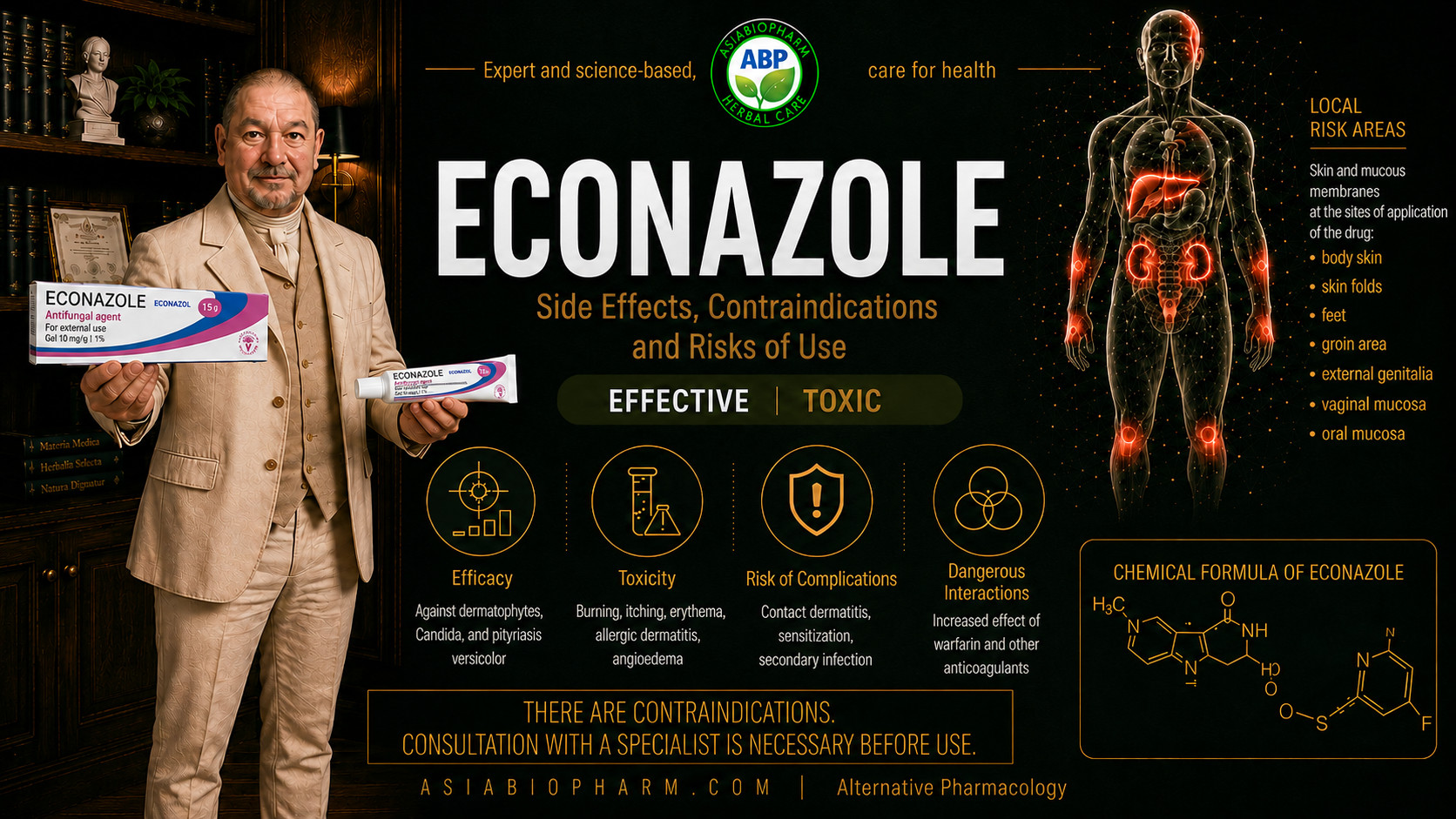
EFFECTIVE | TOXIC
Names Under Which Econazole Is Available
The international nonproprietary name is econazole; the Latin forms are Econazole and Econazolum. The main pharmaceutical salt is econazole nitrate, Econazole nitrate. Preparations for external use usually contain a 1% concentration, corresponding to 10 mg of econazole nitrate per 1 g of cream. Dosage forms include cream, gel, aerosol foam, vaginal cream, and vaginal suppositories or pessaries containing 50 or 150 mg. In Russia and other countries, the drug is marketed under such trade names as Gyno-Pevaryl, Gynoconazole, Ifenek, Pevaryl, Ecodax, Spectazole, Pevaryl, Gyno-Pevaryl, Ecostatin, and Ecoza. The composition of registered products varies by country, so it is important to check not only the brand name but also the “active ingredient” line. Combination topical preparations may contain both econazole and triamcinolone acetonide; these include Pevisone, Econazine, Ecocort, and certain regional equivalents. Such products should not be regarded as ordinary econazole preparations: the presence of a glucocorticosteroid substantially changes the contraindications and the risks associated with long-term use.
Why Econazole Is Considered Harmless and Where the Real Risk Begins
The main danger of using econazole at home is not severe systemic toxicity, but the fact that burning, itching, redness, and worsening inflammation are often mistaken for a natural reaction to the fungus dying off, leading people to continue applying the drug to already damaged skin or mucous membranes. In reality, these symptoms may indicate chemical irritation, contact dermatitis, or sensitization. A false sense of safety is created by its topical form, low systemic absorption, and the availability of some preparations without a prescription. However, application to large areas, the genital region, eroded skin, or under an airtight dressing increases absorption and can make interactions with systemic medications clinically significant. Combination creams containing triamcinolone pose a particular problem: the hormone rapidly reduces redness and itching but may mask an ongoing fungal infection and create the impression that treatment is effective.
Side Effects During the First Hours and Days of Use
The most common reactions to econazole occur directly at the application site: burning, tingling, itching, soreness, and erythema. In clinical studies of topical 1% cream, adverse reactions considered related to the drug were reported in approximately 3% of patients. Clinically significant complications include contact dermatitis, severe rash, urticaria, blistering, and skin peeling. Vaginal use may cause burning, irritation, pain, and swelling of the mucous membrane. Life-threatening reactions are rare, but angioedema and severe hypersensitivity have been reported in post-marketing data. Swelling of the face, lips, tongue, or larynx, difficulty breathing, and rapidly spreading urticaria require immediate discontinuation of the drug and emergency medical care. Contact of the cream with the eyes causes chemical irritation; the eyes should be rinsed immediately with water or saline solution.
Risks of Long-Term and Repeated Use
Typical cumulative hepatotoxicity, nephrotoxicity, hormonal toxicity, drug dependence, or withdrawal syndrome has not been demonstrated with standard topical use of pure econazole. Systemic absorption through intact skin is usually less than 1% of the applied dose. This does not, however, mean that self-treatment for several weeks is harmless. Repeated application to inflamed or damaged skin increases the likelihood of sensitization, chronic contact dermatitis, persistent peeling, and impairment of the skin barrier. Continuing treatment when there is no effect may mask a bacterial infection, psoriasis, eczema, erythrasma, or other disorders mistakenly diagnosed as mycosis. If a combination product containing triamcinolone is used, the long-term risks are determined primarily by the corticosteroid: skin atrophy, striae, telangiectasia, steroid acne, perioral dermatitis, worsening of the fungal infection, and an atypical course of mycosis may occur. The absence of early burning does not confirm that the diagnosis is correct and does not justify uncontrolled prolongation of treatment.
Contraindications and High-Risk Groups
An established hypersensitivity to econazole, to other components of the specific dosage form, or a previous severe reaction to the drug is an absolute contraindication. Topical cream must not be applied to the eyes, taken orally, or used intravaginally unless the specific formulation is intended for that purpose. Vaginal preparations are contraindicated in patients allergic to imidazole antifungal agents and should not be used simultaneously with other internal or external genital products without first assessing compatibility. During pregnancy, especially in the first trimester, econazole should be used only when there is a justified need: controlled studies in pregnant women are insufficient, while embryo- and fetotoxicity has been observed in experiments using high systemic doses. During breastfeeding, the drug must not be applied to the nipples or to areas of skin that may come into contact with the infant. The risk of systemic absorption is increased when econazole is applied to extensive areas, damaged skin, mucous membranes, or under occlusive dressings. Even topical use requires special monitoring in patients receiving warfarin or acenocoumarol.
Dangerous Drug Interactions
The best-established clinically significant interaction is between econazole and warfarin or other coumarin anticoagulants, including acenocoumarol. Econazole may inhibit the enzymatic metabolism of coumarins, enhance the anticoagulant effect, and increase INR, thereby raising the risk of bleeding. This interaction has been reported particularly often when the drug is applied to the genital area, a large surface area of skin, or under an occlusive dressing. This combination is not always absolutely contraindicated, but it requires monitoring of INR and prothrombin time after econazole is started and discontinued and, in some cases, adjustment of the anticoagulant dose.
Vaginal econazole preparations may damage latex condoms and diaphragms or reduce the reliability of local contraceptives, so concomitant use is highly undesirable. Simultaneous use of other vaginal creams, antiseptics, and antifungal agents increases the risk of irritation and does not guarantee greater efficacy. No clinically significant interaction with alcohol, food, caffeine, or nicotine has been established when econazole is used correctly on the skin. However, alcohol should not be used to treat inflamed skin together with econazole because it increases burning and damages the skin barrier. Plant oils, concentrated essential oils, and irritating locally applied dietary supplement ingredients may also worsen dermatitis. Unintentional duplication can occur when econazole cream is used at the same time as a vaginal preparation containing the same active ingredient.
Patient Errors When Using Econazole
The most common mistake is treating any itchy, red, or scaly rash as a fungal infection without microscopy, culture, or at least clinical differential diagnosis. Econazole does not treat allergic dermatitis, psoriasis, viral eruptions, or most bacterial skin lesions. If there is no improvement after the prescribed course, the diagnosis should be reassessed rather than increasing the amount of cream or applying it more frequently. The official instructions explicitly recommend reassessing the diagnosis if there is no clinical improvement.
Other mistakes include applying a thick layer, using the product under plastic film or a tight dressing, treating large areas, allowing an unsuitable dosage form to come into contact with mucous membranes, continuing treatment despite increasing burning, combining several azole preparations, and using a steroid-containing combination cream without understanding its composition. Temporary disappearance of redness after using econazole with triamcinolone should not be considered evidence of cure: the steroid suppresses the inflammatory response faster than the causative organism is eliminated. Prematurely stopping treatment once itching decreases increases the risk that the infection will persist and recur, whereas unjustified prolongation of treatment increases the likelihood of irritation and of masking an incorrect diagnosis.
Econazole Overdose and Poisoning
A toxic single or cumulative dose of econazole in humans has not been established, and no confirmed cases of systemic overdose from topical cream are recorded in the official prescribing information. Experimental LD50 values obtained in animals cannot simply be extrapolated to humans or used to calculate a “safe” dose. Excessive topical application is most likely to cause increased burning, erythema, swelling, blistering, contact dermatitis, and other local reactions. Application over a large area, under a dressing, to the genital region, or to damaged skin increases systemic absorption and raises the risk of interaction with warfarin.
Accidental ingestion of a vaginal suppository or a significant quantity of cream may cause nausea, vomiting, and diarrhea. There is no specific antidote; treatment is symptomatic. Vomiting should not be induced without medical advice. Any remaining product should be removed from the mouth, the approximate amount swallowed should be assessed, and a poison control center should be contacted, especially if a child has swallowed the product. Contact with the eyes may cause severe pain, tearing, and inflammation and requires immediate rinsing. Hidden overdose is more often associated not with a single large dose but with using several econazole-containing products simultaneously, using cream together with vaginal suppositories, shortening the intervals between applications, or applying the product under occlusion. Waiting for severe symptoms to develop is dangerous in patients taking warfarin: the first sign of an interaction may already be an increased INR, bruising, nosebleeds, or blood in the urine.
A Safe Integrative Alternative to Econazole
For superficial fungal infections of the skin and skin folds, ABP-153 may be considered as a primary integrative alternative. It is a multicomponent oil-based herbal mixture containing camphor, Andrographis paniculata, Curcuma longa, Glycyrrhiza glabra, Zingiber cassumunar, Houttuynia cordata, menthol, borneol, clove, and eucalyptus. The formula combines the direct antifungal potential of clove and other plant components with anti-inflammatory, antipruritic, antiseptic, reparative, and barrier-protective effects. Unlike econazole, which primarily inhibits ergosterol synthesis in the fungal membrane, ABP-153 targets several components of the pathological process at once: microbial colonization, inflammation, itching, damage to the skin barrier, and biofilm formation. In mild localized dermatomycosis or cutaneous candidiasis, such substitution may be used on its own after the diagnosis has been confirmed; in widespread, recurrent, or complicated infection, it is more appropriate to use the product as part of a comprehensive regimen. The oil formulation should not be applied to actively weeping or macerated areas: an antifungal spray is more convenient for interdigital spaces, moist skin folds, and fungal infections of the feet. For denser chronic skin lesions, ABP-153-D may be considered, although dimethyl sulfoxide increases penetration of the components and at the same time places greater demands on tolerability and precision of application. Azadirachta indica may be included in topical herbal formulations as an additional antifungal and anti-inflammatory component. For oral candidiasis, specialized dosage forms are more appropriate — a mucosal gel and an oral powder. Onychomycosis requires a separate approach: an antifungal nail treatment is intended for the nail plate, but it contains synthetic azoles and therefore is not a completely herbal substitute for econazole.
Actual Effectiveness of Econazole and Medical Errors
Econazole is genuinely effective against dermatophytoses caused by susceptible species of Trichophyton, Microsporum, and Epidermophyton, as well as cutaneous candidiasis and pityriasis versicolor. The drug inhibits ergosterol formation, disrupts the structure of the fungal cell membrane, and gradually reduces itching, redness, scaling, and spread of the lesion. Clinical improvement may occur before mycological cure, so disappearance of itching after a few days does not mean that the causative organism has been completely eliminated. Econazole does not treat psoriasis, atopic or contact dermatitis, bacterial inflammation, herpes, or other diseases that may resemble mycosis. Nor does it eliminate factors that contribute to recurrence: hyperhidrosis, tight footwear, maceration of skin folds, decompensated diabetes mellitus, immunodeficiency, and reinfection through footwear or personal care items. The most common medical error is prescribing the cream based solely on the appearance of the rash without microscopic confirmation in atypical, chronic, or recurrent disease. The practice of automatically adding a topical glucocorticosteroid is equally questionable: the redness disappears impressively, while the fungal infection is given an opportunity to persist in a less obvious form. Involvement of the nails, scalp, extensive dermatophytosis, or immunodeficiency usually cannot be adequately treated with topical econazole alone.
Safety Monitoring During Treatment
With limited topical use, laboratory monitoring is not required for most patients. The severity of burning, itching, pain, redness, swelling, blistering, oozing, and spread of the rash beyond the original lesion should be assessed daily. Brief mild tingling may occur, but increasing inflammation, marked soreness, a vesicular rash, or worsening after each application indicates irritation or contact allergy and requires discontinuation of the drug. If dermatomycosis does not improve within two to four weeks or the lesion continues to enlarge, the diagnosis should be confirmed by microscopy, culture, or another appropriate method. Patients taking warfarin or acenocoumarol require INR monitoring after starting and after stopping econazole, especially when it is used on the genital area, damaged skin, a large surface area, or under a dressing. Multiple bruises, nosebleeds, or blood in the urine or stool may indicate an enhanced anticoagulant effect. Generalized urticaria, swelling of the lips, tongue, face, or larynx, difficulty breathing, and a rapidly spreading severe skin reaction require immediate medical attention. Delaying care in the presence of such symptoms is dangerous because angioedema may progress and compromise the airway.
Proper Discontinuation of Econazole
Econazole does not cause drug dependence or withdrawal syndrome, so gradual dose reduction is not required. If an allergic reaction, severe burning, blistering, swelling, or contact dermatitis develops, the drug should be discontinued immediately. However, stopping treatment without medical guidance after the first signs of improvement may allow viable organisms to persist and lead to rapid recurrence. The duration of the course depends on the location of the infection, clinical response, and the instructions for the specific dosage form. If the drug is stopped because it has not been effective, it should not immediately be replaced with another antifungal cream on a trial-and-error basis. An incorrect diagnosis, mixed infection, involvement of the nails or hair, resistance of the causative organism, and the need for systemic therapy should first be excluded. No special gradual recovery period is required after treatment is discontinued, but the return of itching and scaling does not represent “withdrawal syndrome”; it is more likely to indicate persistent infection, reinfection, or another skin disease.
A Rational Approach to Treatment
Econazole is justified for a laboratory-confirmed or clinically well-founded superficial fungal infection when predictable local activity of an azole drug is required. It is particularly useful in localized dermatophytosis and cutaneous candidiasis when the causative organism is susceptible, the patient completes the prescribed course, and conditions promoting reinfection are eliminated. For mild, stable skin lesions, ABP-153 may be considered as a multicomponent phytotherapeutic alternative with antifungal, anti-inflammatory, and reparative activity. For moist skin folds and the feet, an antifungal spray is preferable; for the oral mucosa, a specialized gel or powder is more appropriate; and involvement of the nail plate requires a separate prolonged regimen taking the depth of onychomycosis into account. The purpose of an integrative approach is not simply to reject econazole, but to select a formulation suited to the location and severity of the disease, reduce the local toxicological burden, and prevent pointless weeks-long treatment of a rash that has been incorrectly diagnosed. Widespread, inflamed, or recurrent mycosis, involvement of the nails or scalp, diabetes mellitus, and immunodeficiency require in-person diagnostic evaluation; in these situations, herbal remedies should not delay necessary systemic therapy.
If you have questions about the subject of this article, you can ask a clinical pharmacologist in the comments or book an appointment via this link: https://asiabiopharm.com/konsultaciii/
0 comments