
Ciclopirox — Side Effects and Why Nail Fungus Treatment Does Not Work
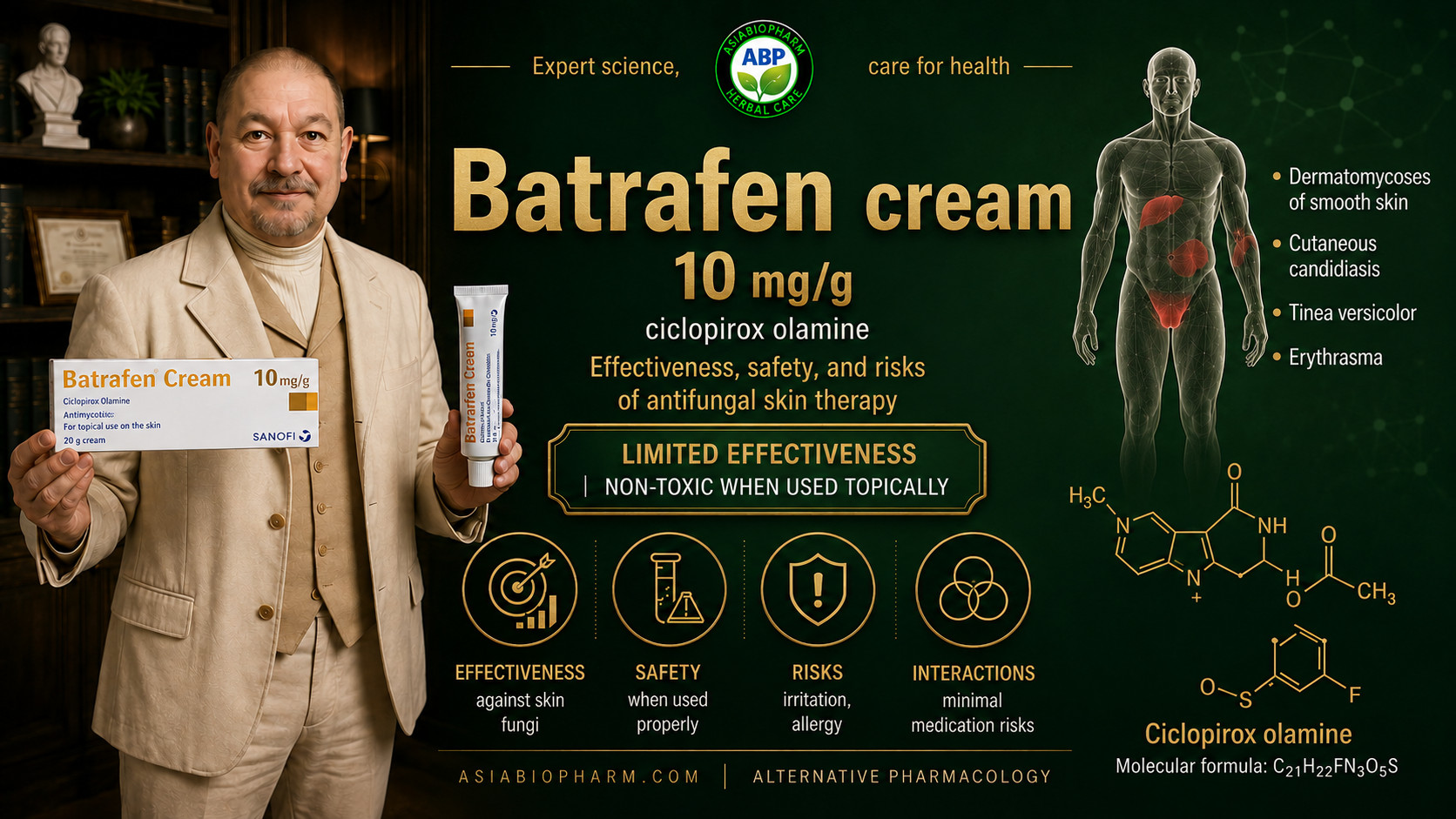
LIMITED EFFECTIVENESS | NON-TOXIC
Names and Dosage Forms of Ciclopirox
The international nonproprietary name is ciclopirox; the Latin spelling is ciclopirox. In topical products, the drug is available as free ciclopirox and as ciclopirox olamine. The main dosage forms are an 8% nail lacquer or solution, 0.77% cream and lotion, 1% ciclopirox olamine cream, 0.77% gel, and 1% shampoo. Common brand names in different countries include Penlac, Batrafen, Loprox, Ciclodan, Mycoster, Ony-Tec, Stieprox, and Sebiprox. Product lines may include different concentrations and dosage forms, so a cream, shampoo, and nail lacquer with similar names should not be considered interchangeable. Combination products containing ciclopirox together with corticosteroids, salicylic acid, or other ingredients are also available, although their regulatory status varies; some combinations listed in drug databases do not have confirmed FDA status for safety and effectiveness.
Why Ciclopirox Is Considered Harmless and Where the Real Risk Begins
Ciclopirox is often perceived as a simple cosmetic nail lacquer for fungal infections, although the outcome of treatment depends less on the amount of product applied than on an accurate diagnosis, the depth of the lesion, penetration of the drug through the nail plate, and regular removal of infected keratin. The lacquer produces virtually no systemic toxicological burden: when applied to all twenty nails for six months, less than 5% of the dose was absorbed, and blood concentrations remained low. The main risk of self-treatment is therefore not liver or kidney injury but loss of time: a person may spend months applying lacquer to a psoriatic, traumatically altered, or too deeply affected nail while assuming that any thickening is caused by fungus. The drug is intended primarily for mild to moderate onychomycosis without involvement of the matrix or lunula; with more extensive infection, topical monotherapy is often insufficient.
Side Effects During the First Days and Weeks of Use
The most common reactions to the nail lacquer are redness of the periungual skin and proximal nail fold, burning, itching, and local irritation. In controlled studies, treatment-related adverse events were reported in approximately 9% of patients, while skin reactions occurred in 8%; periungual erythema developed in about 5%. Changes in nail shape or color, irritation, ingrown nail plate, blisters, swelling, and oozing may occur. Reactions to the cream were uncommon and were usually limited to itching or burning. With the shampoo, itching, erythema, and burning of the scalp have been described; after approval, changes in hair texture or color, irritation, rash, and hair loss were also reported. Life-threatening reactions are not typical when topical ciclopirox is used correctly, but increasing swelling, generalized urticaria, difficulty breathing, or mucosal involvement require immediate discontinuation and emergency assessment for possible severe hypersensitivity.
What Happens With Long-Term and Repeated Use
A course of nail lacquer may continue for up to 48 weeks, and the first noticeable changes may sometimes appear only after six months. Long-term topical use has not been associated with confirmed cumulative hepatotoxicity, nephrotoxicity, hormonal disorders, dependence, or withdrawal syndrome. Even after treating all nails, systemic exposure remains extremely low, and one month after treatment was discontinued the drug was no longer detectable in blood or urine. The real long-term problems are chronic irritation of the periungual skin, nail damage caused by excessive filing, continuation of ineffective treatment when the diagnosis is incorrect, and progression of infection toward the matrix. The safety of daily nail lacquer use beyond 48 weeks has not been established, so indefinitely extending the course simply because some product remains in the bottle makes no pharmacological sense.
Contraindications and Higher-Risk Groups
An absolute contraindication to the lacquer and cream is confirmed hypersensitivity to ciclopirox or any excipient. The lacquer is not intended for use in the eyes, on mucous membranes, in the mouth, or in the vagina. Its effectiveness and safety have not been adequately studied during pregnancy and breastfeeding, in patients with immunodeficiency, HIV infection, after organ transplantation, in insulin-dependent diabetes mellitus, diabetic neuropathy, severe plantar fungal infection, or when continuous anticonvulsant therapy is required. In patients with diabetic neuropathy, the main danger is not ciclopirox itself but self-trimming, filing, and removal of the nail: impaired sensation increases the risk of an unnoticed injury, ulcer, and secondary bacterial infection. Clinical studies of the lacquer have not been conducted in children; the U.S. prescribing information allows its use from the age of 12 based on the adult safety profile, whereas age restrictions for other dosage forms differ.
Hazardous Combinations and Drug Interactions
No clinically significant systemic interactions of ciclopirox with alcohol, caffeine, nicotine, food, dietary supplements, or most medications have been established, which is explained by its low absorption after topical use. Alcohol consumption does not increase the blood concentration of ciclopirox, but the nail lacquer solution contains flammable solvents: until it is completely dry, it must be kept away from fire, cigarettes, heating appliances, and other ignition sources. Conventional cosmetic nail polish and other cosmetic coatings should not be applied to treated nails because they interfere with the treatment regimen and may reduce contact between the drug and the nail plate. Concomitant use of ciclopirox nail lacquer with systemic antifungal drugs was not adequately studied in registration trials; the older Penlac prescribing information therefore did not recommend such a combination, but this does not mean that toxic incompatibility has been proven. The combination should be determined by a healthcare professional based on the extent of onychomycosis. Applying several ciclopirox-containing products over a large surface area increases total skin exposure, although clinically significant systemic overdose remains unlikely.
Patient Mistakes That Make Treatment Ineffective
The main mistake is beginning a year-long course without microscopy, culture, or another form of confirmation of fungal infection. A substantial proportion of abnormal nails are not fungal in origin: the cause may be trauma, psoriasis, eczema, onychodystrophy, or vascular disorders. The second mistake is using the lacquer when the matrix, lunula, most of the nail plate, or multiple nails are affected, or when pronounced subungual hyperkeratosis is present, because penetration of a topical drug is insufficient under these conditions. Effectiveness is reduced by missed daily applications, washing off the coating too early, failure to remove the lacquer layers weekly, irregular trimming and filing of affected material, refusal of professional nail debridement, and stopping treatment after the first signs of improvement. The drug is applied daily over the previous layer, and the accumulated coating is completely removed once every seven days; professional removal of detached infected portions of the nail may be required monthly. Even with strict adherence to the regimen, complete clearance is achieved in far from all patients: in registration studies, fewer than 12% of patients had a completely or almost completely clear nail after 48 weeks.
Ciclopirox Overdose and Poisoning
A toxic single or cumulative dose of ciclopirox in humans has not been established for topical use, and clinical cases of severe systemic overdose from nail lacquer are not a characteristic problem. The average maximum blood concentration after daily application of approximately 340 mg of lacquer to affected nails was tens to hundreds of times lower than levels compared with toxic doses in animal studies. Applying an extra layer usually increases skin irritation but does not improve treatment effectiveness or accelerate the growth of a healthy nail. Actual poisoning is most likely after accidental ingestion of the solution, especially by a child: the risk is determined not only by ciclopirox but also by alcohols and other solvents in the formulation. There is no specific antidote. After ingestion, vomiting should not be induced and one should not wait for severe symptoms to appear; a poison control center or emergency service should be contacted immediately, while keeping the bottle and packaging available so the composition and amount can be identified. If the product gets into the eyes, they should be rinsed thoroughly with water for an extended period. The lacquer is flammable, so storing it near heat sources or using it close to an open flame before it has fully dried creates a more realistic acute hazard than systemic toxicity through the nail plate.
An Integrative Alternative to Ciclopirox for Nail Fungus
As a primary integrative alternative for mild and limited onychomycosis, a comprehensive topical regimen based on ABP-153, Nail Fungus Treatment for direct treatment of the nail plate, and an antifungal spray for the skin of the feet and interdigital spaces may be considered. This approach targets not only the abnormal nail but also the surrounding skin reservoir of infection, from which dermatophytes can recolonize the nail plate. ABP-153-D may be considered an additional option for pronounced nail thickening because of the penetration-enhancing properties of dimethyl sulfoxide, but it should not be applied to a contaminated, damaged, or inflamed surface. Azadirachta indica is of interest as an additional botanical ingredient with antimicrobial and anti-inflammatory potential, but there is insufficient clinical evidence for it to independently replace ciclopirox in confirmed onychomycosis. Gel and oral powder are intended for mucous membranes and are not included in the treatment of nail fungus. A comprehensive topical alternative may be appropriate for superficial or distal involvement of a limited area without matrix involvement. If several nails are affected, pronounced subungual hyperkeratosis is present, the infection extends toward the base of the nail, or the patient has diabetes, immunodeficiency, or no response to treatment, the therapeutic decision should be made by a healthcare professional after laboratory confirmation of the pathogen.
The Real Effectiveness of Ciclopirox and Medical Errors
Ciclopirox inhibits the growth of dermatophytes and other susceptible fungi, but the effectiveness of the lacquer is limited by poor penetration through dense nail keratin. The drug is most justified for mild to moderate distal onychomycosis when only a limited portion of the nail plate is affected and the lunula and matrix are not involved. The lacquer is applied daily for up to 48 weeks, and the first signs of healthy nail regrowth may not appear for several months. In registration studies, statistically significant complete cure was achieved in only one of the two main studies; even with daily application, regular nail care, and professional removal of affected areas, a completely clear nail developed in only a small proportion of patients. Ciclopirox does not restore the part of the nail that has already been destroyed: it must suppress the fungus while the new nail plate slowly grows out. Typical medical errors include prescribing the lacquer without microscopy or another form of confirmation of fungal infection, using it when the matrix is affected, ignoring pronounced hyperkeratosis, failing to debride the nail, and continuing ineffective monotherapy for months. Prescribing a lacquer for a year in psoriatic or traumatic onychodystrophy is technically easy; achieving an antifungal effect when no fungus is present is somewhat more difficult.
Monitoring Safety and Effectiveness During Treatment
Special laboratory monitoring of liver function, kidney function, or blood parameters is usually not required with standard topical ciclopirox use because systemic absorption is minimal. What should be monitored is the condition of the nail plate, the skin surrounding the nail, and the progression of healthy nail growth. Increasing redness, burning, itching, tenderness, swelling, blistering, oozing, or spread of inflammation require discontinuation of application and evaluation for possible contact dermatitis or hypersensitivity. If purulent discharge, throbbing pain, pronounced swelling of the toe or finger, fever, or red streaks extending along the foot appear, a bacterial complication should be ruled out. The absence of a visible zone of healthy regrowth after several months requires reconsideration of the diagnosis, assessment of adherence to the regimen, repeat mycological testing, and evaluation of the depth of the lesion. In patients with diabetes, neuropathy, or impaired circulation, deep self-filing or cutting of the nail is dangerous because of the risk of unnoticed injury, ulceration, and secondary infection. The FDA indicates that the lacquer should be applied daily for up to 48 weeks, accumulated coating layers should be removed regularly, and detached infected portions of the nail should be professionally debrided.
Proper Discontinuation of Treatment
Ciclopirox does not cause drug dependence, rebound syndrome, or systemic withdrawal syndrome, so gradual dose reduction is not required. If severe irritation or an allergic reaction occurs, the drug should be discontinued immediately. However, stopping treatment prematurely after yellow discoloration or crumbling has decreased does not mean that therapy is complete: viable fungus may remain deep in the nail bed, while visible improvement may reflect only partial regrowth of the nail plate. Missed applications and self-directed shortening of the treatment course increase the likelihood that the infection will persist or recur. If mycological testing remains positive after a full course or a healthy nail fails to grow out, it makes no sense to continue the same lacquer indefinitely without reconsidering the diagnosis. After treatment is discontinued, preventive treatment of footwear should be continued, the feet should be kept dry, coexisting interdigital fungal infection should be treated, and shared nail instruments should not be used.
A Rational Approach to Treating Nail Fungus
Ciclopirox is justified for laboratory-confirmed mild to moderate onychomycosis without matrix involvement when the patient is prepared to use the drug daily for many months and regularly care for the nail plate. Its advantage is minimal systemic absorption and the absence of the toxicological burden characteristic of oral antifungal drugs; its disadvantage is the low probability of complete cure in deep or extensive disease. In limited disease, a comprehensive topical regimen may be used: ABP-153 for anti-inflammatory and antimicrobial effects, a nail treatment product for direct treatment of the nail plate, and an antifungal spray to eliminate fungal reservoirs on the skin of the feet. Such an alternative should be regarded as a pharmacologically reasonable topical strategy, but not as a guaranteed equivalent replacement in severe onychomycosis. If the matrix, several nails, or a substantial area of the nail plate is affected, the pathogen should be confirmed and the need for combination or systemic therapy should be assessed. The goal of a rational approach is not to replace diagnosis with an attractive bottle, but to choose treatment that actually reaches the site of infection.
If you have questions about the topic of this article, you can ask a clinical pharmacologist in the comments or schedule an appointment using this link: https://asiabiopharm.com/konsultaciii/
0 comments