
Bifonazole — Why Antifungal Cream Can Be Dangerous and Why Treatment Fails
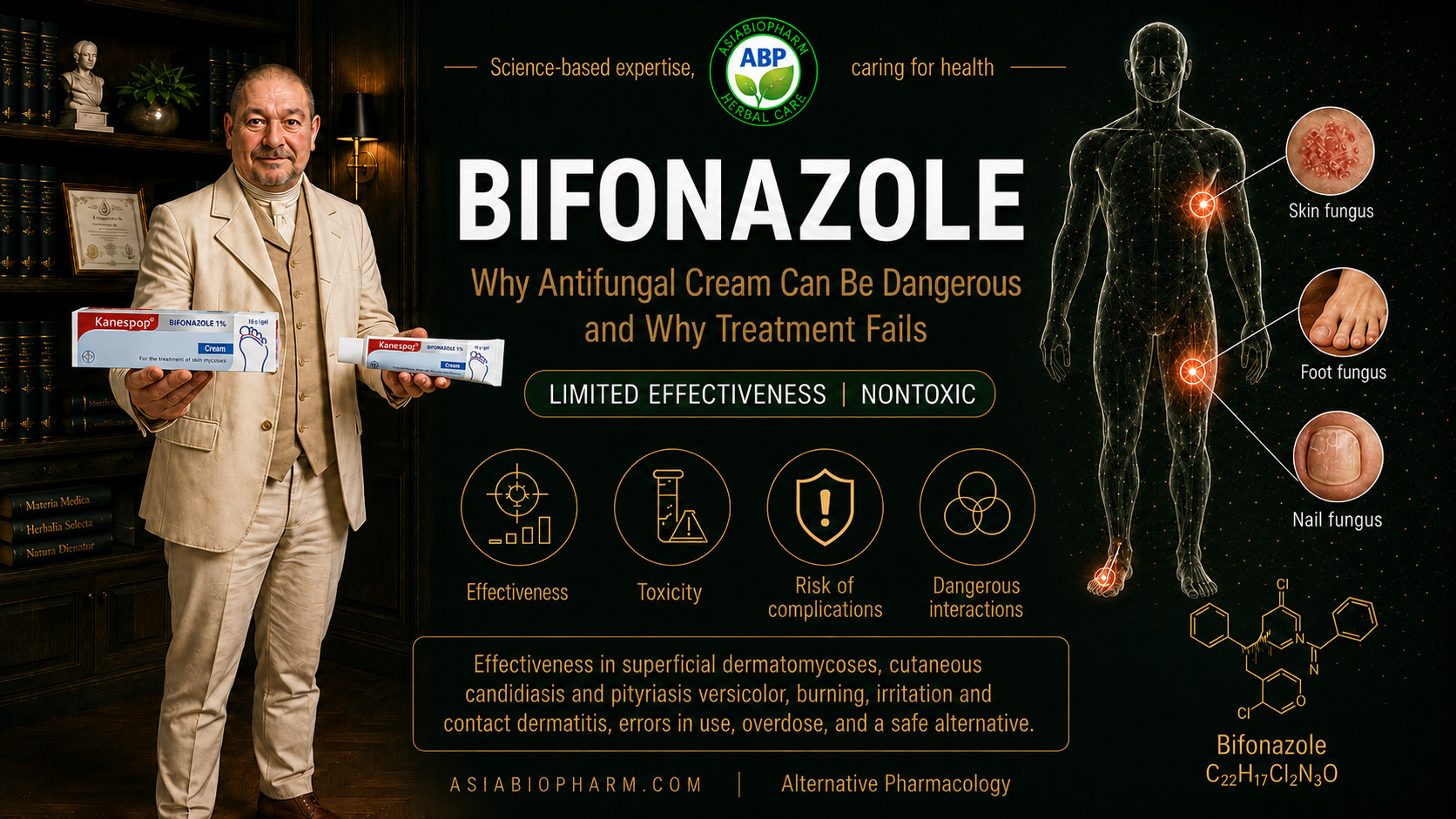
Limited Effectiveness | Nontoxic
Names Under Which Bifonazole Is Available
The international nonproprietary name is bifonazole, the Latin spelling is Bifonazole, and the pharmaceutical Latin variant is Bifonazolum. The active ingredient is usually supplied as the nonsalt form of bifonazole at a concentration of 1%, or 10 mg/g. Dosage forms include cream, solution, spray, powder, and preparations for treating the nail bed. The main brand names used in different countries include Canespor, Canesten Bifonazole Once Daily, Mycospor, and generic products marketed as Bifonazole. Combination kits for the treatment of onychomycosis may contain bifonazole together with a high concentration of urea: the urea softens the affected nail plate, while bifonazole is used for subsequent treatment of the exposed nail bed. Skin cream and nail treatment kits cannot be considered interchangeable dosage forms: ordinary cream is largely unable to provide complete treatment of a fungal infection located within an intact nail plate.
Why Bifonazole Is Considered Harmless and Where the Real Risk Begins
Bifonazole is perceived as a harmless cream primarily because it is applied topically, is available without a prescription in many countries, and rarely causes systemic reactions. The real danger of unsupervised everyday use lies not so much in poisoning as in incorrect diagnosis and prolonged suppression of the visible symptoms of a disease without eliminating its cause. Redness, scaling, and itching may be associated not only with dermatophytes but also with eczema, psoriasis, bacterial inflammation, contact dermatitis, or a mixed infection. In these situations, the cream may temporarily reduce inflammation or may itself cause irritation, while the patient continues to interpret the deterioration as the “fungus coming out.” A false sense of safety leads to repeated courses, application over large areas, use on damaged skin, and application under a dressing. Systemic absorption through intact skin is approximately 0.6–0.8%, but it increases to about 2–4% through inflamed skin, making the condition of the skin barrier critically important.
Side Effects During the First Days of Use
The most common reaction to the cream is a burning sensation of the skin; in the current European product information, it is classified as a very common adverse effect. Redness, itching, irritation, tenderness, local swelling, dryness, scaling, maceration, eczema, rash, blisters, and urticaria may also occur. Contact or allergic dermatitis is a clinically significant reaction: the application area becomes redder, swollen, itchy, and painful, and may sometimes develop oozing and small blisters. The cause may be bifonazole itself or the excipients — benzyl alcohol and cetostearyl alcohol can cause local irritation and contact allergy. Life-threatening reactions to topical bifonazole are exceptionally rare; however, rapidly spreading urticaria, swelling of the face, lips, or larynx, and difficulty breathing require immediate discontinuation and emergency medical care. Reported local reactions are usually reversible after the medicine is discontinued.
Risks of Long-Term and Repeated Use
Dependence, tolerance, withdrawal syndrome, and cumulative organ toxicity have not been confirmed with standard topical use of bifonazole. The main problem with prolonged use is chronic damage to the skin barrier and masking of an incorrectly diagnosed condition. Repeated application to irritated or macerated skin may sustain inflammation and worsen tenderness, scaling, and oozing. If a patient continues using the cream for weeks without laboratory confirmation of mycosis, contact dermatitis may be mistaken for a resistant fungal infection, after which the frequency of application and the treated area may be increased even further. The safety of continuous use for more than four weeks has not been established for some registered formulations. The absence of early irritation does not prove effectiveness: the medicine may be well tolerated yet fail to work in a nonfungal condition, against a resistant pathogen, in deep tissue involvement, in onychomycosis without removal of the infected portion of the nail, or when constant reinfection occurs through footwear and a damp environment.
Contraindications and High-Risk Groups
An absolute contraindication is hypersensitivity to bifonazole or to any component of the specific dosage form. Patients with allergic reactions to other imidazole antifungal agents — clotrimazole, miconazole, or econazole — have an increased risk of a cross-reactive local reaction. The cream must not be applied to the eyes or swallowed. Certain registered formulations are not intended for treating diaper dermatitis in infants, infections of the scalp, or fungal infection within an intact nail plate. In children, the medicine should be used under medical supervision. In patients with diabetes mellitus, a fungal infection of the foot requires prior assessment because of the risk of ulcers, bacterial infection, impaired sensation, and a more severe course. Absorption increases when the product is applied to open, eroded, or severely inflamed skin. Official instructions in different countries describe restrictions during pregnancy and breastfeeding differently; however, current evidence does not support unsupervised use during these periods, and an individual assessment of benefits and risks is required.
Dangerous Drug Interactions
Almost no systemic interactions have been established for topical bifonazole because of its low bioavailability. The most clinically significant confirmed combination is with warfarin. Limited data indicate that concomitant use may increase the international normalized ratio and enhance the anticoagulant effect, so INR monitoring is required, especially when bifonazole is applied to inflamed, damaged, or extensive areas of skin. This combination is not an absolute contraindication, but use without monitoring is undesirable. Clinically significant interactions with alcohol, food, caffeine, nicotine, and most herbal products have not been confirmed for the topical formulation. However, alcohol-containing solutions, acids, alkalis, essential oils, irritating antiseptics, and keratolytic agents may intensify burning and skin damage when applied sequentially to the same area. Using several bifonazole-containing creams at the same time does not increase antifungal effectiveness, but it does increase exposure to excipients and the risk of contact dermatitis.
Patient Errors That Cause Treatment to Fail
The main mistake is treating any itching and scaling as a fungal infection without microscopy or another form of diagnostic confirmation. Patients apply the cream to eczema, psoriasis, allergic dermatitis, bacterial inflammation, and lesions caused by scabies mites, and then explain the lack of effect as a “severe fungal infection.” The second mistake is attempting to treat nail fungus with an ordinary cream: bifonazole is intended for treating the skin and the nail bed after infected keratin has been removed, not for reliably penetrating an intact, thickened nail plate. Other causes of treatment failure include irregular application, stopping the course too early once itching decreases, applying the product to damp skin, failing to treat footwear and socks, reinfection, applying it under an airtight dressing, and mixing it with irritating agents. Increasing the amount of cream or applying it several times a day does not compensate for an incorrect diagnosis and does not turn a topical preparation into systemic treatment. If there is no improvement within seven days, the official instructions recommend reconsidering the diagnosis and consulting a physician or pharmacist.
Overdose and Accidental Poisoning
A toxic single or cumulative dose for topical bifonazole has not been established. Acute intoxication after a single application of an excessive amount of cream is considered unlikely because systemic absorption through healthy skin is minimal. The risk increases when it is applied over a large area, to eroded or inflamed skin, under an occlusive dressing, and in infants. In studies, absorption after application to inflamed skin was approximately four times higher than through an intact skin barrier. Accidental ingestion may cause dizziness, nausea, and vomiting, but no specific antidote exists. Vomiting must not be induced and gastric lavage must not be performed independently; the official product information permits lavage only if clinical symptoms develop and only when the airway is reliably protected. A hidden overdose usually does not represent systemic poisoning but rather excessive local exposure: burning, swelling, maceration, tenderness, and contact dermatitis become more severe.
A Safe Integrative Alternative to Bifonazole
For limited superficial skin mycoses, the oil-based herbal mixture ABP-153 may be considered as an integrative alternative. Its practical advantage lies in combining an antifungal direction with support for the damaged skin barrier and reduction of dryness, scaling, and the inflammatory response. However, there are insufficient direct comparative clinical studies of ABP-153 and bifonazole, so it cannot be claimed that the herbal formula is superior to a standard azole antifungal in every situation. A complete substitution is most justifiable in a mild, limited process without pronounced hyperkeratosis, suppuration, diabetic foot, or deep tissue involvement. In chronic infiltrated lesions, ABP-153-D may be considered, although enhanced penetration of its components also increases the need for prior assessment of skin sensitivity. In cases of oozing, maceration, and interdigital mycosis, an antifungal spray containing Zingiber cassumunar, Citrus hystrix, and Cuscuta reflexa is more convenient. In onychomycosis, an ordinary cream cannot be considered sufficient therapy: the nail plate requires a separate antifungal nail preparation containing ketoconazole, miconazole, herbal extracts, and a keratolytic component. This is a combination product, not a fully herbal preparation. Azadirachta indica may be included in topical complexes as an additional herbal component. For oral candidiasis and other mucosal lesions, specialized dosage forms are used — an oral gel or an oral powder — but they do not replace topical treatment of skin dermatomycosis.
The Real Effectiveness of Bifonazole and the Causes of Treatment Failure
Bifonazole genuinely inhibits dermatophytes, yeasts, and the causative organism of pityriasis versicolor. Clinical studies confirm the effectiveness of 1% cream, solution, and powder in superficial dermatomycoses, cutaneous candidiasis, and pityriasis versicolor when applied once daily. In tinea pedis, bifonazole is more effective than placebo and is generally comparable with other topical azoles, but treatment usually continues for several weeks; some modern antifungal agents provide a comparable result with a shorter course. The medicine treats a confirmed superficial fungal infection, but it does not eliminate eczema, psoriasis, allergic dermatitis, bacterial inflammation, or vascular and trophic causes of skin damage. It also cannot reliably eradicate infection in deep tissues or penetrate a thickened, intact nail plate. Therefore, the statement “bifonazole does not help” often reflects not the pharmacological uselessness of the medicine, but an incorrect diagnosis, an unsuitable dosage form, an excessively short course, or constant reinfection. A typical medical error is prescribing the cream based on the appearance of the lesion without microscopy, dermoscopy, or culture in a recurrent condition. Repeatedly extending treatment without confirmation of a fungal infection is equally questionable: if the diagnosis has not been established, an additional tube does not make the diagnosis more accurate.
Safety Monitoring During Treatment
For a small, limited mycosis involving intact skin, laboratory monitoring is usually unnecessary. Burning, redness, swelling, tenderness, oozing, blisters, spread of the rash, and the condition of the skin barrier should be assessed daily. Mild, brief burning after application may occur, but increasing burning, the development of eczematous inflammation, or expansion of the affected area requires discontinuation of the medicine and reassessment of the diagnosis. If there is no initial positive change after seven days, continuing self-treatment without diagnostic evaluation is unreasonable. Mycological confirmation and assessment of the need for systemic therapy are required for nail mycosis, scalp involvement, extensive lesions, diabetes mellitus, immunodeficiency, purulent discharge, ulcers, or a recurrent process. When warfarin is used concurrently, INR monitoring is advisable, especially if bifonazole is applied to inflamed, damaged, or extensive areas of skin. Generalized urticaria, rapidly increasing swelling of the face, lips, or larynx, difficulty breathing, and marked weakness require immediate medical care. Waiting in such situations is dangerous because the systemic reaction may progress.
Proper Discontinuation of Bifonazole
Bifonazole may be stopped immediately: gradual dose reduction is not required because the medicine does not cause physical dependence, withdrawal syndrome, or pharmacological rebound. However, stopping treatment prematurely after itching and redness disappear may leave viable pathogens in the stratum corneum and lead to recurrence. The duration of treatment is determined by the site of infection and the confirmed causative organism, not only by visible improvement. A missed application should not be compensated for by using twice the amount of cream. If irritation develops, the medicine should be stopped immediately rather than continued “until the skin gets used to it.” Independently switching from the cream to a preparation intended for nails or mucous membranes, or to a formulation with enhanced penetration, without assessing the location of the condition may also cause chemical irritation and further damage to the barrier. The return of symptoms after discontinuation does not indicate bifonazole withdrawal syndrome, but rather persistence of the infection, reinfection, or an initially incorrect diagnosis.
A Rational Approach to Treating Fungal Infection
Bifonazole is justified in laboratory-confirmed or clinically convincing superficial dermatomycosis when a predictable local azole effect is required and the patient is able to complete the full course of treatment. Its advantages are a broad spectrum of activity and once-daily application. In mild, limited lesions without complications, ABP-153 may be considered as an integrative topical alternative focused on antifungal activity and skin restoration. For moist interdigital lesions, an antifungal spray is more practical; for chronic dense lesions, ABP-153-D may be considered; and for onychomycosis, a specialized nail preparation is required. For mucosal candidiasis, separate dosage forms are selected — an oral gel or an oral powder. In extensive dermatomycosis, hair involvement, pronounced onychomycosis, immunodeficiency, diabetic foot, or secondary bacterial infection, topical herbal products must not delay full diagnostic evaluation and systemic treatment. The goal of an integrative approach is not the mechanical replacement of an effective medicine, but the selection of a formulation appropriate to the pathogen, location, and condition of the tissues, with minimal risk of irritation, polypharmacy, and repeated ineffective courses.
If you have questions about the subject of this article, you can ask a clinical pharmacologist in the comments or schedule an appointment using the following link: https://asiabiopharm.com/konsultaciii/
0 comments