
Aluminum Acetate — Burow’s Solution, Uses, Side Effects and Contraindications
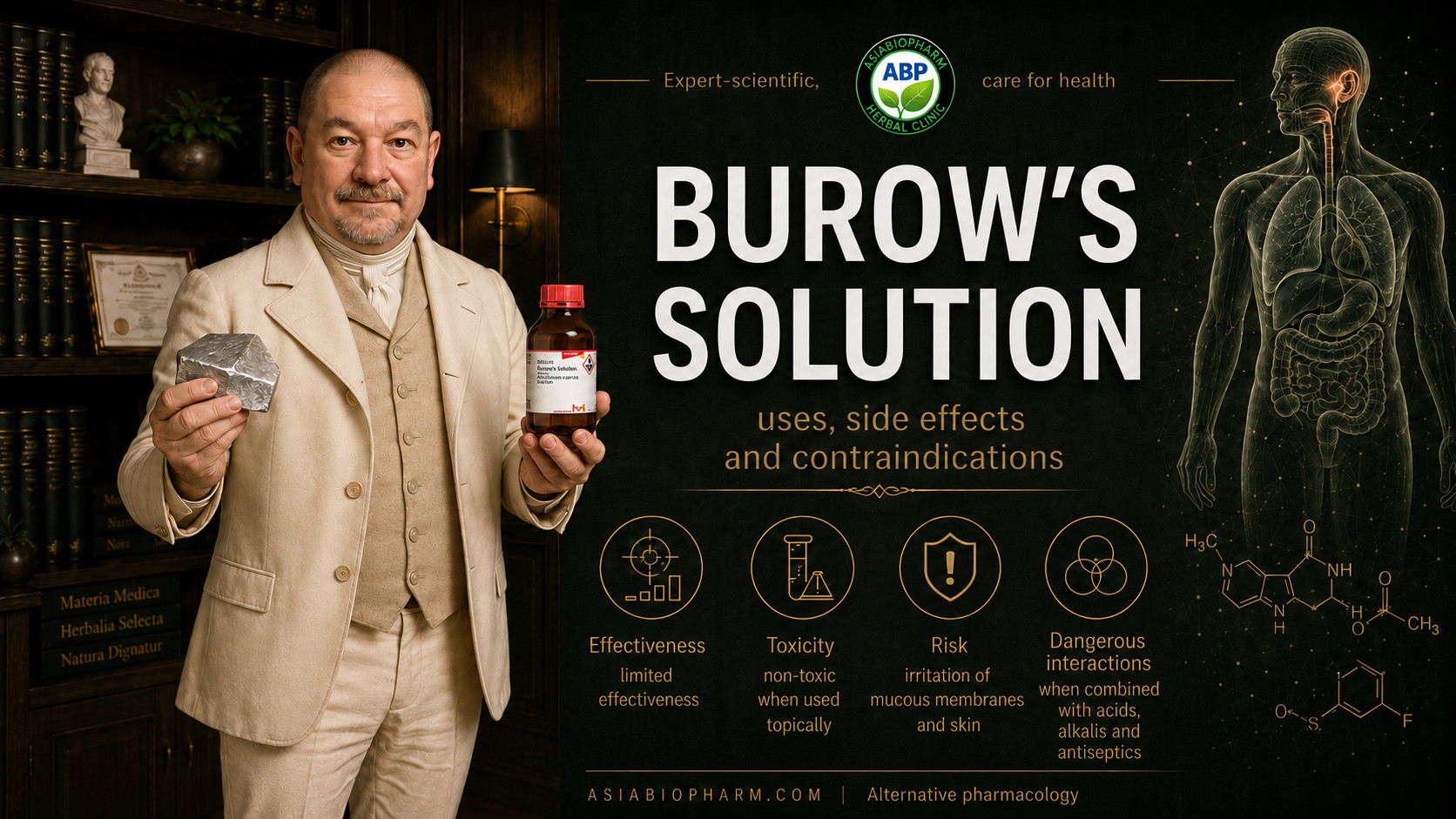
LIMITED EFFECTIVENESS | NON-TOXIC
Names Under Which Aluminum Acetate Is Found
The active ingredient is referred to as aluminum acetate, aluminium acetate, acetic acid aluminum salt, Aluminium acetate or Aluminum acetate. The solution is traditionally known as Burow’s solution, Burow’s fluid or Burow solution. Commercially available forms include ready-to-use solutions, gels and creams, as well as powders or packets containing aluminum sulfate and calcium acetate: once dissolved in water, they form aluminum acetate. The best-known brand name is Domeboro; products marketed as Astringent Solution, Aluminum Acetate Topical Solution, TriCalm Hydrogel and Dermeleve are also available. Aluminum acetate should not be confused with aluminum chloride, aluminum hydroxide, aluminum alum or zinc acetate: these are different substances with different indications and risk profiles.
Why Burow’s Solution Is Considered Harmless and Where the Real Risk Begins
Aluminum acetate is sold as a topical astringent and is often perceived as an almost neutral “medicated compress.” However, it does not eliminate an infection, an allergen or the cause of dermatitis: the solution temporarily reduces oozing, irritation and itching through its drying and astringent effects. The real risk begins when the powder is diluted incorrectly, compresses are left on for too long, the solution is applied to large damaged areas, gets into the eyes or is swallowed. It is particularly wrong to interpret increased burning as proof that the solution is “working”: this may be a sign of additional chemical irritation of the skin. Official instructions emphasize that the product is intended for external use only and that treatment should be discontinued if the condition worsens or symptoms persist for more than seven days.
Side Effects During the First Hours and Days of Use
The most characteristic reactions are skin tightness, dryness, burning, redness, peeling and increased irritation. They occur more often when an excessively concentrated solution is used, the affected area is soaked for too long or compresses are repeatedly applied without assessing the condition of the skin. Excessive drying of an oozing lesion may lead to clinically significant cracking, pain and disruption of the skin barrier. Contact with the eyes may cause severe burning, tearing and inflammation of the conjunctiva; the eyes must be rinsed immediately and thoroughly with water for an extended period. In rare cases, a hypersensitivity reaction may occur, with increasing redness, swelling, rash or worsening itching. No characteristic confirmed systemic toxicity has been described when the product is applied externally for a short period to a small area of skin.
Consequences of Prolonged and Repeated Use
Aluminum acetate is not intended for uncontrolled long-term treatment of chronic skin diseases. Repeated and prolonged compresses may persistently overdry the skin, increase peeling, perpetuate irritant dermatitis and delay restoration of the epidermal barrier. A wet dressing must not be covered with polyethylene: this prevents evaporation, alters the action of the compress and increases the likelihood of maceration and irritation. The most significant long-term problem is not cumulative systemic toxicity but masking of the underlying disease. A temporary reduction in oozing may delay the diagnosis of a fungal or bacterial infection, allergic contact dermatitis, eczema or another condition requiring specific treatment. Dependence syndrome and pharmacological withdrawal syndrome are not characteristic of aluminum acetate.
Contraindications and Higher-Risk Groups
The product is contraindicated in cases of known hypersensitivity to aluminum acetate or to other components of the specific dosage form. It must not be taken internally or applied to the eyes, oral cavity or other mucous membranes. Deep wounds, extensive burns, severely damaged skin and areas showing signs of a serious infection should not be treated without medical supervision. Particular caution is required in young children: they may lick the solution, remove the compress or experience more intense exposure because of their larger skin surface area relative to body weight. Use in the external auditory canal is permissible only after perforation of the tympanic membrane has been ruled out and only as directed by a specialist: a solution intended for skin compresses must not automatically be considered safe ear drops.
Dangerous Interactions
No clinically significant systemic drug interactions have been established with the usual topical use of aluminum acetate. However, alcohol-based solutions, acids, alkalis, hydrogen peroxide, concentrated antiseptics, keratolytics and other drying or irritating products should not be used simultaneously on the same area of skin: their combined effect increases burning, dryness and damage to the skin barrier. Sequential application of creams, ointments and Burow’s solution may also alter skin moisture and the effectiveness of each product. Alcohol, food, caffeine and nicotine do not cause any specific interaction with topical aluminum acetate. The main practical danger is not a pharmacokinetic interaction but the simultaneous treatment of inflamed skin with several products, each of which may cause irritant or allergic contact dermatitis.
Patient Errors
The most common error is preparing the solution “stronger” than recommended by the manufacturer. A higher concentration does not provide faster treatment but increases the likelihood of burning, excessive dryness and skin inflammation. Other errors include continuous soaking instead of a time-limited compress, sealing the compress with polyethylene, reusing the prepared solution contrary to the instructions, applying it to the eyes or mucous membranes, instilling it into the ear without examining the tympanic membrane and continuing self-treatment for more than seven days. A reduction in oozing must not be used as the sole criterion of recovery: an astringent solution may dry the surface without eliminating the fungal, bacterial or allergic cause of the disease.
Overdose and Poisoning
A standardized toxic single dose of aluminum acetate for humans has not been established, so it is unacceptable to specify an arbitrary number of millilitres as “safe.” Topical overdose is manifested by increased burning, pronounced dryness, redness, inflammation, pain and damage to the skin barrier. The product should be removed, the skin rinsed with water and further application discontinued. If it gets into the eyes, immediate and thorough rinsing with plenty of water is required; persistent pain, photophobia or visual impairment requires urgent ophthalmological assessment. If swallowed, irritation of the oral cavity and gastrointestinal tract, nausea, vomiting and abdominal pain may occur. Vomiting should not be induced independently: a poison control centre or emergency medical service should be contacted, especially if the solution was swallowed by a child, the quantity is unknown or severe symptoms have developed. There is no specific antidote; treatment is based on the clinical presentation.
Safe Integrative Alternative ABP-153 Oil-Based Phytomixture
For diseases of the external auditory canal, ABP-153 oil-based phytomixture may be considered as an integrative alternative to aluminum acetate. Its most justified areas of use are eczematous otitis externa, seborrhoeic dermatitis, itching, dryness and irritation of the ear canal, as well as diffuse otitis externa and otomycosis when the tympanic membrane is intact. The manufacturer provides for local use of the product by instillation into the external auditory canal or by insertion of a sterile turunda.
Aluminum acetate and ABP-153 address different parts of the therapeutic task. Burow’s solution has a rapid astringent, acidifying and drying effect, which makes it particularly appropriate in cases of pronounced oozing, maceration and swelling of the external auditory canal. ABP-153 has an oil base and is aimed primarily at reducing inflammation, itching and irritation, preserving the lipid barrier and restoring damaged skin. Therefore, in oozing otitis externa, the oil mixture is not a direct substitute for a drying solution, but in dry, eczematous or seborrhoeic inflammation it may be a more physiological option.
ABP-153 contains camphor, Andrographis paniculata, Curcuma longa, Glycyrrhiza glabra, Zingiber cassumunar, Houttuynia cordata, menthol, borneol, clove and eucalyptus, as well as four proprietary botanical components. The pharmacological rationale for the formula is associated with the anti-inflammatory, antipruritic, antiseptic, antifungal and reparative properties of its components. However, the claimed properties of the entire composition cannot automatically be equated with the results of randomized clinical trials specifically involving ABP-153: the clinical evidence base for the finished product requires further documentary confirmation.
Complete replacement of Burow’s solution with ABP-153 is most logical in dry eczematous otitis externa, skin irritation, idiopathic itching and seborrhoeic dermatitis of the ear canal. In otomycosis, the product may be used only after the diagnosis has been confirmed and primarily as part of combination therapy. In bacterial otitis externa accompanied by severe pain, purulent discharge, swelling and narrowing of the ear canal, assessment by an ENT specialist is required and, as a rule, a product with proven antibacterial activity should be prescribed. Current recommendations regard topical therapy as the foundation of treatment for acute otitis externa, while in cases of tympanic membrane perforation only non-ototoxic products should be used.
The Real Effectiveness of Aluminum Acetate
Aluminum acetate can indeed reduce oozing, maceration, swelling, itching and inflammation of the skin of the external auditory canal. Its effect develops relatively quickly because it is based on an astringent action and modification of the local environment. In cases of pronounced swelling, Burow’s solution may be used to moisten an ear wick in order to deliver the product into a narrowed ear canal.
In acute diffuse otitis externa, aluminum acetate has not demonstrated a clear advantage over combination antibacterial and glucocorticoid products. The available comparative data show a comparable result after four weeks, but do not allow the conclusion that it is more effective than the absence of active treatment. Acidifying and antiseptic solutions may be sufficient in mild cases and during a short course, but in prolonged bacterial inflammation they are generally inferior to more targeted therapy.
The product does not restore the tympanic membrane, does not treat otitis media, does not eliminate Eustachian tube dysfunction and does not directly affect sensorineural hearing loss or tinnitus. Its role is primarily limited to the external auditory canal. A common medical error is prescribing the solution without a complete otoscopic examination, without ruling out perforation and without distinguishing bacterial otitis externa from otomycosis, eczema and contact dermatitis.
Safety Monitoring During Treatment
Before intra-aural use, the integrity of the tympanic membrane must be confirmed. If the membrane cannot be visualized because of swelling, cerumen or discharge, aluminum acetate should not be used independently. In cases of known or suspected perforation, the presence of a tympanostomy tube or previous ear surgery, only products with confirmed non-ototoxicity should be selected.
During treatment, the intensity of pain, itching, swelling, the amount of discharge, patency of the ear canal and hearing should be assessed. Improvement in uncomplicated otitis externa should appear within 48–72 hours. The absence of positive changes requires reassessment of the diagnosis, cleaning of the ear canal, microbiological testing in recurrent cases and adjustment of therapy.
Immediate discontinuation is required if pain or burning increases sharply, dizziness, tinnitus, sudden hearing loss, bloody discharge, marked swelling of the auricle or spread of inflammation to surrounding tissues occurs. Urgent evaluation is required in cases of fever, severe night pain, weakness of the facial muscles, diabetes mellitus or immunodeficiency, as these signs may indicate complicated or malignant otitis externa.
Before using ABP-153, the tympanic membrane must also be examined. The presence of camphor, menthol, eucalyptus, clove and other aromatic components creates a risk of local burning, sensitization and contact dermatitis. Increased itching, pain, swelling or discharge is grounds for discontinuing the product.
Proper Discontinuation of the Product
Aluminum acetate does not cause dependence, tolerance or withdrawal syndrome, so gradual dose reduction is not required. Once oozing and swelling have decreased, the product may be stopped immediately. Continuing drying compresses “to consolidate the result” is not advisable: excessively prolonged use damages the skin barrier and may perpetuate irritation.
The return of symptoms after discontinuation does not indicate withdrawal syndrome but persistence of the underlying cause of the disease — infection, otomycosis, eczema, allergy, trauma to the ear canal or constant exposure to water. In this case, the diagnosis should be reassessed rather than Burow’s solution being restarted indefinitely.
ABP-153 also does not require gradual discontinuation. If the result is satisfactory, the course is stopped after the skin of the ear canal has stabilized. If itching, oozing or pain quickly returns, fungal infection, chronic dermatosis, a bacterial process and a reaction to a hearing aid, earphones, ear drops or hygiene products should be ruled out.
A Reasonable Approach to Treatment
Aluminum acetate is justified as a short course of topical therapy for an oozing, swollen or macerated external auditory canal when a rapid astringent and drying effect is required. Its effectiveness is limited, and it should not be regarded as a universal remedy for any ear pain, itching or discharge.
In dry eczematous otitis externa, seborrhoeic dermatitis, irritation and disruption of the skin barrier, ABP-153 may be a more appropriate integrative option provided that the tympanic membrane is intact. Such replacement reduces the risk of further overdrying, but it does not eliminate the need for diagnosis and does not replace antibacterial or antifungal therapy when an infection has been confirmed.
In cases of severe pain, purulent discharge, significant hearing loss, tympanic membrane perforation, diabetes mellitus, immunodeficiency or spread of inflammation beyond the ear canal, experimenting with solutions and oil mixtures is not acceptable. Otoscopy, cleaning of the ear canal and treatment directed at the underlying cause are required.
If you have any questions related to the topic of this article, you may ask a clinical pharmacologist in the comments or book an appointment using the following link: https://asiabiopharm.com/konsultaciii/
0 комментариев