
Oxymetazoline — how dangerous it is, side effects, tolerance and dependence on nasal drops
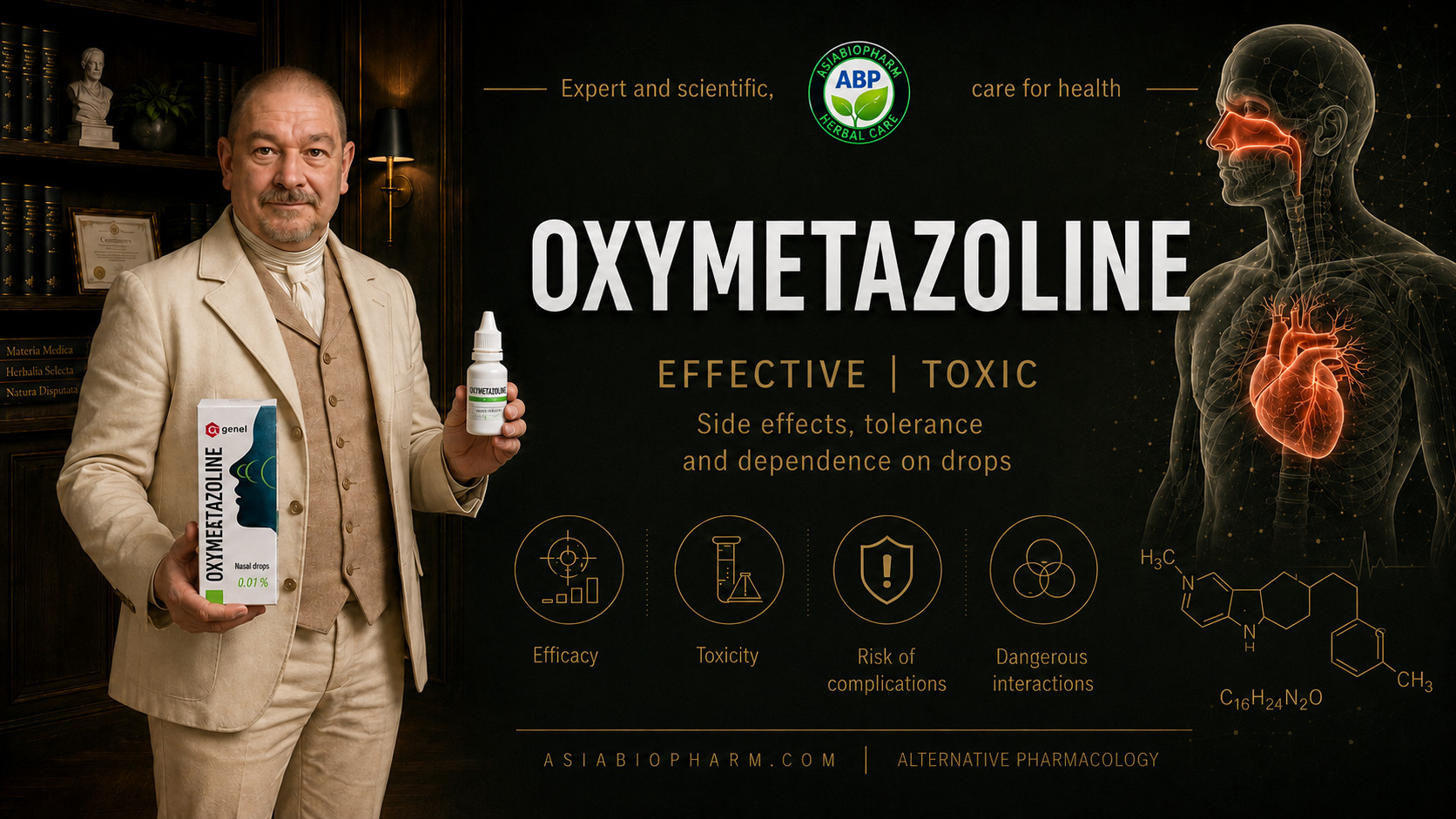
EFFECTIVE | TOXIC
Names under which oxymetazoline is found: the international nonproprietary name is oxymetazoline, the Latin spelling is oxymetazoline, and the active ingredient in medicinal products is usually present as oxymetazoline hydrochloride. The main dosage forms are nasal drops, metered-dose nasal spray, and a solution for topical use; ophthalmic solutions and dermatological preparations containing oxymetazoline also exist, but they have different indications and concentrations. Common trade names include Afrin, Nazivin, Nazivin Sensitive, Vicks Sinex, Dristan, Nazol, Nostrilla, Sudafed OM, and Zicam Extreme Congestion Relief. The composition of products sold under identical or similar trade names may differ between countries, so the “active ingredient” line should always be checked. Oxymetazoline is also included in the combination product Kovanaze together with tetracaine and may be present in multi-ingredient remedies for nasal congestion. Using several nasal, ophthalmic, or combination products containing oxymetazoline at the same time creates a risk of unintentional dose duplication.
Why oxymetazoline is considered harmless and where the real risk begins: the drug is sold over the counter, rapidly restores nasal breathing, and acts considerably longer than many other vasoconstrictor drops. This rapid effect creates the false impression that the spray actually treats a runny nose. In reality, oxymetazoline temporarily constricts blood vessels in the nasal mucosa and reduces swelling, but it does not eliminate a viral infection, allergy, chronic inflammation, polyps, a deviated nasal septum, or any other cause of congestion. With repeated use, a cycle develops: the effect wears off, the blood vessels dilate, the swelling returns more strongly, the person shortens the intervals between sprays, and gradually becomes unable to breathe normally without the drug. This is not classic drug addiction, but it is a clinically significant physical dependence on the vasoconstrictor effect, accompanied by rebound congestion and rhinitis medicamentosa. Official instructions limit unsupervised use to three days because frequent or prolonged use may cause nasal congestion to return or worsen.
Side effects with short-term use: the most common reactions are related to the local vasoconstrictor and irritant effects: burning, dryness, tingling in the nose, sneezing, increased nasal discharge, discomfort in the nasopharynx, and headache. In people with increased sensitivity, after excessive amounts of the solution, or with substantial systemic absorption, palpitations, increased blood pressure, tachycardia, less commonly paradoxical bradycardia, anxiety, agitation, insomnia, dizziness, and weakness may occur. Clinically dangerous reactions occur mainly with overdose, swallowing of the solution, use in young children, or malfunction of the dosing device. Hypertensive crisis, marked bradycardia, depression of consciousness, and respiratory depression are possible. In a child, severe systemic intoxication may develop after an amount that would seem insignificant to an adult.
Side effects with prolonged and repeated use: the main cumulative risk is rebound congestion and rhinitis medicamentosa. Persistent vasoconstriction disrupts normal regulation of vascular tone in the nasal mucosa, and once the drug’s effect wears off, reactive hyperemia and swelling develop. The patient increases the frequency of use, while the duration of unobstructed breathing gradually becomes shorter. Chronic congestion, dryness, burning, sleep disturbance, reduced sense of smell, and a constant need to carry the bottle may develop. Inflammatory and structural changes may form in the mucosa, and recovery after discontinuation can take days or weeks; after particularly prolonged misuse, symptoms may persist for longer. The absence of palpitations or other systemic reactions does not mean that the mucosa is not being damaged: the main harm from long-term use often develops locally and is initially perceived by the patient simply as a “worsening runny nose.”
Contraindications and higher-risk groups: oxymetazoline is more dangerous in people with arterial hypertension, ischemic heart disease, and other cardiovascular diseases because its systemic adrenergic effect may increase vascular resistance and alter heart rate. Hyperthyroidism increases sensitivity to sympathomimetic effects; in diabetes mellitus, vascular and metabolic responses may be less predictable. Symptoms may worsen in patients with difficulty urinating due to prostatic hyperplasia. Nasal formulations require particular caution in angle-closure glaucoma and after certain operations involving the nasal cavity or pituitary gland. Young children are especially vulnerable because of their low body weight, the possibility of swallowing the solution, and a more pronounced systemic response. Pregnancy and breastfeeding require an individual assessment rather than automatic use without medical consultation.
Dangerous interactions: combining oxymetazoline with monoamine oxidase inhibitors is contraindicated or strongly discouraged during treatment and for two weeks after they are discontinued because an excessive rise in blood pressure may occur. Tricyclic antidepressants and other drugs that increase adrenergic transmission raise the risk of hypertension and cardiac rhythm disturbances. Other sympathomimetics — pseudoephedrine, phenylephrine, stimulants, and some bronchodilators — may produce additive vasoconstrictor and cardiac-stimulating effects. Oxymetazoline may reduce the effectiveness of certain antihypertensive medications, including beta-blockers and methyldopa. Simultaneous use of several products containing oxymetazoline increases the likelihood of hypertension, bradycardia, and other systemic reactions. Caffeine, nicotine, and energy drinks do not produce a specific pharmacokinetic interaction, but they may intensify palpitations, anxiety, and blood pressure fluctuations. Alcohol does not relieve nasal congestion and may make it more difficult to recognize dizziness, weakness, or impaired consciousness in time.
Patient errors: the most typical mistake is using oxymetazoline not as a short-term symptomatic remedy, but as permanent treatment for chronic nasal congestion. The patient increases the number of sprays, uses the drug before the recommended interval has elapsed, gives an adult concentration to a child, tilts the head back and swallows part of the solution, buys several cold remedies at the same time, or continues using the drug for weeks or months. Another mistake is spraying the drug whenever congestion occurs without establishing its cause: allergic rhinitis, chronic rhinosinusitis, turbinate hypertrophy, polyps, or a deviated septum continue to progress while oxymetazoline temporarily masks the symptoms. Over-the-counter availability does not turn a potent alpha-adrenergic agonist into a neutral moisturizing spray.
Overdose and poisoning: there is no universally established toxic dose of oxymetazoline because severity depends on age, body weight, solution concentration, route of administration, comorbidities, and the amount of drug swallowed. Accidental ingestion and uncontrolled spraying in children are especially dangerous. Pediatric literature describes systemic toxicity after exposure to approximately 1–2 ml of nasal solution; incorrect spraying technique or turning the bottle upside down may increase the actual administered volume several-fold. Symptoms usually begin rapidly — within minutes or the first few hours. Initial agitation, restlessness, pallor, sweating, nausea, increased blood pressure, and tachycardia may occur, followed by drowsiness, profound weakness, constricted pupils, bradycardia, reduced blood pressure, respiratory depression, hypothermia, and impaired consciousness. In children, the clinical picture may resemble poisoning with a sedative drug. There is no specific antidote: urgent assessment of breathing, heart rhythm, and blood pressure, observation, and supportive treatment are required. Vomiting must not be induced independently. If the drug has been swallowed, or if pronounced drowsiness, unusual lethargy, difficulty breathing, or a sudden change in pulse or blood pressure occurs, emergency medical care should be sought immediately without waiting for further deterioration.
A safe integrative alternative to oxymetazoline: oxymetazoline and a botanical treatment regimen address different problems. The synthetic drug constricts mucosal blood vessels within minutes and temporarily opens the nasal passages, whereas the integrative alternative targets inflammation, allergic reactions, hypersecretion, mucosal damage, and the causes of chronic swelling. Therefore, in severe acute congestion, a botanical regimen does not always reproduce the speed of action of oxymetazoline, but it is suitable for breaking the cycle of continuous vasoconstrictor exposure and for subsequent treatment of the disease that is maintaining the congestion. The basic systemic alternative is Rhinitis and rhinosinusitis, mixture in LH capsules. The complex contains Solanum indicum, Vitex trifolia, Croton oblongifolius, Blumea balsamifera, and Eleusine indica and is positioned for allergic and vasomotor rhinitis, acute and chronic rhinosinusitis, postnasal drip, and inflammatory diseases of the upper respiratory tract. Its pharmacological rationale is based on the combination of anti-inflammatory, antiallergic, antioxidant, and mucus-regulating effects of its components.
An essential local component is ABP-153 — an oil-based herbal mixture for mucous membranes. Unlike an alpha-adrenergic agonist, it does not cause repeated vasoconstriction and is used to reduce dryness, irritation, and mucosal damage during withdrawal from vasoconstrictor drops. Kaempferia parviflora enhances the anti-inflammatory component of treatment and is particularly appropriate for a chronic or vasomotor phenotype with persistent swelling. In allergic rhinitis, eosinophilic inflammation, bronchial hyperreactivity, cough, or a combination of rhinitis and asthma, Bronchial asthma type 2, LH capsules is added.
For persistent swelling of the nasal turbinates, postnasal drip, and signs of tissue congestion, the LYMPHOBLOCK complex is used: Plucao — Houttuynia cordata, Murdannia loriformis, Ruscus aculeatus, and Squalene 1000. In this combination, Plucao and Murdannia provide anti-inflammatory and immunoregulatory support, Ruscus is used as a venotonic and anti-edematous component, and squalene provides antioxidant and cytoprotective support. Ruscus requires separate assessment in patients with arterial hypertension and when used concurrently with vasoconstrictor or antihypertensive drugs.
There are no direct comparative clinical studies of this entire regimen versus oxymetazoline, so it cannot be claimed to be an immediate equivalent of a nasal decongestant. Its advantage lies in a different therapeutic strategy: addressing inflammatory and allergic mechanisms without perpetuating rebound vasodilation. In mild and stable rhinitis, complete replacement may be possible. Severe rhinosinusitis, polyps, high fever, unilateral pain, purulent discharge, bronchial obstruction, or marked impairment of nasal breathing require diagnostic evaluation, and the regimen should be part of comprehensive treatment.
The real effectiveness of oxymetazoline: the drug is genuinely effective for rapid, short-term relief of congestion associated with the common cold, allergic rhinitis, and mucosal swelling. It activates alpha-adrenergic receptors in nasal blood vessels, causes vasoconstriction, and increases the diameter of the nasal passages. Oxymetazoline acts rapidly and for a prolonged period, but its effect remains symptomatic: the drug does not eliminate the pathogen, suppress the underlying allergic inflammation, remove polyps, correct anatomical narrowing, treat chronic rhinosinusitis, or eliminate other causes of obstruction.
When used for a short recommended course, oxymetazoline produces a pronounced decongestant effect, and high-quality short-term studies do not support the assertion that rhinitis medicamentosa inevitably develops in every patient. The risk arises primarily when the recommended duration is exceeded, the frequency of administration is increased, and chronic congestion is treated without diagnostic evaluation. Therefore, two extreme claims are equally incorrect: that the drug is harmless and that any use inevitably destroys the mucosa. It is useful as a short-term tool but becomes irrational when the bottle replaces proper investigation and treatment directed at the cause of disease.
Common medical errors include prescribing the drug without establishing the cause of congestion, failing to warn about the maximum duration of the course, advising repeated treatment whenever swelling returns, and ignoring hypertension, cardiovascular disease, hyperthyroidism, diabetes mellitus, and prostatic hyperplasia. Another error is regarding restored breathing after spraying as evidence that the underlying disease has been treated. Official labeling states that the drug only temporarily relieves congestion and that frequent or prolonged use may cause congestion to recur or worsen.
Safety monitoring during treatment: laboratory monitoring is generally not required during a standard short course. The frequency of use, duration of effect, condition of the nasal mucosa, and, in patients with cardiovascular risk, blood pressure and pulse should be monitored. Increasing congestion, the need to shorten the intervals between doses, waking at night for another spray, and inability to breathe without the bottle indicate development of a rebound mechanism. Burning, dryness, nosebleeds, and persistent impairment of smell require examination of the nasal mucosa.
The drug should be discontinued immediately and medical assistance sought in the event of pronounced palpitations, a significant rise or fall in blood pressure, chest pain, severe headache, confusion, unusual drowsiness, fainting, or breathing difficulties. Drowsiness, bradycardia, hypothermia, and respiratory depression in a child after possible ingestion of the solution are especially dangerous. Delaying care in such cases worsens the prognosis because there is no specific antidote and treatment depends on early monitoring and support of breathing, circulation, and neurological status.
Proper discontinuation of oxymetazoline: after short-term use, special gradual dose reduction is not required — the drug can be stopped immediately. If rhinitis medicamentosa has developed, abrupt discontinuation is often accompanied by pronounced rebound congestion, sleep disturbance, anxiety, and a temporary inability to breathe normally through the nose. This does not mean that oxymetazoline should be restarted: another dose constricts the blood vessels again but prolongs the pathological cycle.
Discontinuation may be immediate or gradual under professional supervision. With a gradual approach, use is first stopped in one nostril or the frequency of administration is progressively reduced while the mucosa is restored and the original rhinitis is treated. There is no single universal withdrawal regimen. In clinical practice, saline solutions, topical anti-inflammatory therapy, and treatment of allergy or rhinosinusitis are used; in this integrative regimen, local recovery is supported by ABP-153, while systemic treatment is provided by the “Rhinitis and rhinosinusitis” mixture and components selected according to the disease phenotype. Recovery may take from several days to several weeks, and longer after years of misuse. Observations of patients with rhinitis medicamentosa confirm a gradual reduction in swelling and restoration of mucosal sensitivity after discontinuation of the decongestant.
A rational approach to treatment: oxymetazoline is justified when nasal breathing needs to be restored rapidly and temporarily during acute swelling of the mucosa. Its advantage is its speed and predictable action; its limitation is that it does not affect the cause of the disease and carries a risk of rebound congestion with repeated or prolonged use. The drug should not become a permanent treatment for allergic, vasomotor, or chronic inflammatory rhinitis.
When the condition is stable, it is preferable to move away from continuous vasoconstriction toward treatment of inflammation, allergy, mucosal damage, and impaired tissue drainage. The basis of such a replacement is the “Rhinitis and rhinosinusitis” mixture together with ABP-153; Kaempferia, the “Bronchial asthma type 2” product, and LYMPHOBLOCK are added according to the clinical phenotype. Brief concurrent use is possible only as a transitional stage because continuing oxymetazoline without a time limit preserves the mechanism of dependence itself. The goal of an integrative approach is not to reject a fast-acting drug where it is genuinely needed, but to prevent a symptomatic spray from becoming months-long treatment for a chronic disease.
If you have any questions about the subject of this article, you can ask a clinical pharmacologist in the comments or book an appointment here: https://asiabiopharm.com/konsultaciii/
0 comments