
Omalizumab — Xolair Side Effects, Anaphylaxis, and Consequences of Treatment Discontinuation
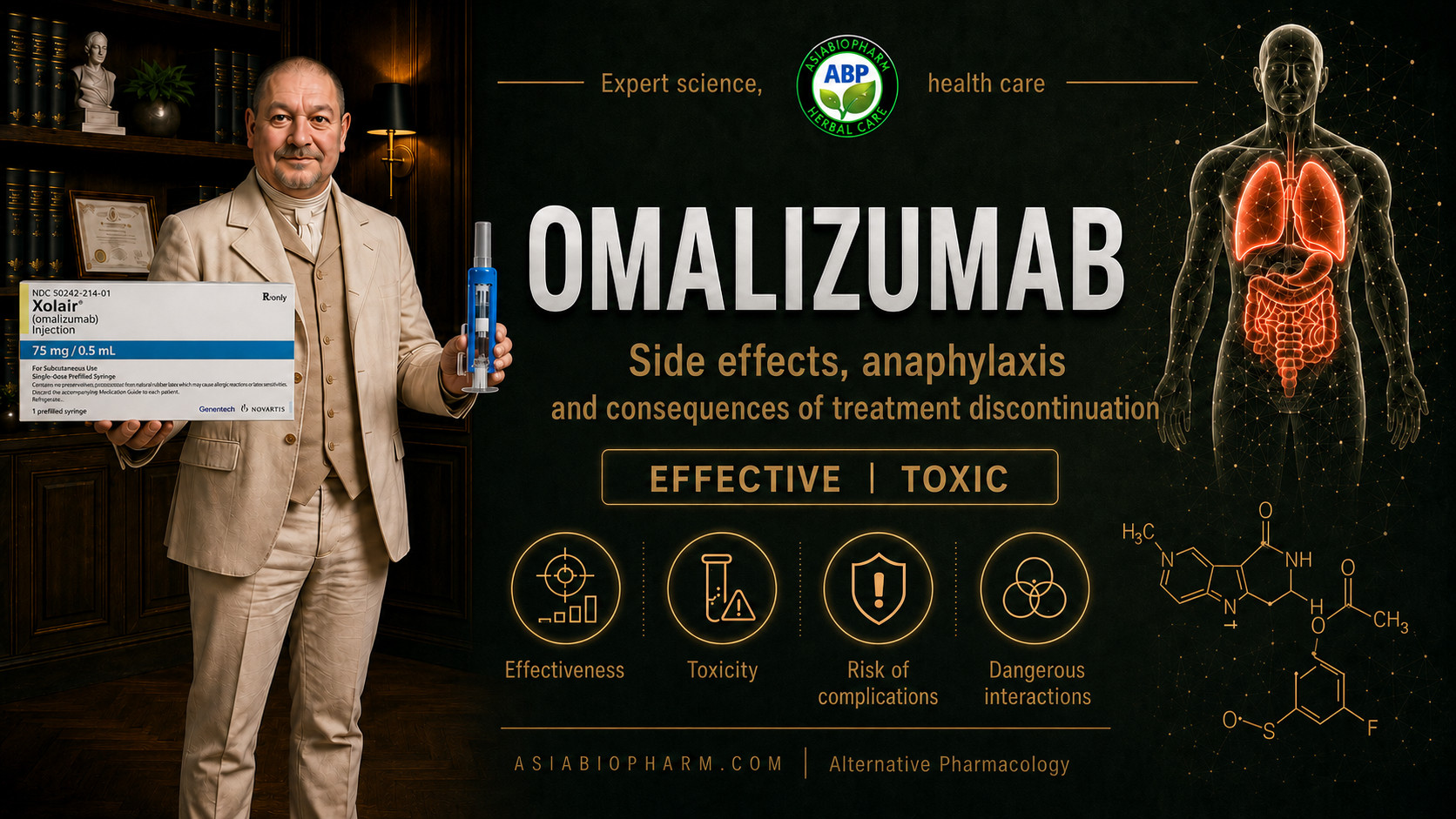
EFFECTIVE | TOXIC
Other names for omalizumab
The international nonproprietary name of the drug is omalizumab; the Latin spelling is omalizumab. Medical records, prescribing information, and search queries may use the terms “omalizumab,” “omalizumab injections,” “antibodies to immunoglobulin E,” and “anti-IgE therapy.” The main brand name is Xolair. In some countries, omalizumab biosimilars, including Omlyclo, have been registered. The drug is available as a solution for subcutaneous administration in prefilled syringes and autoinjectors, as well as a lyophilized powder for solution preparation. No combination products containing omalizumab together with another active ingredient in the same syringe or vial have been registered. Concomitant use of Xolair and an omalizumab biosimilar represents duplication of the same monoclonal antibody rather than a combination of different medicines.
Why omalizumab is considered harmless and where the real risk begins
Omalizumab is often perceived as a targeted biologic that binds IgE and therefore is supposedly incapable of causing a severe systemic reaction. In reality, the main acute complication associated with the drug is anaphylaxis with bronchospasm, swelling of the tongue or larynx, a drop in blood pressure, impaired consciousness, and a risk of asphyxiation. It may develop after the first injection, after several previously well-tolerated doses, or after months and even more than a year of regular treatment.
The possibility of self-administering the drug at home can also create a false sense of security. Home administration is permitted only for carefully selected patients who are able to inject the drug correctly, recognize the first symptoms of anaphylaxis, and immediately initiate emergency measures. Omalizumab does not relieve an acute bronchial asthma attack, does not replace epinephrine in anaphylaxis, and is not intended for emergency administration after accidental exposure to a food allergen.
Early signs of a systemic reaction may not be a pronounced rash or choking but rather throat irritation, cough, itching of the palms, sudden weakness, dizziness, hoarseness, or a feeling of pressure in the chest. Attempting to simply observe the progression of symptoms at home can result in rapid airway swelling and a fall in blood pressure.
Side effects after the first injection and in the short term
Common reactions include pain, redness, itching, burning, swelling, induration, or bruising at the injection site, headache, arthralgia, dizziness, fatigue, nausea, upper abdominal pain, nasopharyngitis, cough, upper respiratory tract infections, and fever. Local reactions usually appear within the first few hours but may sometimes persist for several days.
Clinically significant reactions include generalized urticaria, angioedema, severe bronchospasm, and a delayed serum sickness-like reaction. Several days after the injection, fever, widespread rash, joint pain and swelling, muscle pain, and enlarged lymph nodes may occur. The next administration may provoke a recurrent or more severe reaction.
Life-threatening anaphylaxis may begin within the first few minutes, within several hours, or after a delay. Its signs include rapidly spreading urticaria, swelling of the face, tongue, or larynx, hoarseness, difficulty swallowing, cough, wheezing, bronchospasm, chest tightness, hypotension, tachycardia, dizziness, and fainting. Previous injections being well tolerated does not rule out anaphylaxis after the next dose.
Consequences of long-term and repeated treatment
Omalizumab does not have characteristic dose-dependent hepatotoxicity or nephrotoxicity and does not cause classic drug dependence. However, the absence of early complications does not guarantee the safety of subsequent administrations. An immunologic reaction may occur for the first time after prolonged treatment, when both the patient and medical staff may no longer regard each injection as potentially dangerous.
Long-term observational studies have identified a signal suggesting a possible increase in the frequency of certain cardiovascular and thromboembolic events, including transient ischemic attacks, myocardial infarction, venous thrombosis, and pulmonary embolism. A causal relationship with omalizumab has not been definitively established because patients receiving it generally had more severe asthma and more baseline risk factors. Nevertheless, in a patient with sudden chest pain, unilateral leg swelling, neurologic symptoms, or unexplained shortness of breath, the condition should not automatically be attributed to the underlying allergic disease.
Early studies raised the question of a possible association between omalizumab and malignancies. Subsequent observations did not confirm a marked increase in overall cancer risk, but the effect of very long-term therapy on rare tumors cannot be completely excluded. This is particularly relevant for older patients, smokers, and people with pre-existing precancerous or oncologic conditions.
Reducing the activity of free IgE may weaken certain defense mechanisms against helminths. In patients who live in or spend prolonged periods in endemic regions, parasitic infection should be considered in cases of unexplained eosinophilia, abdominal symptoms, weight loss, or lack of the expected response to treatment.
In chronic spontaneous urticaria, omalizumab suppresses itching, wheals, and angioedema but does not guarantee elimination of the autoimmune and mast-cell mechanisms of the disease. Symptoms often return after treatment is discontinued. This is not a classic withdrawal syndrome but rather the return of disease activity after the anti-IgE effect wears off.
Contraindications and high-risk groups
Severe hypersensitivity to omalizumab or components of the dosage form is an absolute contraindication. Re-administration after confirmed drug-induced anaphylaxis may provoke an even more severe systemic reaction.
Patients with a history of systemic reactions to food, medications, insect stings, or other allergens have a higher risk of anaphylaxis. In these patients in particular, home administration requires especially careful assessment of their ability to recognize symptoms and use epinephrine.
In severe or unstable bronchial asthma, omalizumab must not be used as a substitute for emergency anti-asthma therapy. It does not immediately relax the bronchi and does not relieve acute respiratory failure. Attempting to replace a short-acting bronchodilator, systemic glucocorticosteroid, or emergency medical care with omalizumab creates a risk of progressive bronchospasm.
Patients with active helminthic infestation or a high risk of infection require additional monitoring. If persistent eosinophilia develops, parasitic infection must be distinguished from allergic inflammation, eosinophilic disease, and a reaction related to changes in the glucocorticosteroid dose.
Patients with a vasculitic rash, increasing shortness of breath, peripheral neuropathy, marked eosinophilia, or cardiac symptoms require particular attention. Such manifestations may become apparent after rapid reduction of systemic glucocorticosteroids and may indicate a previously suppressed systemic eosinophilic disorder.
In patients with latex allergy, the design of the specific prefilled syringe should be checked because certain parts of the device may contain derivatives of natural rubber.
Dangerous drug combinations
Formal pharmacokinetic interactions of omalizumab have been studied only to a limited extent. The drug is not metabolized by the cytochrome P450 system, so typical interactions caused by inhibition or induction of hepatic enzymes are not characteristic of it. This does not mean that every combination is automatically safe.
Concomitant administration of Xolair and another omalizumab product without a specific medical indication is contraindicated. Such a combination duplicates the active ingredient, increases the total dose, and creates an unpredictable risk of a systemic reaction.
It is highly undesirable to start omalizumab while simultaneously stopping systemic or inhaled glucocorticosteroids abruptly. Anti-IgE therapy does not immediately replace their effects. A sudden dose reduction may lead to worsening asthma, adrenal insufficiency, or manifestation of eosinophilic vasculitis.
Combination with allergen-specific immunotherapy, other biologic agents, or systemic immunosuppressants requires an individualized decision and monitoring. Simultaneously targeting several components of the immune system may alter infection rates and the nature of immunologic reactions, while clinical data for many combinations remain limited.
No direct proven interaction of omalizumab with alcohol, food, caffeine, or nicotine has been established. However, alcohol can intensify dizziness, weakness, and vascular reactions and can also make early recognition of anaphylaxis more difficult. Drinking alcohol immediately before an injection and during the observation period afterward is not advisable.
Dietary supplements and herbal products generally do not alter omalizumab concentrations through hepatic enzymes, but they may themselves cause urticaria, bronchospasm, hypotension, or angioedema. Starting several new products on the day of the injection makes it difficult to identify the cause of a systemic reaction.
Patient errors
One of the most dangerous mistakes is using omalizumab as an emergency medication. It does not relieve an acute asthma attack, anaphylaxis that has already begun, or an acute reaction to a food allergen. A patient receiving omalizumab for food allergy must continue to avoid dangerous foods and have access to epinephrine.
Increasing the dose independently or shortening the interval between injections when there is no rapid effect does not accelerate the result but increases exposure and the risk of adverse reactions. For allergic asthma, nasal polyposis with rhinosinusitis, and food allergy, the dose is calculated according to baseline total IgE and body weight. Chronic spontaneous urticaria uses a separate dosing regimen that does not depend on IgE. Applying a regimen for one disease to another is unacceptable.
Recalculating the dose according to total IgE measured during treatment is also a mistake. After binding to omalizumab, laboratory-measured total IgE rises and may remain altered for a long time after discontinuation. This value does not reflect free active IgE and should not be used by the patient for independent dose adjustment.
The absence of a reaction after the first injections does not mean that further observation is unnecessary. Anaphylaxis may occur after many previously tolerated doses. It is particularly dangerous to administer the drug at home without epinephrine, without understanding the early symptoms, and without the ability to summon help quickly.
After asthma improves, patients sometimes independently discontinue inhaled glucocorticosteroids or other maintenance medications. Omalizumab is an add-on maintenance therapy, not an automatic replacement for all previously prescribed treatment.
Fever, rash, severe joint pain, and enlarged lymph nodes after an injection should not be explained solely by a viral infection or an “allergy flare.” This combination may correspond to a serum sickness-like reaction.
In chronic urticaria, stopping treatment immediately after the wheals disappear without assessing the stability of remission is a mistake. The return of itching, angioedema, and rash after discontinuation does not indicate dependence on the drug but may require resumption of therapy.
Omalizumab overdose and poisoning
No clearly defined toxic single or cumulative dose has been established for omalizumab, no typical dose-dependent poisoning syndrome has been described, and there is no specific antidote. It is a monoclonal antibody rather than a low-molecular-weight substance with predictable concentration-dependent organ toxicity.
Overdose is most likely to occur due to selection of the wrong syringe, repeated injection, shortening of the interval, incorrect dose calculation, or concomitant use of Xolair and its biosimilar. Errors are particularly likely when patients attempt to recalculate the dose themselves on the basis of the current total IgE level.
During the first minutes and hours after excessive or erroneous administration, the main danger is systemic hypersensitivity. The development of itching, urticaria, swelling of the tongue or larynx, hoarseness, cough, bronchospasm, a drop in blood pressure, tachycardia, dizziness, and loss of consciousness should be monitored. Several days later, fever, generalized rash, arthralgia, arthritis, and enlarged lymph nodes may occur.
If overdose is suspected, medical observation is required with monitoring of respiration, oxygen saturation, hemodynamics, and signs of delayed anaphylaxis. In anaphylaxis, intramuscular epinephrine is the first-line treatment. Omalizumab is not a treatment for an allergic reaction caused by omalizumab itself. Waiting for pronounced laryngeal edema or a drop in blood pressure worsens the prognosis because the initial signs may be limited to cough, itching, throat irritation, or sudden weakness.
Integrative alternative: Nigella sativa, Boswellia serrata, Punica granatum, and Atractylodes lancea
The approved combination includes black seed — Nigella sativa, Indian frankincense — Boswellia serrata, pomegranate — Punica granatum, and Atractylodes lancea. The formula is not a herbal analogue of a monoclonal antibody and does not bind free IgE with the same selectivity as omalizumab. Its purpose is to partially target downstream components of allergic inflammation: the Th2 response, eosinophilic infiltration, leukotriene synthesis, oxidative damage to the respiratory epithelium, and mast-cell degranulation.
Nigella sativa is the foundation of the combination. Thymoquinone and other active constituents of black seed suppress inflammatory signaling pathways and reduce Th2 cytokine production, eosinophil activity, and bronchial hyperresponsiveness. Clinical data in bronchial asthma suggest the possibility of improved symptom control and reduced eosinophilia, although effects on spirometric parameters remain moderate and depend on the composition of the product.
Boswellia serrata adds an effect on the 5-lipoxygenase pathway and the formation of cysteinyl leukotrienes. These mediators are involved in bronchospasm, mucosal edema, eosinophil migration, and bronchial mucus hypersecretion. Boswellia is particularly relevant in an asthma phenotype characterized by bronchospasm and a prominent leukotriene component.
Punica granatum provides additional anti-inflammatory and antioxidant activity. Pomegranate polyphenols, including punicalagins and ellagic acid derivatives, may reduce oxidative stress, NF-κB activity, and inflammatory injury to the respiratory epithelium. In clinical studies involving mild to moderate allergic asthma, pomegranate extract improved certain symptoms and functional parameters and also affected eosinophil, neutrophil, and immunoregulatory cytokine levels. A standardized industrial extract with controlled levels of marker polyphenols is required for a reproducible effect.
Atractylodes lancea is included as an anti-mast-cell component. In preclinical models, atractylone, atractylodin, and β-eudesmol suppressed mast-cell degranulation, histamine and tryptase release, production of IL-4, IL-5, and IL-13, as well as NF-κB and MAPK activity. The level of clinical evidence in asthma and chronic urticaria remains limited, so its role is based primarily on its pharmacologic mechanism.
The components of the formula divide their functions without unnecessary duplication. Nigella sativa primarily targets Th2-eosinophilic inflammation and bronchial reactivity, Boswellia serrata targets leukotrienes and bronchospasm, Punica granatum targets oxidative stress and epithelial inflammation, and Atractylodes lancea targets mast cells and mediator release.
Complete replacement of omalizumab with this combination has not been proven in severe allergic asthma, antihistamine-resistant chronic spontaneous urticaria, severe chronic rhinosinusitis with nasal polyps, or food allergy with anaphylaxis. The formula is most justified in mild or moderate stable allergic asthma when biologic therapy is not yet indicated, or as an adjunctive complex for reducing inflammatory burden.
When stable disease control has been achieved, the herbal combination may be used alongside maintenance therapy with subsequent assessment of symptoms, exacerbation frequency, need for emergency medications, and lung function. The decision to reduce or discontinue omalizumab in severe, complicated, or unstable disease should be made by the treating specialist.
Herbal origin does not eliminate the risk of adverse reactions. Individual hypersensitivity, dyspepsia, reduced blood glucose or blood pressure, and interactions with anticoagulants, antiplatelet agents, glucose-lowering drugs, and antihypertensive agents may occur. Atractylodes lancea belongs to the Asteraceae family, so additional caution is required in patients allergic to plants of this family. All components should not be started simultaneously in a patient with high allergic reactivity; sequential introduction allows the tolerability of each extract to be determined.
Real effectiveness of omalizumab and medical errors
Omalizumab is genuinely effective in confirmed moderate-to-severe persistent allergic asthma that remains inadequately controlled despite appropriate inhaled therapy. It reduces the frequency of exacerbations, the need for systemic glucocorticosteroids, and the severity of symptoms. Its effect develops gradually and does not replace emergency bronchodilators.
In chronic spontaneous urticaria, omalizumab reduces itching, the number of wheals, and the frequency of angioedema in patients who do not respond to adequate doses of H1 antihistamines. The drug suppresses disease manifestations but does not eliminate all of its autoimmune and mast-cell causes, so relapse is common after discontinuation.
In chronic rhinosinusitis with nasal polyps, omalizumab may reduce nasal congestion, polyp size, impaired sense of smell, and the need for systemic glucocorticosteroids. The result is assessed over a period of months, not after one or two injections.
In IgE-mediated food allergy, omalizumab raises the threshold amount of allergen capable of triggering a reaction after accidental exposure. This reduces the risk of a severe response to a small amount of the food but does not permit unrestricted consumption of the allergen and does not eliminate the need to have epinephrine available.
Omalizumab does not treat acute bronchospasm, does not stop anaphylaxis, does not eliminate infectious, parasitic, or non-allergic causes of eosinophilia, and does not guarantee lifelong remission after treatment discontinuation.
It is a medical error to prescribe the drug for asthma without confirming the allergic phenotype, evaluating inhaler technique, treatment adherence, and the adequacy of maintenance therapy. Not every case of severe asthma is IgE-dependent, and an expensive injection does not correct improper inhaler use.
Calculating the dose according to total IgE measured after treatment has already begun is an error. An increase in laboratory-measured total IgE after initiation of therapy is expected and does not indicate worsening of the disease.
Omalizumab must not be started at the same time as systemic or inhaled glucocorticosteroids are abruptly discontinued. Their dose should be reduced separately and gradually after stable disease control has been achieved.
Continuing treatment for years without assessing exacerbations, lung function, urticaria activity, polyposis, and the need for concomitant therapy turns biologic treatment into an expensive ritual. Periodic assessment of outcomes is necessary to distinguish a true clinical benefit from the habit of administering the drug regularly.
In chronic urticaria, medication-related causes, physically inducible forms, autoimmune diseases, and conditions mimicking urticaria should be evaluated before treatment is prescribed. Suppressing wheals does not make an incomplete diagnostic evaluation correct.
Safety monitoring during treatment
Initial administrations of omalizumab should take place in a medical facility equipped with epinephrine, oxygen, and equipment for maintaining airway patency. The duration of observation is determined by the patient’s history, risk of anaphylaxis, and tolerability of previous doses.
Before each injection, it is necessary to determine whether generalized urticaria, swelling of the face, tongue, or larynx, hoarseness, difficulty breathing, bronchospasm, a fall in blood pressure, dizziness, or fainting occurred after the previous administration. Even delayed symptoms are relevant when deciding whether to give the next dose.
Swelling of the tongue or larynx, rapidly increasing shortness of breath, wheezing, impaired consciousness, a drop in blood pressure, and generalized urticaria require immediate administration of epinephrine and emergency medical care. Waiting for spontaneous improvement is dangerous because airway obstruction may progress rapidly.
Fever, rash, severe joint pain, and enlarged lymph nodes several days after an injection may indicate a serum sickness-like reaction. The next dose should not be administered until the cause has been clarified.
New eosinophilia, vasculitic rash, numbness or weakness of the limbs, worsening breathing, and cardiac symptoms, especially after the dose of systemic glucocorticosteroids has been reduced, require exclusion of systemic eosinophilic disease.
In bronchial asthma, monitoring includes the frequency of daytime and nighttime symptoms, need for a rescue bronchodilator, number of exacerbations, use of systemic glucocorticosteroids, validated control scores, and spirometry. In chronic urticaria, the intensity of itching, number of wheals, angioedema, and results of validated activity and control scales are assessed. In chronic rhinosinusitis with nasal polyps, nasal breathing, sense of smell, need for systemic therapy, and endoscopic findings are evaluated.
Routine monitoring of liver enzymes and kidney function solely because of omalizumab is generally not required. Total IgE during treatment is not used to assess effectiveness or for independent dose adjustment.
Proper discontinuation of omalizumab and consequences of stopping treatment
Omalizumab does not cause pharmacologic dependence and does not require gradual dose reduction to prevent a classic withdrawal syndrome. Injections can be stopped without sequential reduction in the number of milligrams. However, discontinuation should take into account the drug’s long elimination period and the risk of a gradual return of disease activity.
In chronic spontaneous urticaria, itching, wheals, and angioedema may return after treatment is stopped. Relapse often develops within weeks or months as free IgE and mast-cell activity recover. This represents a return of the disease, not dependence on omalizumab.
In allergic asthma, discontinuation may be followed by a gradual increase in symptom frequency, need for rescue medication, and risk of exacerbations. Inhaled glucocorticosteroids and other maintenance medications should not be stopped at the same time as omalizumab.
Missing a single dose usually does not cause an immediate rebound because the drug is eliminated slowly. Repeated missed doses reduce the anti-IgE effect. They must not be compensated for by a double dose or by shortening the interval.
In stable remission, controlled discontinuation or extension of the interval between administrations may be possible. Before stopping treatment, criteria for restarting therapy should be established: more frequent exacerbations, worsening asthma control, return of severe urticaria, angioedema, or nasal obstruction.
If omalizumab is discontinued because of anaphylaxis or another severe systemic reaction, re-administration without a specialized allergologic assessment is unacceptable.
A rational final approach to treatment
Omalizumab is justified in severe IgE-mediated asthma, chronic spontaneous urticaria not controlled by antihistamines, severe chronic rhinosinusitis with nasal polyps, and food allergy with a high risk of reaction after accidental exposure. In these situations, its selectivity, predictability, and clinical evidence base are of fundamental importance.
The combination of Nigella sativa, Boswellia serrata, Punica granatum, and Atractylodes lancea is rational in mild or moderate stable allergic asthma and as an adjunctive anti-inflammatory strategy. It partially targets the Th2-eosinophilic, leukotriene, oxidative, and mast-cell components of the disease, with a lower risk of the systemic reaction characteristic of injectable omalizumab.
In severe, unstable, or life-threatening allergic disease, phytotherapy remains an adjunct rather than a reason for immediate discontinuation of effective anti-IgE treatment. When stable control has been achieved, the herbal complex may be used concomitantly, followed by objective assessment of the result and subsequent reduction of pharmacologic burden under specialist supervision.
The goal of an integrative approach is not to reject effective treatment but to choose the minimum sufficient therapy, reduce polypharmacy, and prevent unjustified long-term use of a drug without reassessing whether it is truly necessary.
If you have questions about the subject of this article, you can ask a clinical pharmacologist in the comments or schedule an appointment via the following link: https://asiabiopharm.com/konsultaciii/
0 comments