
Olopatadine — Side Effects, Contraindications, and Why the Drug Can Be Dangerous
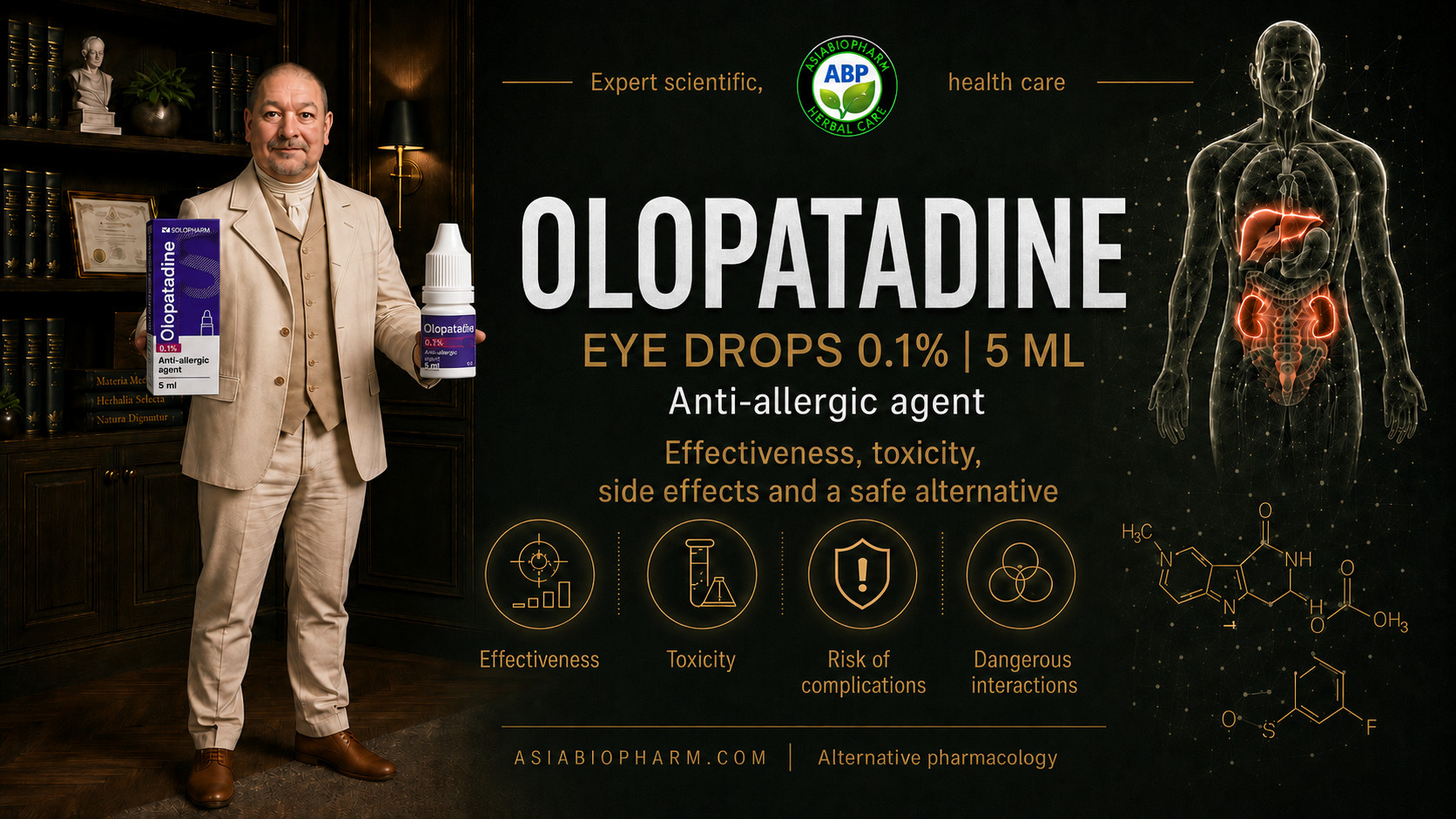
EFFECTIVE | NON-TOXIC WHEN USED LOCALLY AT THERAPEUTIC DOSES
Names Under Which Olopatadine Is Available
The international nonproprietary name is olopatadine, Olopatadine; medicinal products usually contain olopatadine hydrochloride — Olopatadine hydrochloride. The main dosage forms are 0.1%, 0.2%, and 0.7% eye drops and a 0.6% metered-dose nasal spray; oral tablets are registered in some countries. Trade names include Opatanol, Patanol, Pataday, Pazeo, Patanase, Visallergol, Olapasan, Olopatadine-SZ, Olopatallerg, Olopatin, Oloridin, Stablomax, and other regional products. The combination nasal product Ryaltris contains olopatadine together with mometasone furoate. Simultaneous use of Ryaltris and a separate olopatadine spray creates hidden duplication of the antihistamine component, while adverse reactions to the combination may be associated with either olopatadine or the corticosteroid.
Why Olopatadine Is Considered Harmless and Where the Real Risk Begins
The main danger of olopatadine is not pronounced systemic organ toxicity, but incorrect use of a topical drug for conditions that are not allergic in nature. The drops temporarily reduce allergic itching but do not treat infectious conjunctivitis, corneal damage, glaucoma, dry eye syndrome, or irritation caused by contact lenses. Continuing self-treatment in the presence of pain, photophobia, purulent discharge, or reduced vision may delay the diagnosis of a sight-threatening condition. The nasal spray can cause drowsiness and reduced attention, so combining it with alcohol or sedatives cannot be considered harmless.
Preservatives, especially benzalkonium chloride, create an additional risk. They can irritate the ocular surface and nasal mucosa, be absorbed by soft contact lenses, and worsen dryness or burning. Ophthalmic olopatadine should not be used to treat irritation caused by contact lenses; lenses should be removed before instillation and reinserted no earlier than ten minutes later, and they should not be worn when the eye is red.
Side Effects After the First Dose and a Short Course
After instillation, the most likely effects are temporary burning, stinging, irritation, foreign-body sensation, dryness, tearing, redness, and transient blurred vision. Eye pain, eyelid swelling, photophobia, and headache may occur. If vision becomes blurred, driving or operating machinery should be avoided until vision has recovered. Contamination of the bottle tip through contact with fingers, eyelashes, or surfaces creates a separate risk of microbial contamination of the solution and subsequent eye infection.
With nasal use, the most characteristic effects are a bitter or unpleasant taste in the mouth, nasal irritation, mucosal dryness, nosebleeds, headache, and drowsiness. Incorrectly directing the spray toward the nasal septum increases local irritation and bleeding. If the spray gets into the eyes, it causes irritation and should be rinsed out with water. Rare hypersensitivity reactions are clinically dangerous: rapidly increasing swelling of the face, lips, or larynx, urticaria, wheezing, and difficulty breathing.
Side Effects With Long-Term or Repeated Use
Olopatadine has not been shown to cause characteristic cumulative hepatotoxicity, nephrotoxicity, hormonal toxicity, drug dependence, or a withdrawal syndrome when used locally. The low systemic exposure from eye drops limits the risk of internal-organ injury. Therefore, portraying olopatadine as a drug that predictably “destroys the liver and kidneys” is pharmacologically unfounded. The real problems associated with long-term treatment are usually chronic irritation of the ocular or nasal mucosa, preservative exposure, incorrect administration technique, and masking of an incorrect diagnosis.
Repeated use of eye drops containing benzalkonium chloride may perpetuate dryness and discomfort in patients whose ocular surface is already damaged. If itching persists for weeks, a constant need to increase the frequency of instillation is more likely to indicate continued allergen exposure, concomitant dry eye syndrome, blepharitis, or another cause of symptoms than the development of tolerance. With the olopatadine–mometasone combination spray, long-term risks are additionally determined by the corticosteroid component: mucosal injury, delayed healing, candidiasis, and systemic steroid effects may occur and should not automatically be attributed to olopatadine itself.
Contraindications and High-Risk Groups
A direct contraindication is established hypersensitivity to olopatadine or to excipients in the specific product. Eye drops should not be used if the solution has changed color or become cloudy, nor should they be used to relieve discomfort caused by contact lenses. Eye pain, marked photophobia, trauma, chemical burns, purulent discharge, sudden deterioration of vision, or persistent unilateral redness require diagnostic evaluation rather than continued antihistamine self-treatment.
The nasal formulation requires particular caution in people whose work involves driving, working at heights, moving machinery, or the need for continuous concentration: even moderate drowsiness increases the risk of injury. In children, only the concentration and age-specific regimen authorized in the instructions for the specific product should be used. During pregnancy and breastfeeding, topical use should be assessed individually: evidence of pronounced reproductive toxicity in humans is insufficient, but uncontrolled use without a clear indication is unjustified. The contraindications and restrictions for the combination product Ryaltris are broader because it contains mometasone.
Dangerous Interactions
Clinically significant systemic drug interactions are unlikely with eye drops because only a small amount of olopatadine reaches the bloodstream. When other ophthalmic products are used at the same time, at least five minutes should be allowed between instillations so that the drugs do not wash out or dilute one another. After instillation, gently closing the eyelids and briefly pressing the area of the tear duct reduces drainage of the solution into the nose and systemic absorption.
Combining the nasal spray with alcohol, sleeping pills, benzodiazepines, sedating antihistamines, opioid analgesics, some antipsychotics, and other central nervous system depressants is highly undesirable: drowsiness may be additive, psychomotor responses may slow, and coordination may worsen. Nicotine and caffeine are not antidotes and do not make driving safe. Formal studies of most drug combinations involving intranasal olopatadine have not been conducted, so the absence of an interaction in the product instructions is not equivalent to proven compatibility.
Ryaltris contains both olopatadine and mometasone. Simultaneous use with separate olopatadine duplicates antihistamine therapy, while combining it with other intranasal corticosteroids increases the total steroid burden. CYP3A4 inhibitors capable of increasing systemic exposure to mometasone should also be considered with Ryaltris; this interaction concerns the corticosteroid component, not olopatadine.
Patient Errors
A typical mistake is to assume that any redness or itching is a manifestation of allergy. Olopatadine can reduce histamine-dependent itching but does not eliminate bacterial or viral infection, corneal damage, a foreign body, chemical irritation, or decompensated dry eye syndrome. Increasing the number of drops or the frequency of use does not accelerate recovery, but it does increase contact between the mucosa and the preservative and raises the likelihood of local irritation.
Other common mistakes include touching the eyelashes with the bottle tip, sharing one bottle between several people, instilling drops over contact lenses, using a cloudy solution, using the product after its expiration date, spraying the nasal formulation toward the septum or eyes, and combining the nasal form with alcohol before driving. Self-treatment should not be continued simply because the drug is available without a prescription in some countries: over-the-counter status confirms that the product may be used according to the instructions, but it does not turn every red eye into allergic conjunctivitis.
Overdose and Poisoning
No specific single dose of olopatadine has been established that predictably causes severe poisoning in humans after accidental excessive topical administration. A few extra drops in the eye usually lead primarily to increased local burning, tearing, and blurred vision; excess medication can be removed by rinsing with clean water. Repeated instillation “until an effect appears” is inappropriate: one additional drop does not increase the selectivity of action but does increase exposure of the mucosa and preservative.
Accidental ingestion of the contents of the bottle, especially by a child, requires medical consultation or contact with a poison control center even if symptoms have not yet appeared. Possible early manifestations of systemic antihistamine exposure include drowsiness, dizziness, dry mouth, nausea, agitation, or impaired coordination; severity depends on the amount of drug, age, body weight, kidney function, and simultaneous use of sedating substances. There is no specific antidote; treatment is supportive and determined by the clinical condition. Vomiting should not be induced unless specifically instructed by a toxicology specialist.
Overdose of the nasal spray is more likely with repeated spraying, malfunction of the dispenser, use of an adult dosing regimen in a child, or simultaneous use of several olopatadine-containing products. The main expected risk is increased drowsiness and psychomotor slowing. Loss of consciousness, severe lethargy, impaired breathing, seizures, swelling of the face, or laryngeal edema require emergency care. In an overdose of a combination product, not only olopatadine but also mometasone must be taken into account: clinical assessment should cover both active ingredients.
Safe Integrative Alternative to Olopatadine
Olopatadine rapidly suppresses H1 receptor-dependent itching and other symptoms of allergic conjunctivitis, but it acts predominantly symptomatically and does not eliminate the systemic tendency toward IgE-dependent inflammation. As a basic systemic alternative when ocular and respiratory manifestations occur together, Allergy Mixture, Capsules LH may be considered. The combination of Andrographis paniculata, Schefflera leucantha, and Murdannia loriformis is intended to provide anti-inflammatory, immunomodulatory, and antihistamine-like effects, including effects on NF-κB-dependent mediator production, Th2 inflammation, histamine release, and mucosal edema. This regimen may be useful for seasonal allergy, allergic rhinitis, and rhinitis combined with a respiratory allergic phenotype, but it is not equivalent to a single eye drop in terms of how quickly it relieves intense acute itching.
To influence the early phase of the allergic response, it may be reasonable to supplement the main mixture with Kra Chai Dam — Kaempferia parviflora. The pharmacological rationale for this combination is related to possible suppression of IgE–FcεRI–Syk-dependent activation and mast-cell degranulation. This does not mean that full clinical equivalence to olopatadine in allergic conjunctivitis has been proven: data for the herbal product are predominantly mechanistic and experimental, whereas ophthalmic olopatadine formulations have a directly registered indication for the treatment of ocular itching and symptoms of allergic conjunctivitis. Therefore, in mild stable disease, the herbal regimen may be used for systemic control of the allergic background, while local olopatadine acts faster and more predictably in intense acute ocular itching.
In cases of marked mucosal edema, prolonged rhinitis, rhinosinusitis, or a bronchial component, Boswellia serrata may be added. Boswellic acids affect the formation of 5-lipoxygenase products and leukotriene-dependent inflammation, but this mechanism does not make boswellia a direct H1 antihistamine and does not provide immediate relief of ocular itching. Its role is to control the inflammatory component of the allergic process, especially when the clinical phenotype extends beyond isolated conjunctivitis. Experimental activity against 5-LOX has been demonstrated, but clinical efficacy depends on the composition and standardization of the specific extract.
When nasal congestion, sneezing, hypersecretion, and chronic inflammation of the paranasal sinuses predominate, a more targeted regimen is Rhinitis and Rhinosinusitis Mixture, Capsules LH together with the topical oil-based herbal mixture ABP-153. The ABP-153-D version contains DMSO and requires stricter adherence to the method of use because DMSO can alter tissue permeability and the transport of dissolved substances. Neither ABP-153 nor ABP-153-D should be placed into the conjunctival sac without specific authorization in the instructions for the particular product. These products are intended for nasal and rhinosinusitis phenotypes, not as universal eye drops.
Pinellia ternata retains a role when allergic inflammation is combined with cough, bronchial hyperreactivity, eosinophilic inflammation, and mucus hypersecretion. In confirmed Th2 or eosinophilic asthma, the specialized regimen Bronchial Asthma Type 2, Capsules LH is used. In bronchial obstruction with thick sputum that is difficult to expectorate, Bolus “Asthma With Tenacious Sputum” may be considered. These products are not needed for isolated seasonal eye itching without cough, sputum, or bronchial symptoms: adding bronchopulmonary products solely because of the word “allergy” creates polypharmacy of herbal origin.
Thus, for a mild or stable systemic allergic phenotype, the main option is Allergy Mixture LH in combination with Kra Chai Dam; Boswellia serrata is added for leukotriene-dependent inflammation, while nasal and bronchopulmonary products are selected strictly according to the clinical phenotype. In cases of marked eyelid edema, intense photophobia, pain, purulent discharge, reduced vision, bronchospasm, or unstable asthma, self-directed replacement of treatment is unacceptable: infection, corneal damage, and threatening airway obstruction must first be excluded.
Actual Effectiveness of Olopatadine and Medical Errors
Olopatadine is genuinely effective for allergic conjunctivitis: it reduces histamine-dependent itching, redness, and tearing. The 0.1% ophthalmic solutions are used to treat the signs and symptoms of allergic conjunctivitis, while the 0.2% formulations are used primarily to reduce ocular itching. Intranasal olopatadine is effective for symptoms of seasonal allergic rhinitis. The drug acts relatively quickly because it blocks peripheral H1 receptors and limits mediator release from mast cells, but it does not eliminate sensitization, the source of the allergen, or the cause of chronic inflammation. Once contact between the drug and the receptors ends, symptoms may return if the allergic process persists.
Olopatadine should not be expected to treat bacterial or viral conjunctivitis, blepharitis, keratitis, glaucoma, eye trauma, chemical injury, or pronounced dry eye syndrome. It also does not prevent anaphylaxis and does not replace maintenance therapy for bronchial asthma. Prescribing drops for any red eye without assessing pain, the nature of the discharge, the condition of the cornea, and visual acuity is a typical diagnostic error. The antihistamine effect may temporarily reduce itching and create an illusion of treatment while a disease unrelated to histamine continues to progress.
Other medical errors include unjustified increases in instillation frequency, failure to consider benzalkonium chloride in chronic ocular-surface damage, ignoring contact lens use, prescribing several olopatadine-containing products simultaneously, and confusing the risks of olopatadine alone with those of the olopatadine–mometasone combination. In patients with persistent “allergic” redness, the diagnosis should be reconsidered rather than endlessly renewing a prescription for another bottle.
Safety Monitoring During Treatment
With short-term use of ophthalmic olopatadine, routine laboratory tests, monitoring of liver or kidney function, or electrocardiography are usually unnecessary. The clinical response should be monitored: reduction in itching and tearing and the appearance of burning, pain, dryness, eyelid swelling, photophobia, or changes in vision. Mild transient blurring immediately after instillation may occur, but persistent deterioration in vision, increasing pain, or marked photophobia are not symptoms that should simply be watched at home.
The drug should be discontinued and the eye urgently evaluated in the event of sudden loss of vision, severe pain, trauma, chemical exposure, purulent discharge, corneal clouding, increasing unilateral redness, or lack of improvement within the period specified in the instructions. Swelling of the face, lips, tongue, or larynx, generalized urticaria, wheezing, and difficulty breathing require emergency care because of the risk of a systemic hypersensitivity reaction.
During nasal use, drowsiness, dizziness, impaired coordination, nosebleeds, dryness, and mucosal ulceration should be monitored. Until the individual response is known, driving and potentially hazardous work should be avoided. Alcohol and sedatives may intensify psychomotor impairment. With the olopatadine–mometasone combination spray, complications associated with the intranasal corticosteroid should also be assessed, including persistent bleeding, candidiasis, impaired mucosal healing, and ophthalmic symptoms during long-term use.
Proper Discontinuation of Olopatadine
Olopatadine does not cause drug dependence and does not require gradual dose reduction. Eye drops or the pure nasal spray may be stopped immediately. A withdrawal syndrome such as that associated with systemic glucocorticosteroids, benzodiazepines, or vasoconstrictor nasal preparations has not been established for olopatadine.
The return of itching, sneezing, tearing, or nasal congestion after discontinuation does not indicate pharmacological withdrawal but persistence of the allergen and activity of the underlying disease. Frequent missed doses reduce symptomatic control but do not create a separate toxic syndrome. If the drug has been used for weeks without a sustained result, the correct approach is to clarify the diagnosis and the pattern of allergen exposure rather than repeatedly alternating discontinuation and renewed instillation.
The olopatadine–mometasone combination product should be considered separately. Although topical intranasal corticosteroids usually do not require complicated discontinuation after a standard course, the duration, dose, and degree of systemic exposure to mometasone should be assessed separately. The absence of a withdrawal syndrome with olopatadine itself cannot automatically be extrapolated to every product that contains olopatadine in its name.
A Rational Approach to Treatment
Olopatadine is justified when rapid and predictable relief of ocular itching in confirmed allergic conjunctivitis or nasal symptoms of allergic rhinitis is required. When used properly and locally, it is not considered a drug with pronounced systemic organ toxicity. Its weakness is not “organ destruction” but the limited scope of its therapeutic role: it suppresses symptoms but does not eliminate sensitization or the chronic inflammatory background.
In mild or stable allergic disease, the systemic treatment burden may be reduced using an integrative regimen selected according to the phenotype. The basic option is Allergy Mixture LH with Kra Chai Dam; Boswellia serrata is added for leukotriene-dependent inflammation, Rhinitis and Rhinosinusitis Mixture LH, ABP-153, or ABP-153-D for the nasal phenotype, and Pinellia ternata and specialized bronchial products only when the corresponding symptoms are present.
Combined use is possible when olopatadine is used for rapid local control and integrative therapy is directed at the systemic and inflammatory mechanisms of allergy. Complete replacement is most realistic in mild, stable disease without warning symptoms. In severe conjunctivitis, corneal involvement, unstable asthma, marked rhinosinusitis, or a systemic allergic reaction, treatment should be determined by the clinical situation rather than by a principled desire to use only synthetic or only herbal products.
If you have questions about the topic of this article, you can ask a clinical pharmacologist in the comments or make an appointment using the link.
0 comments