
Lidocaine — Side Effects, Contraindications and the Risk of Overdose
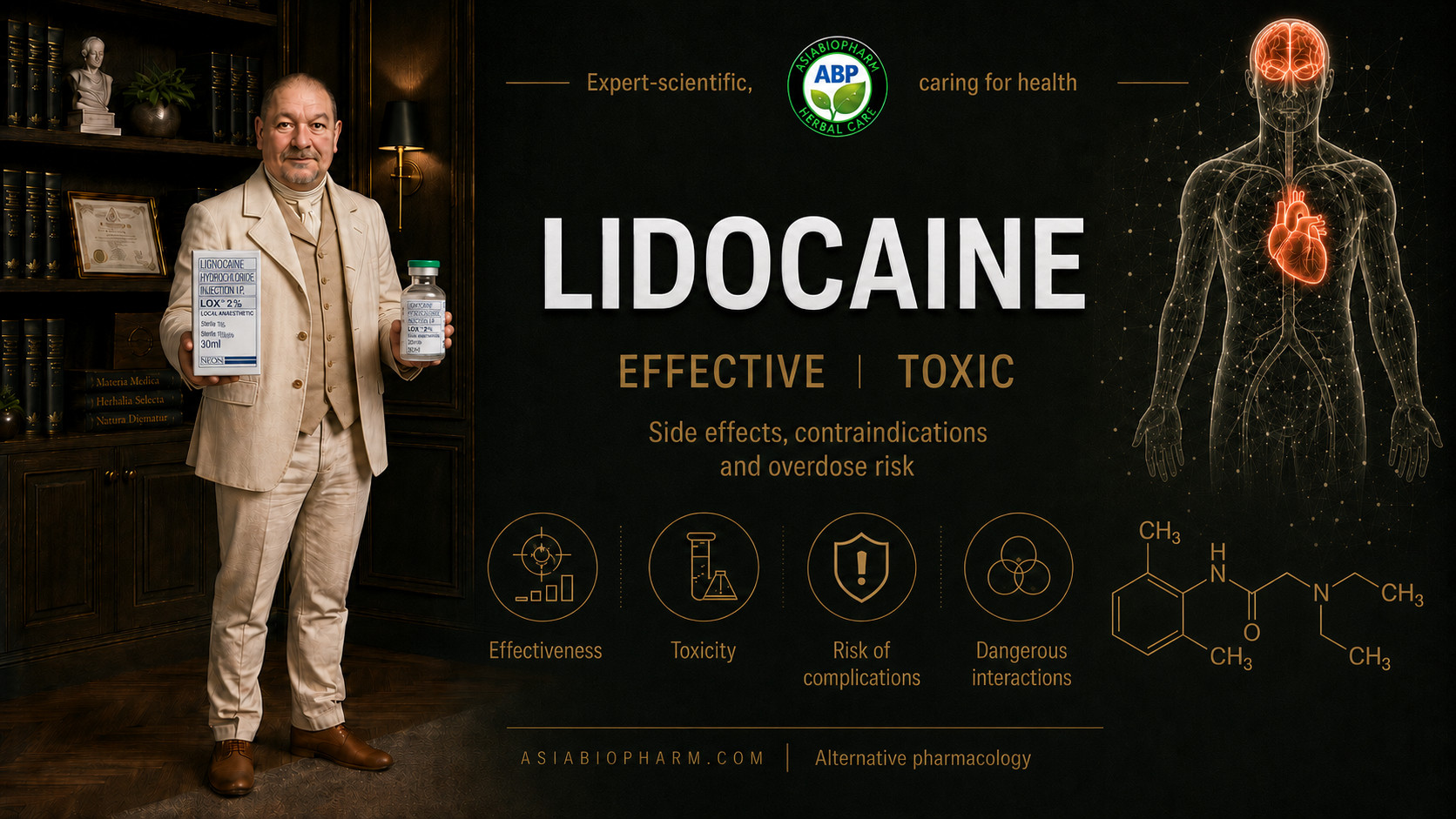
EFFECTIVE | TOXIC
What Names Is Lidocaine Sold Under
The international nonproprietary name is lidocaine, Lidocaine; the British variant is Lignocaine, and the Russian transliteration is lignocaine. In injectable products, the active ingredient is usually lidocaine hydrochloride — Lidocaine hydrochloride or Lignocaine hydrochloride. The main dosage forms include solutions for local and regional anaesthesia, intravenous solutions, sprays, aerosols, gels, ointments, creams, patches and preparations for mucous membranes. Injectable forms include Lidocaine Hydrochloride Injection 2% — Lignocaine Hydrochloride Injection 2% Neon and Lidocaine Hydrochloride with Adrenaline Injection — Lignocaine and Adrenaline Injection 2% Neon. Common brand names include Xylocaine, Lidocaine, Lidocaine Bufus, Lidocaine-Vial, Versatis and Lidoderm. Lidocaine is also included in combination products: EMLA contains lidocaine and prilocaine, Otipax contains lidocaine and phenazone, Kamistad contains lidocaine and chamomile, and Instillagel contains lidocaine and antiseptic components. A patient may use a spray, gel, patch and injectable product at the same time without realising that the total dose of the same active ingredient continues to increase.
Why Lidocaine Is Considered Harmless and Where the Real Risk Begins
Lidocaine is often perceived as a familiar medicine that simply and temporarily “numbs” an area of skin or mucous membrane. This false sense of safety is particularly dangerous when using Lidocaine Hydrochloride Injection 2% and Lidocaine Hydrochloride with Adrenaline, because a dosing error, rapid administration or accidental intravascular injection can affect the central nervous system and the heart within minutes.
Lidocaine blocks voltage-gated sodium channels not only in sensory nerves but also in the brain, the cardiac conduction system and the myocardium. Adrenaline slows local absorption and prolongs anaesthesia, but at the same time adds the risk of tachycardia, elevated blood pressure, ischaemia and drug interactions. Early signs of toxicity — a metallic taste, numbness of the lips, ringing in the ears, dizziness, anxiety or drowsiness — can easily be mistaken for stress before a procedure. Repeated administration, the use of several lidocaine-containing products and underestimation of the total dose may result in seizures, respiratory depression, arrhythmia and circulatory arrest.
Side Effects During the First Hours and Days of Use
Following administration of Lidocaine Hydrochloride Injection 2%, pain, burning, swelling, haematoma and temporary weakness or altered sensation may occur in the area of the block. Topical use may cause irritation, redness and contact dermatitis. Following anaesthesia of the mouth and throat, reduced sensation can impair swallowing and increase the risk of aspiration, biting the tongue and burns from hot food.
Clinically significant systemic toxicity begins with numbness around the mouth, a metallic taste, ringing in the ears, visual disturbances, slurred speech, tremor, agitation or sudden drowsiness. Muscle twitching, generalised seizures, coma, respiratory depression and apnoea may then develop. Cardiovascular complications include hypotension, bradycardia, slowed intracardiac conduction, ventricular arrhythmias and cardiac arrest.
When Lidocaine Hydrochloride with Adrenaline is used, additional effects may include palpitations, tremor, anxiety, headache, elevated blood pressure, tachycardia and cardiac rhythm disturbances. Accidental intravascular administration of a solution containing adrenaline can cause an abrupt haemodynamic response. Even a small dose injected in the head or neck region may sometimes cause pronounced cerebral toxicity if the substance enters the arterial circulation.
Allergy to lidocaine itself is rare, but urticaria, angioedema and anaphylaxis may occur. The reaction may instead be caused by preservatives, antioxidants or sulphites present in some adrenaline-containing solutions.
Side Effects of Long-Term or Repeated Use
Lidocaine does not cause classic physical dependence, but repeated use of Lidocaine Hydrochloride Injection 2% or topical forms may mask a dental infection, nerve injury, inflammation, a tumour process or another cause of pain. The patient continues to suppress the symptom while the underlying disease progresses.
Repeated doses may lead to accumulation of lidocaine and its active metabolites, particularly in liver failure, heart failure, shock, older age and reduced hepatic blood flow. Each subsequent injection may increase the plasma concentration more than expected because the previous dose has not yet been fully metabolised.
Prolonged application to the skin may sustain irritant or allergic dermatitis. Repeated exposure of a mucous membrane increases the likelihood of injury to numb tissue. Prolonged administration of local anaesthetics directly into a joint has been associated with severe cartilage damage, so such methods should not be regarded as routine pain relief.
Adding adrenaline to Lidocaine with Adrenaline reduces the rate of systemic lidocaine absorption but does not eliminate toxicity and adds its own haemodynamic risks. Repeated administration into tissues with limited blood supply may worsen ischaemia. The absence of a pronounced reaction after the first injection does not prove that subsequent doses are safe.
Contraindications and High-Risk Groups
Lidocaine Hydrochloride Injection 2% and Lidocaine Hydrochloride with Adrenaline are contraindicated in patients with confirmed hypersensitivity to lidocaine or other amide-type local anaesthetics. Solutions containing certain excipients must not be used in patients who are allergic to the preservatives, antioxidants or sulphites contained in the particular product.
Severe sinoatrial or atrioventricular conduction disorders without a functioning pacemaker increase the risk of critical bradycardia and cardiac arrest. In severe hypotension, shock and heart failure, hepatic blood flow decreases, causing lidocaine to be eliminated more slowly and to reach toxic concentrations more rapidly.
Liver disease reduces the metabolic elimination of lidocaine. Older, frail and acutely ill patients, as well as children, require lower doses calculated according to body weight and clinical condition.
Lidocaine with Adrenaline is particularly hazardous in uncontrolled arterial hypertension, marked tachyarrhythmia, severe ischaemic heart disease, hyperthyroidism and high sensitivity to sympathomimetics. Its use in tissues with critically impaired blood supply requires a separate assessment of the risk of ischaemia.
Injection into inflamed, infected or highly vascularised tissues produces a less predictable effect and more rapid systemic absorption. Even a negative aspiration test does not completely exclude an intravascular needle position.
Dangerous Drug Combinations
The toxic effects of local anaesthetics are additive. Concomitant use of Lidocaine Hydrochloride Injection 2% with other lidocaine-containing products, prilocaine, mepivacaine, bupivacaine or related agents increases the risk of neurological and cardiovascular toxicity.
Class I antiarrhythmic drugs may enhance sodium-channel blockade and conduction disturbances. Amiodarone, β-blockers and other drugs that slow the heart rate may increase the likelihood of bradycardia and haemodynamic instability. Cimetidine and some β-blockers reduce the hepatic clearance of lidocaine, increasing its concentration during repeated administration or infusion.
Interactions involving Lidocaine Hydrochloride with Adrenaline are particularly important. Monoamine oxidase inhibitors and tricyclic antidepressants may cause severe and prolonged hypertension. Non-selective β-blockers can cause a marked increase in blood pressure accompanied by bradycardia. Ergotamine and other ergot alkaloids increase the risk of persistent hypertension and cerebrovascular complications. Such combinations are contraindicated or require strict haemodynamic monitoring.
Cocaine, amphetamines and other sympathomimetic psychoactive substances increase the cardiotoxic potential of adrenaline. Caffeine and nicotine may further increase heart rate and make early reactions more difficult to interpret. Alcohol increases drowsiness, impairs coordination and may mask early neurological signs of toxicity.
Hidden duplication occurs when a patient uses a lidocaine spray, dental gel, patch, ear drops or a combination cream before or after an injection. All dosage forms must be counted as part of the same total dose.
Patient Errors
The most dangerous error is self-administration of Lidocaine Hydrochloride Injection 2% or Lidocaine Hydrochloride with Adrenaline without knowledge of anatomy, injection technique or dose calculation. A 2% solution contains 20 mg of lidocaine in each millilitre. Therefore, one ampoule or several injections represent a clinically significant systemic dose rather than a negligible amount of local anaesthetic.
The volume must not be increased when the effect is insufficient, the intervals between injections shortened, solutions mixed, the drug readministered before the previous dose has been assessed, or veterinary formulations used. Failure to achieve anaesthesia may be due not to an insufficient dose but to incorrect technique, inflamed tissue, anatomical variability or an incorrectly selected injection site.
It is dangerous to choose a solution containing adrenaline independently simply because it lasts longer. Lidocaine with Adrenaline requires consideration of cardiovascular status, drug interactions and the blood supply to the injection area.
A common error is failing to tell the doctor about lidocaine-containing sprays, gels and patches because the patient does not regard them as medicines capable of affecting the injectable dose. Familiarity with the name and the absence of previous complications do not mean that the next injection will be safe.
Lidocaine Overdose and Poisoning
The risk of poisoning is determined not only by the total dose but also by the rate of administration, injection site, tissue blood supply, accidental intravascular administration, body weight, age, liver and cardiac function, acid-base status and concomitant use of other local anaesthetics.
For a healthy adult, the maximum recommended single dose of lidocaine without adrenaline generally should not exceed 4.5 mg/kg, with a total dose not exceeding 300 mg. For Lidocaine Hydrochloride Injection 2%, this corresponds to no more than 15 ml of a 2% solution even in an adult if body-weight calculation does not require a lower dose. These figures are upper limits, not target doses, and do not guarantee safety.
When Lidocaine Hydrochloride with Adrenaline is used in a healthy adult, the usual stated limit is 7 mg/kg and no more than 500 mg. In older people, children, frail patients, and those with liver disease, heart disease, shock or pregnancy, the permissible dose may be substantially lower.
With intravascular administration, symptoms occur within seconds or minutes: metallic taste, numbness of the lips and tongue, ringing in the ears, impaired vision and speech, anxiety, agitation and tremor. Muscle twitching and generalised seizures then develop. As the concentration rises, central nervous system excitation gives way to depressed consciousness, coma, respiratory suppression and apnoea.
Cardiac toxicity manifests as hypotension, bradycardia, widening of ECG complexes, atrioventricular block, ventricular arrhythmia, cardiovascular collapse and asystole. With an adrenaline-containing solution, the early phase may be accompanied by tachycardia and marked hypertension, after which haemodynamics may deteriorate rapidly.
There is no specific chemical antidote to lidocaine. Administration must be stopped immediately, with maintenance of airway patency, oxygenation, ventilation and control of seizures and cardiac rhythm. In severe systemic local-anaesthetic toxicity, intravenous 20% lipid emulsion is administered according to a specialised resuscitation protocol. Lipid therapy should not be delayed until cardiac arrest occurs.
Haemodialysis is of little benefit. Waiting for severe symptoms is dangerous: hypoxia and acidosis increase cardiotoxicity and reduce the likelihood of successful resuscitation.
Safe Integrative Alternative
There is no single universal natural substitute for Lidocaine Hydrochloride Injection 2% and Lidocaine Hydrochloride with Adrenaline. The alternative must be selected according to the clinical objective: topical anaesthesia of a mucous membrane, dental pain, chronic neuropathic pain or the need for deep injectable anaesthesia.
For topical anaesthesia of mucous membranes and dental pain, the most pharmacologically justified combination is Acmella oleracea standardised for spilanthol and Syzygium aromaticum standardised for eugenol. Spilanthol produces rapid tingling and numbness of the mucosa by reducing the activity of sensory nerve endings. Eugenol complements this effect through modulation of voltage-gated sodium channels and TRPV1 and also has anti-inflammatory and antimicrobial activity.
Such a combination may be used for painful gums, superficial dental pain, mucosal lesions and before minimally traumatic procedures. It does not replace Lidocaine without Adrenaline or Lidocaine with Adrenaline for infiltration, conduction, epidural or surgical anaesthesia. Concentrated eugenol can irritate and damage the mucosa, so a standardised dosage form is required.
For chronic localised peripheral neuropathic pain, capsaicin is an alternative to topical forms of lidocaine. It activates TRPV1, initially causes a burning sensation and subsequently produces prolonged desensitisation of nociceptors. High-concentration capsaicin formulations are used for postherpetic neuralgia and other localised peripheral neuropathies. Capsaicin does not provide immediate anaesthesia and does not replace injectable preparations.
For severe chronic and neuropathic pain, Tetrodocain — Tetrodocain Injection based on tetrodotoxin may be considered. It blocks TTX-sensitive voltage-gated sodium channels and interrupts transmission of the pain impulse. However, it is a highly active natural neurotoxin with a narrow therapeutic range, not a safe household alternative to lidocaine. Parenteral administration requires professional supervision because of the risk of muscle weakness, impaired swallowing, respiratory paralysis and hypotension.
Neosaxitoxin is an investigational natural blocker of the external region of sodium channels. In clinical studies, it produced prolonged local sensory blockade, but it remains an investigational molecule and is not currently an accessible routine replacement for Lidocaine Hydrochloride.
Thus, Acmella oleracea with eugenol may be used for topical anaesthesia of mucous membranes, capsaicin for chronic localised neuropathic pain, Tetrodocain only as a specialised zoological preparation under medical supervision, while neosaxitoxin remains a promising development platform. For surgical wound management, suturing, deep wounds and conduction blockade, a registered injectable local anaesthetic remains necessary.
Actual Effectiveness of Lidocaine and Prescribing Errors
Lidocaine Hydrochloride Injection 2% is genuinely effective for infiltration and conduction anaesthesia, regional blocks and other procedures requiring rapid, reversible loss of sensation. The drug blocks sodium channels and stops the conduction of nerve impulses. It relieves pain for a limited period but does not treat infection, inflammation, caries, pulpitis, nerve damage or any other underlying cause of pain. Official instructions provide for its use in local and regional anaesthesia by various accepted techniques.
Lidocaine Hydrochloride with Adrenaline lasts longer because adrenaline reduces local blood flow and slows absorption of the anaesthetic. This helps reduce bleeding in the operative field and prolong anaesthesia. However, the product does not automatically become safer: adrenaline adds its own cardiovascular risks and limitations.
Medical errors include administering a dose without calculating it according to body weight, failing to account for topical and combination forms of lidocaine, repeating an injection before assessing the effect of the previous dose, using an adrenaline-containing solution without evaluating cardiovascular risk, and ignoring drug interactions, liver failure and conduction disorders.
It is dangerous to work without continuous monitoring of the patient and without immediate access to equipment and medicines for treating systemic local-anaesthetic toxicity. It is particularly questionable to continue pain relief without establishing the cause of the pain: the disappearance of the symptom creates an attractive silence in which the disease simply continues with its own business.
Safety Monitoring During Treatment
When Lidocaine Hydrochloride Injection 2% is used, the total dose in milligrams, the patient's body weight, the site and rate of administration, level of consciousness, speech, breathing, pulse rate, blood pressure and cardiac rhythm must be monitored.
When Lidocaine Hydrochloride with Adrenaline is used, baseline blood pressure and heart rate, the presence of tachyarrhythmia, ischaemic heart disease and hyperthyroidism, and the use of drugs that interact with adrenaline must also be assessed.
After each injection, the patient should be monitored for anxiety, agitation, ringing in the ears, dizziness, visual disturbances, tremor, drowsiness and changes in speech. These symptoms may be early signs of toxicity rather than an emotional reaction to the procedure.
A metallic taste, numbness of the lips and tongue outside the area of the block, muscle twitching, seizures, loss of consciousness, difficulty breathing or respiratory arrest, marked hypotension, bradycardia, tachyarrhythmia, conduction disturbances and chest pain require immediate discontinuation.
For major blocks, repeated doses, intravenous infusion, liver failure or heart failure, continuous monitoring of ECG, oxygen saturation and haemodynamics is required, together with immediate access to oxygen, ventilation equipment and 20% lipid emulsion. Waiting for the results of a lidocaine concentration test must not delay treatment of acute toxicity.
Proper Discontinuation of Lidocaine
After a single or short-term use of Lidocaine Hydrochloride Injection 2%, gradual dose reduction is not required. Lidocaine does not cause a classic withdrawal syndrome. In the event of a toxic or allergic reaction, administration is stopped immediately.
Pain may return after the anaesthetic effect wears off because the drug blocked signal transmission but did not eliminate the cause of the condition. The return of pain does not indicate drug dependence and is not a reason for self-administration of another injection.
Lidocaine with Adrenaline likewise does not require gradual withdrawal after local administration. Complete recovery of sensation should be awaited and the condition of the tissues monitored, especially if the drug was used in an area with limited blood supply.
When intravenous lidocaine is used to treat ventricular arrhythmia, adjustment or discontinuation of the infusion is based on ECG findings and the clinical condition. The danger is not a withdrawal syndrome but recurrence of the arrhythmia and the underlying heart disease.
A Rational Approach to Treatment
Lidocaine Hydrochloride Injection 2% is justified where rapid, predictable and reversible loss of sensation is required: during dental procedures, wound treatment, suturing, regional blockade and other medical procedures.
Lidocaine Hydrochloride with Adrenaline is rational when it is necessary to prolong anaesthesia, reduce systemic lidocaine absorption and decrease local bleeding. It requires stricter consideration of cardiovascular contraindications and drug interactions.
For superficial mucosal pain and minor dental procedures, a standardised combination of Acmella oleracea and eugenol may be used. Capsaicin may be used for localised peripheral neuropathic pain. These agents should not mechanically replace injectable lidocaine when deep anaesthesia is required.
Tetrodotoxin and neosaxitoxin demonstrate that substances of natural origin can be powerful sodium-channel blockers. At the same time, they show why the word “natural” is not a toxicological characteristic: a natural neurotoxin can be substantially more dangerous than a synthetic anaesthetic.
Rational pharmacology does not consist of abandoning Lidocaine without Adrenaline or Lidocaine with Adrenaline, but of choosing the correct formulation for the specific task, using the minimum sufficient dose, applying precise administration technique and being prepared to recognise systemic toxicity before seizures and cardiac arrest develop.
If you have any questions about the subject of this article, you can ask a clinical pharmacologist in the comments or book an appointment via the following link: https://asiabiopharm.com/konsultaciii/
0 comments