
Desoximetasone — Its Dangers, Side Effects, and Skin Atrophy
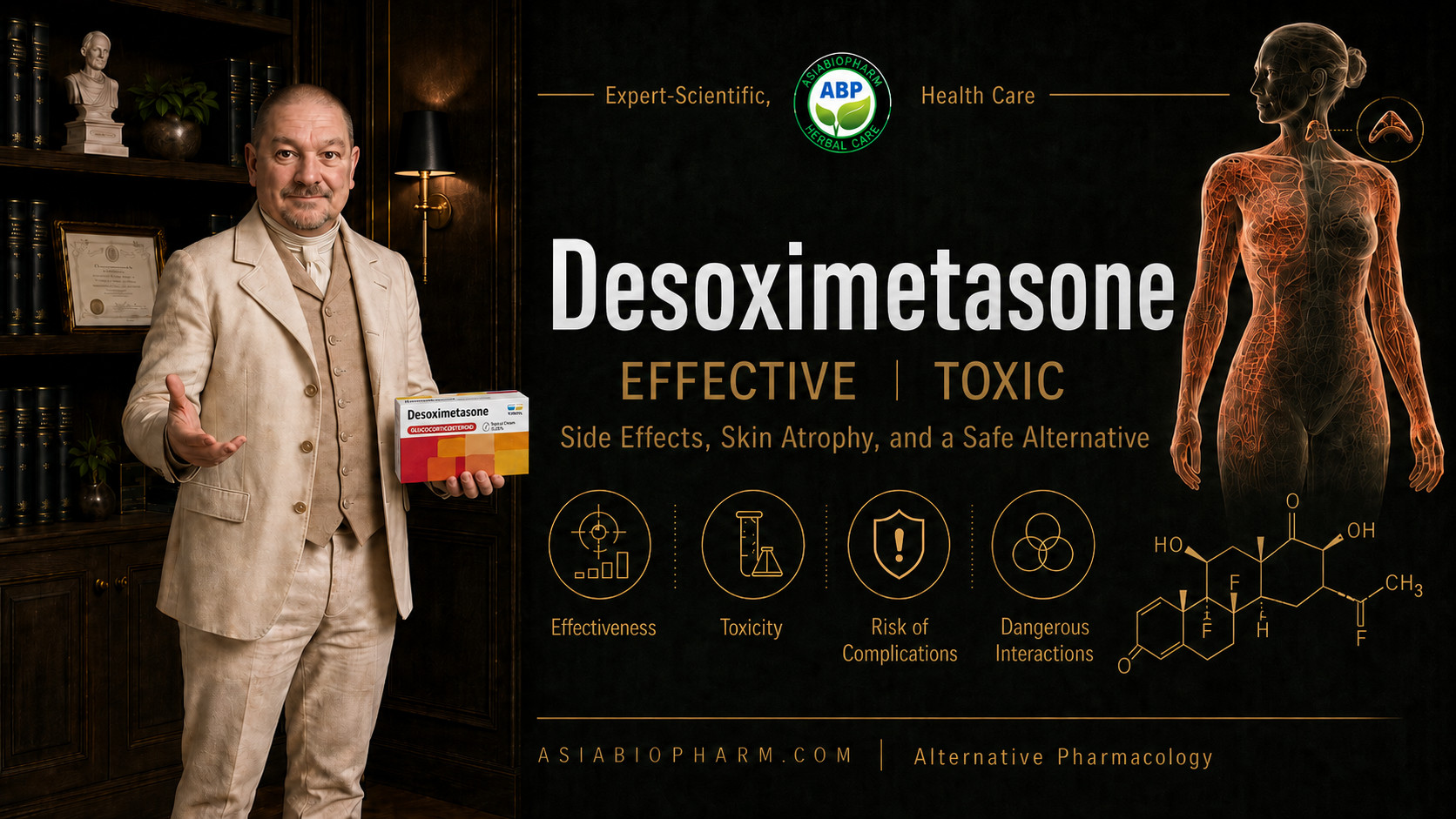
EFFECTIVE | TOXIC
Names Under Which Desoximetasone Is Available
The international nonproprietary name is desoximetasone; the Latin and English spelling is desoximetasone. It is a synthetic fluorinated glucocorticosteroid for topical use. It is available as a cream, ointment, gel, and spray, usually in concentrations of 0.05% and 0.25%. The best-known brand name is Topicort. Products marketed under the name of the active ingredient are also available: Desoximetasone Cream, Desoximetasone Ointment, Desoximetasone Gel, and Desoximetasone Topical Spray. Desoximetasone should not be confused with dexamethasone, betamethasone, mometasone, or other glucocorticosteroids: these are different substances, although some of their side effects overlap. Using several topical hormonal products simultaneously increases the total steroid burden, even when the products have different brand names.
Why Desoximetasone Is Considered Harmless and Where the Real Risk Begins
Because desoximetasone is applied to the skin, many people mistakenly regard it as a local treatment that cannot cause serious consequences. However, the drug suppresses inflammation not only at the affected site: part of the dose may penetrate through the skin and enter the systemic circulation. Absorption increases when it is applied to large areas, damaged or inflamed skin, beneath a dressing, in skin folds, on the face, or during prolonged treatment. A rapid reduction in redness and itching may create a false impression of recovery, even though an infection, contact allergen, or underlying disease may continue to progress.
Repeatedly using leftover ointment for any new rash is particularly dangerous. Desoximetasone may temporarily suppress the manifestations of a fungal, bacterial, or viral infection, alter the appearance of the affected area, and delay diagnosis. The absence of burning after the first applications does not mean that toxicity is absent: skin atrophy and suppression of adrenal function may develop gradually and initially cause almost no noticeable symptoms.
Side Effects During the First Hours and Days of Use
The most common early reactions are burning, tingling, itching, irritation, dryness, and increased redness at the application site. These reactions were reported relatively infrequently in clinical studies of the cream and gel; however, short-term studies do not adequately reflect the consequences of prolonged and uncontrolled use. Inflammation of the hair follicles, folliculopustular lesions, acneiform eruptions, skin maceration, and heat rash may occur.
Clinically significant complications include allergic contact dermatitis, secondary bacterial or fungal infection, worsening rosacea, perioral dermatitis, and spread of an initially localized infectious process. An allergy to a corticosteroid is sometimes mistakenly interpreted as the ointment being “not strong enough,” after which the patient applies it more frequently and only intensifies the reaction.
If the product enters the eyes or is applied very close to the eyelids, there is a risk of ophthalmic complications, especially with repeated use. Desoximetasone is not intended for ophthalmic use.
Side Effects With Prolonged and Repeated Use
The main local complication is steroid-induced skin atrophy. A glucocorticosteroid reduces fibroblast activity and disrupts the production of collagen and components of the extracellular matrix. The skin becomes thin, shiny, dry, and vulnerable, and blood vessels begin to show through it. Telangiectasia, purpura, striae, delayed wound healing, and a tendency for the skin to tear may develop. Some local changes may persist after discontinuation and may be irreversible.
Prolonged use on the face may provoke steroid-induced rosacea, perioral dermatitis, acneiform eruptions, and persistent dilation of blood vessels. In skin folds, the groin, and the armpits, atrophy develops more rapidly because of thin skin, moisture, and natural occlusion. Hypopigmentation, hypertrichosis, and secondary infections may occur.
With substantial systemic absorption, desoximetasone may suppress the hypothalamic-pituitary-adrenal axis. The body reduces its own cortisol production, and transient glucocorticoid insufficiency may therefore occur after intensive therapy is stopped abruptly. Excessive use may cause manifestations of hypercortisolism, including cushingoid changes, hyperglycemia, and glucosuria.
Contraindications and High-Risk Groups
Desoximetasone is contraindicated in patients with confirmed hypersensitivity to the active substance or any component of the dosage form. It must not be applied to the eyes or used as a universal treatment for rashes of undetermined origin.
The risk of complications is particularly high in children: because their body surface area is greater relative to their body weight, they absorb proportionally more of the drug. Suppression of adrenal function, Cushing syndrome, delayed linear growth, slowed weight gain, and intracranial hypertension have been reported in children.
Particular caution is required when applying the drug to the face, eyelids, genitals, groin or axillary folds, or to thinned or damaged skin. The danger increases in extensive psoriasis, when the product is used beneath an occlusive dressing, and when other topical or systemic glucocorticosteroids are used simultaneously.
If a bacterial, fungal, parasitic, or viral infection is suspected, using a steroid without etiotropic therapy may suppress the local immune response and promote the spread of the pathogen. The rapid disappearance of redness in such a situation is not treatment of the infection but pharmacological masking of it.
Dangerous Interactions
A clinically significant interaction occurs primarily when other glucocorticosteroids are used at the same time, including ointments, creams, nasal sprays, inhalers, eye drops, tablets, and injections. The combined exposure increases the likelihood of skin atrophy, suppression of adrenal function, hyperglycemia, and other systemic steroid complications.
Applying desoximetasone together with other potent topical steroids to the same area is strongly discouraged. The prescribing information specifically warns that other topical products containing corticosteroids should not be used without consulting a physician.
Occlusive dressings, tightly adhering patches, diapers, and tight impermeable clothing are not medications, but they increase absorption. They enhance steroid penetration and raise the risk of both local and systemic complications. The treated area should not be covered unless specifically instructed.
Irritating cosmetic products, alcohol-based solutions, acids, retinoids, and aggressive exfoliating products may further damage the skin barrier. This increases burning and may enhance the absorption of desoximetasone through the skin.
No direct pharmacokinetic interaction with alcohol has been established when the drug is applied topically to a limited area. However, alcohol may worsen rosacea, intensify vascular reactions in the skin, and reduce control over the dose and duration of use. Therefore, this combination cannot be considered neutral when the drug is applied to the face or when steroid-induced rosacea has already developed.
Patient Errors
The most common error is using desoximetasone for any itching or redness without an established diagnosis. Similar symptoms may conceal dermatophytosis, candidiasis, scabies, bacterial infection, contact allergy, rosacea, and other conditions in which a steroid may alter the clinical picture and worsen the course of the disease.
The second error is increasing the amount of ointment and the frequency of application when the effect seems insufficient. A thicker layer does not make the action more precise, but it increases exposure and the risk of side effects. Applying the drug to an area much larger than prescribed turns local treatment into a potential source of systemic glucocorticoid exposure.
The third error is applying the product to the face, eyelids, groin, armpits, or beneath a dressing in the same way as it is applied to the hands and trunk. Skin permeability differs in these areas, so the same concentration creates different risks of atrophy.
The fourth error is continuing treatment for weeks after the marked inflammation has disappeared. The patient notices that redness returns without the ointment and interprets this as proof that continuous use is necessary. In reality, the cause may be recurrence of the underlying disease, steroid rebound, perioral dermatitis, rosacea, or an unrecognized infection.
The fifth error is using several “hormonal ointments” with different names at the same time. The patient may not realize that the products belong to the same class and may effectively multiply the total dose.
Overdose and Poisoning
No single acute toxic dose has been established for desoximetasone because the risk depends not only on the amount of the drug but also on its concentration, the area of application, the condition of the skin barrier, the duration of treatment, the patient’s age, and the presence of occlusion. A single accidental application of an excessive layer usually does not cause severe acute poisoning. Chronic overdose is more dangerous and includes regular application to a large area, use beneath a dressing, and combining several corticosteroids.
Early signs of excessive local exposure may include burning, irritation, increased dryness, folliculitis, and changes in pigmentation. Later, thinning of the skin, visible vascular networks, purpura, striae, delayed healing, and secondary infection may develop.
Systemic overdose develops gradually. Possible manifestations include weight gain, a moon-shaped face, muscle weakness, increased blood pressure, swelling, hyperglycemia, and reduced resistance to infections. Suppression of adrenal function may cause no noticeable symptoms until treatment is stopped abruptly or a severe illness develops. After discontinuation, weakness, nausea, low blood pressure, dizziness, and deterioration of the general condition may occur.
There is no specific antidote. If substantial systemic absorption is suspected, the function of the hypothalamic-pituitary-adrenal axis is assessed, including measurement of cortisol levels and, when necessary, an ACTH stimulation test. After prolonged intensive use, discontinuation should take into account the risk of glucocorticoid insufficiency rather than follow the principle that “it is only a topical ointment, so it can be stopped in any way.”
A Safe Integrative Alternative to Desoximetasone
A topical ointment containing dry extracts of Nigella sativa, Scutellaria baicalensis, and Centella asiatica may be used to reduce noninfectious skin inflammation, itching, and irritation. This is not simply a “natural equivalent of a hormonal ointment,” but a combination with anti-inflammatory, antioxidant, and reparative effects that does not cause the steroid-induced skin atrophy or suppression of the hypothalamic-pituitary-adrenal axis characteristic of glucocorticosteroids.
The most convincing clinical component of this combination is Nigella sativa. In a small randomized study involving hand eczema, a topical Nigella sativa ointment reduced disease severity and impairment of quality of life; no statistically significant difference from betamethasone was found in the changes in the main outcome measures. However, this study does not prove that Nigella sativa is equivalent to potent glucocorticosteroids in all forms and severities of dermatitis.
Scutellaria baicalensis strengthens the anti-inflammatory action of the ointment. Experimental studies show reductions in contact and atopic-like skin inflammation, suppression of pro-inflammatory signaling pathways, and protection of keratinocytes against oxidative damage. However, there are still insufficient high-quality clinical studies in humans involving topical Scutellaria baicalensis products. Its role should therefore be regarded as pharmacologically justified but not yet conclusively proven in clinical practice.
Centella asiatica is included not as the main anti-inflammatory component but to support skin repair. Its triterpenes — asiaticoside, madecassoside, asiatic acid, and madecassic acid — are involved in regulating inflammation, fibroblast activity, collagen synthesis, epithelialization, and restoration of the skin barrier. These properties are particularly relevant in cases of dryness, fissures, delayed healing, and skin damage following prolonged use of topical steroids. The evidence is stronger for wound healing and tissue repair than for fully replacing a potent steroid in active severe dermatosis.
Ointment Made From Nigella sativa, Scutellaria baicalensis, and Centella asiatica Extracts
To prepare 100 g of ointment, use 4 g of dry Nigella sativa extract, 4 g of dry Scutellaria baicalensis extract, 3 g of dry Centella asiatica extract, 69 g of coconut oil, 15 g of beeswax, and 5 g of lanolin.
Place the coconut oil, beeswax, and lanolin in a clean, dry, heat-resistant container and heat them in a water bath until the wax has completely melted. The mixture should not be allowed to boil. Separately grind the dry extracts into a uniform fine powder and mix them with a small amount of the warm oil base until a smooth, lump-free paste is obtained. Gradually add the resulting paste to the main mixture while stirring continuously. Once the extracts are evenly distributed, remove the ointment from the water bath, continue stirring as it cools, and transfer it to a clean, tightly sealed container.
Apply a thin layer of the ointment to a limited area of intact skin once or twice daily. Before the first use, apply a small amount to the skin of the forearm and observe the reaction. Increased redness, swelling, burning, blisters, or spreading of the rash requires discontinuation. Do not apply to the eyes, eyelids, mucous membranes, open weeping wounds, or areas showing signs of active infection.
This ointment may be considered as an independent option for mild or moderate noninfectious skin inflammation when rapid and strong suppression of the immune response is not required. In a severe exacerbation of atopic dermatitis, severe contact dermatitis, widespread psoriasis, or sudden deterioration, it cannot guarantee a speed of action comparable to that of desoximetasone. In these situations, the herbal ointment may be used after acute inflammation has been controlled or during maintenance care, but the decision to replace a potent topical steroid should take into account the diagnosis and severity of the disease.
The Real Effectiveness of Desoximetasone
Desoximetasone genuinely reduces inflammation, redness, swelling, and itching in dermatoses that respond to glucocorticosteroids. It can rapidly suppress active inflammation in eczema, contact and atopic dermatitis, certain forms of psoriasis, and other steroid-responsive skin disorders. Its principal strength is its relatively rapid and predictable symptomatic effect.
The drug does not eliminate the allergen, infection, disruption of the skin barrier, occupational exposure to an irritant, or another primary cause of the disease. It suppresses the inflammatory response, so the skin may appear better while the pathological factor continues to act. For this reason, the return of symptoms after discontinuation does not always mean that the patient “constantly needs a hormonal treatment.” It often indicates that the cause of the disease remains present or that the diagnosis was incorrect.
Desoximetasone should not be used to treat unexplained itching, fungal lesions, bacterial infections, rosacea, or perioral dermatitis without appropriate diagnosis. A steroid may reduce redness while simultaneously facilitating the spread of an infectious process.
A common medical error is prescribing a potent topical steroid without specifying the exact application area, amount, treatment duration, and method of discontinuation. Repeatedly renewing the prescription without examining the skin is equally problematic. When an ointment suppresses the same lesion for months without the diagnosis being reassessed, this is no longer disease control but pharmacological masking of the problem.
Safety Monitoring During Treatment
For a short course applied to a small area, laboratory monitoring is generally not required. The condition of the skin should be assessed, including reduction of inflammation and the appearance of burning, dryness, folliculitis, visible vascular networks, shininess and thinning of the skin, purpura, striae, pigmentation changes, or signs of secondary infection.
When the drug is applied to large areas, used for prolonged treatment, applied under occlusion, used in children, or combined with other glucocorticosteroids, systemic absorption must be taken into account. In such situations, the official prescribing information provides for assessment of hypothalamic-pituitary-adrenal axis function. Morning cortisol measurement and an ACTH stimulation test may be used for this purpose.
A rapidly spreading rash, severe swelling, difficulty breathing, swelling of the face or larynx, blisters, skin detachment, purulent lesions, fever, or sudden severe pain in the affected area require immediate discontinuation and medical assessment. These signs may indicate a severe allergic reaction, infection, or another condition that was initially mistaken for ordinary dermatitis.
After intensive or prolonged use, pronounced weakness, dizziness, low blood pressure, nausea, reduced exercise tolerance, hyperglycemia, unusual weight gain, and cushingoid changes are warning signs. Systemic absorption of topical corticosteroids may cause suppression of adrenal function, hyperglycemia, and glucosuria.
Proper Discontinuation of Desoximetasone
After a short course applied to a small area, desoximetasone can usually be discontinued without a special prolonged dose-reduction schedule. However, the absence of a classic withdrawal syndrome does not exclude recurrence of inflammation because the drug suppressed the symptoms but did not necessarily eliminate the cause of the disease.
After prolonged daily use, treatment of large areas, application beneath dressings, or confirmed suppression of adrenal function, abrupt discontinuation is undesirable. The official prescribing information recommends discontinuing the drug, reducing the frequency of application, or switching to a less potent corticosteroid. Hypothalamic-pituitary-adrenal axis function usually recovers after discontinuation, but signs of glucocorticoid insufficiency may occur in rare cases.
In practice, this may mean reducing the frequency of application from daily use to every other day, then to twice weekly, followed by discontinuation. However, there is no universal schedule suitable for every patient. The discontinuation procedure depends on the potency of the drug, the duration of treatment, the application area, the site of application, and the condition of the skin.
If redness, burning, swelling, and itching suddenly intensify after treatment is stopped, the previous amount of ointment should not automatically be resumed. An exacerbation of the underlying disease must be distinguished from rebound inflammation, perioral dermatitis, steroid-induced rosacea, contact allergy, and infection.
A Reasonable Approach to Treatment
Desoximetasone is justified when pronounced noninfectious skin inflammation must be suppressed rapidly and the diagnosis genuinely belongs to the group of steroid-responsive dermatoses. A short course applied to a limited area may produce a faster and more predictable result than a herbal ointment.
For mild or moderate stable inflammation, frequent relapses, dryness, damage to the skin barrier, and the need for prolonged care, preference may be given to an ointment containing Nigella sativa, Scutellaria baicalensis, and Centella asiatica. Its purpose is to reduce inflammatory activity while supporting skin repair without causing steroid-induced atrophy or systemic glucocorticoid exposure.
A rational treatment plan does not require synthetic drugs and herbal remedies to be treated as opposites. During a severe exacerbation, desoximetasone may be used for a limited course, after which maintenance care may be switched to a safer topical combination. In mild disease, the herbal ointment may be used from the outset. If infection is suspected, neither desoximetasone nor an anti-inflammatory herbal ointment should replace identification of the pathogen and etiotropic treatment.
The aim of treatment is not to make the skin temporarily pale and outwardly calm at any cost, but to control inflammation, eliminate provoking factors, restore the skin barrier, and prevent short-term therapy from becoming chronic steroid-induced damage.
If you have questions about the subject of this article, you may ask a clinical pharmacologist in the comments or schedule an appointment using this link.
0 comments