
Desonide — Why This Hormonal Cream Can Be Dangerous and Why It Should Not Be Used Long-Term
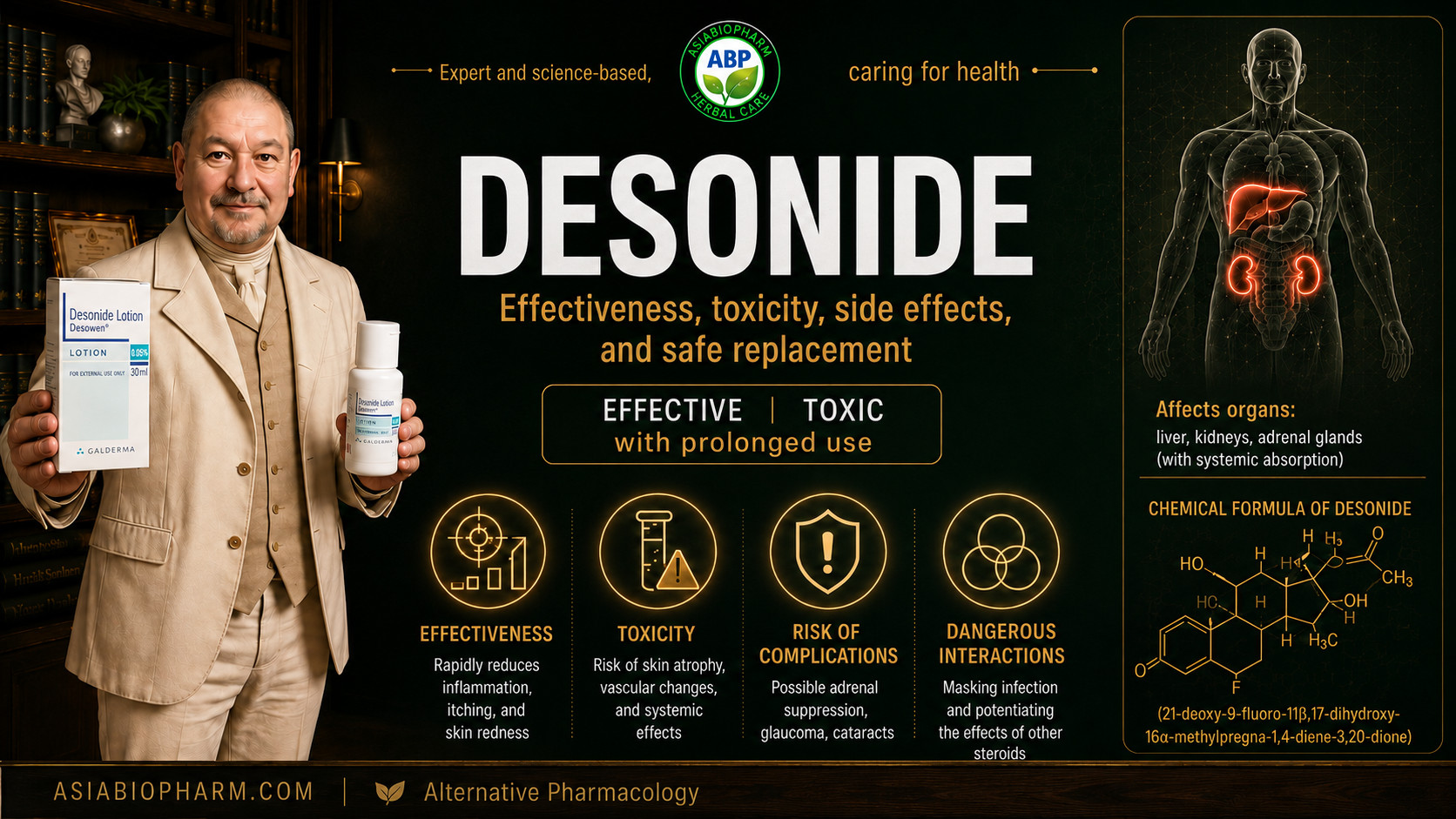
EFFECTIVE | TOXIC WITH PROLONGED, EXTENSIVE, OR OCCLUSIVE USE
Under What Names Is Desonide Available
The international nonproprietary name is desonide; the Latin spelling is desonide. The active ingredient is generally used without formation of a separate medicinal salt, at a concentration of 0.05%. The main topical dosage forms are cream, ointment, lotion, gel, and aerosol foam. In different countries, the drug is available under the trade names DesOwen, Desonate, and Verdeso; numerous generic products labeled Desonide 0.05% are also available. Desonide should not be confused with desoximetasone, which is a different active ingredient and a more potent topical corticosteroid. Standard registered desonide formulations are predominantly single-ingredient products; current U.S. prescribing information does not include widely used fixed combinations containing desonide that are comparable in prevalence to its single-ingredient formulations. However, cumulative corticosteroid exposure may go unnoticed when other hormonal creams, nasal sprays, inhalers, eye drops, or systemic glucocorticosteroids are used at the same time.
Why Desonide Is Considered Harmless and Where the Real Risk Begins
Desonide is considered a “mild” hormonal cream because it is a low-potency topical corticosteroid and rapidly reduces itching, redness, and inflammation. However, low potency does not mean that systemic absorption cannot occur. The risk increases when it is applied to the face, eyelids, skin folds, damaged skin, large areas, under a dressing or diaper, as well as with repeated or prolonged courses. Under these conditions, penetration of the drug increases, and topical treatment can lead not only to thinning of the skin but also to suppression of the hypothalamic-pituitary-adrenal axis. The rapid disappearance of redness can be particularly misleading: the drug suppresses the inflammatory response but does not always eliminate its cause and may mask a fungal, bacterial, or viral infection. Using several corticosteroid products simultaneously increases the total hormonal exposure, even when each is applied or administered by a different route.
Side Effects During the First Hours and Days of Use
Common early reactions include burning, itching, soreness, irritation, redness, dryness, and rash at the application site. Folliculitis, acneiform eruptions, heat rash, pustular rash, and peripheral edema may also occur. Worsening of an unrecognized infection can become a clinically significant complication: reduced redness creates the impression of improvement while microorganisms continue to multiply against the background of a suppressed local immune response. Contact dermatitis may be caused either by desonide itself or by components of the cream or lotion base. Life-threatening reactions are rare, but generalized urticaria, swelling of the face or larynx, and difficulty breathing require immediate discontinuation of the drug and emergency medical care. In controlled studies of the 0.05% cream, the overall incidence of reported adverse reactions was approximately 1%; however, short-term studies poorly reflect the consequences of everyday use for several weeks on the face, in skin folds, or over large areas of skin.
What Happens With Prolonged and Repeated Use
When used for weeks or months, desonide can cause skin atrophy, thinning of the dermis, telangiectasia, striae, increased skin fragility, delayed healing, changes in pigmentation, steroid acne, perioral dermatitis, and rosacea-like inflammation. These complications develop more rapidly on the face because the skin is thinner and the drug penetrates more deeply. Some vascular and atrophic changes resolve slowly, while pronounced striae may persist permanently. Prolonged application around the eyes increases the risk of ophthalmic complications, including increased intraocular pressure, glaucoma, and cataracts, especially when the drug is regularly applied to the eyelids. Systemic absorption may suppress the body's own cortisol production; in children, linear growth retardation, slowed weight gain, and intracranial hypertension have been reported. In a study of children aged six months to six years who received desonide gel twice daily on areas covering at least 35% of the body surface, laboratory evidence of adrenal suppression was detected in one of 37 patients after four weeks of treatment. The absence of skin irritation during the first few days does not rule out the gradual development of atrophy and systemic hormonal effects.
Contraindications and High-Risk Groups
An absolute contraindication is hypersensitivity to desonide or to the excipients of the specific formulation. The drug should not be applied to untreated bacterial, fungal, tuberculous, or viral skin lesions because suppression of the local inflammatory response can facilitate the spread of infection and make it more difficult to recognize. In rosacea and perioral dermatitis, a topical corticosteroid may temporarily reduce redness and then cause a more severe flare. Application to ulcers, open wounds, and areas with a significantly impaired epidermal barrier increases systemic absorption. Particular caution is required in young children: their skin surface area-to-body weight ratio is higher, so the same amount of drug results in greater systemic exposure. A diaper acts as an occlusive dressing and further increases absorption. In patients with pre-existing adrenal suppression, Cushing syndrome, diabetes mellitus, or concurrent treatment with other corticosteroids, the risk of systemic effects is increased. Application to the eyelids is acceptable only when medically justified and for a short course because of the risk of contact with the eyes.
Dangerous Interactions
No clinically significant direct interaction between desonide and food, caffeine, or nicotine has been established because the drug is used topically. Alcohol likewise does not produce a specific pharmacokinetic interaction with desonide, but it may aggravate redness, itching, and flares of certain dermatoses, creating a false impression that the treatment is ineffective. The most important interaction is the cumulative effect with other glucocorticosteroids: prednisolone or dexamethasone tablets and injections, hormonal inhalers, nasal sprays, eye drops, and other topical steroids. Such combinations require assessment of total exposure and, during prolonged treatment, monitoring of adrenal function. Applying several hormonal preparations to the same area at the same time without medical advice is strongly discouraged: this increases the risk of skin atrophy, masking of infection, and systemic absorption. Occlusive dressings, tight clothing, and diapers physically interact with the drug by markedly increasing its penetration. If an infection develops, antimicrobial treatment may be required; simply adding an antibiotic or antifungal agent without reassessing the need for the corticosteroid may mask progression of the disease.
Patient Mistakes
The main mistake is continuing application after the redness has disappeared on the assumption that “the cream is mild, so it cannot do any harm.” Desonide is often used on the face as a universal remedy for any rash, although in acne, rosacea, perioral dermatitis, or infection it may worsen the course of the condition. Increasing the frequency of application or the thickness of the layer, applying the cream to a large area, covering it with plastic film, using it under a diaper, or repeating a course without clarifying the diagnosis is dangerous. A common mistake is for family members to use someone else’s medication for a rash that looks similar. Similar redness may be caused by atopic dermatitis, fungal infection, herpes, scabies, or contact allergy, and the response to a corticosteroid will differ fundamentally in these conditions. The drug should not be applied to the eyelids, mucous membranes, groin, or skin folds simply because it was well tolerated on the hands. Another mistake is using desonide cream together with another hormonal drug sold under a different trade name without taking the cumulative effect into account. For 0.05% cream and ointment, official prescribing information limits self-directed treatment to two weeks unless a physician has prescribed a different regimen.
Overdose and Systemic Toxicity
A precise single toxic dose of desonide in grams has not been established because the severity of overdose depends not only on the amount of cream, but also on the area of application, duration of treatment, condition of the skin barrier, patient age, and the presence of occlusion. A single excessive application usually does not cause immediate classic poisoning. Hidden chronic overdose is more dangerous: daily use over large areas, application under a dressing or diaper, treatment of inflamed and damaged skin, or simultaneous use of several corticosteroids. Over days and weeks, facial swelling, weight gain, increased blood glucose, weakness, changes in blood pressure, and signs of hypercortisolism may appear. If adrenal suppression is pronounced, abrupt withdrawal can lead to cortisol deficiency, with weakness, nausea, low blood pressure, dizziness, and, in severe cases, adrenal crisis. There is no specific antidote. If suppression of the hypothalamic-pituitary-adrenal axis is confirmed, the drug is discontinued, the frequency of application is reduced, or it is replaced with a less potent agent; adrenal function usually recovers after exposure is stopped, although systemic replacement therapy is sometimes required. If a child accidentally swallows the contents of the package, or develops lethargy, vomiting, impaired consciousness, or marked weakness, immediate toxicological evaluation is required rather than observation at home.
A Safe Integrative Alternative to Desonide
For mild or moderate localized inflammation of non-infected skin, an alternative to repeated courses of desonide may be ABP-153 combined with an individually prepared ointment containing dry extracts of Nigella sativa and Scutellaria baicalensis. A working formula for 100 g is: dry Nigella sativa extract — 5 g, dry Scutellaria baicalensis extract — 5 g, coconut oil — 70 g, beeswax — 15 g, lanolin — 5 g. Melt the coconut oil and wax in a water bath at 55–60 °C and add the lanolin; first triturate the extracts with a small amount of the warm base, then gradually incorporate them into the main mixture, stir until uniform, cool to approximately 40 °C, and transfer into sterile dark-glass jars. The final extract concentration is 10% — 5% of each. The ointment is applied in a thin layer 1–2 times daily to a limited area of non-infected skin after a preliminary patch test. Nigella sativa has a limited but clinically meaningful evidence base: in a small randomized study of hand eczema, a topical Nigella preparation reduced disease severity, while a systematic review confirmed the existence of clinical studies in several dermatological conditions. Scutellaria baicalensis has been shown to suppress experimental contact and atopic-like dermatitis, although these findings are predominantly preclinical; the plant extract itself can also cause allergic contact dermatitis. For dryness, skin thinning, residual inflammation, and the need to restore the skin barrier after a steroid course, a second option may be used: Nigella sativa — 4 g, Scutellaria baicalensis — 4 g, Centella asiatica — 2 g, coconut oil — 70 g, beeswax — 15 g, lanolin — 5 g. It is specifically the 4 + 4 + 2 g ratio that provides 10% total extracts; the original 4 + 4 + 3 g formula actually contains 11%. Centella triterpenes support tissue repair, fibroblast activity, and collagen synthesis, but this does not make the ointment suitable for deep wounds or active infectious lesions. Both formulations are contraindicated for the eyelids, mucous membranes, purulent lesions, open wounds, deep erosions, active herpes, and untreated fungal infection. In severe widespread dermatitis, pronounced oozing, edema, severe itching, or rapidly progressing disease, desonide may act faster and more predictably, so immediately replacing it with a herbal product without establishing the diagnosis is not justified. Boswellia serrata and Curcuma longa may be considered as oral anti-inflammatory support, but they are not proven oral equivalents of desonide: evidence in dermatitis is limited, and a substantial proportion of studies on boswellic acids and curcuminoids concern other inflammatory diseases or experimental models.
Real Effectiveness of Desonide and Errors in Medical Prescribing
Desonide is genuinely effective in mild to moderate corticosteroid-responsive inflammatory dermatoses: atopic dermatitis, certain forms of contact dermatitis, dry eczema, and other conditions in which itching, erythema, edema, and inflammatory infiltration need to be reduced quickly. Improvement may begin within the first few days, but the drug suppresses the inflammatory response rather than eliminating the allergen, irritant, infection, impaired skin barrier, or another primary cause of the disease. Therefore, disappearance of redness after several applications does not prove that the disease has been cured. In fungal infection, desonide can create a particularly convincing appearance of “effectiveness”: inflammation visibly decreases while the pathogen continues to spread. Prescribing it without examination and differential diagnosis turns its anti-inflammatory action into a means of masking disease. Common prescribing errors include using desonide for an undiagnosed rash, failing to check for mycosis or bacterial infection, unjustified use on the face and eyelids, automatic extension of the treatment course, failure to specify the application area and amount of drug, and ignoring other corticosteroids the patient is receiving. It is unacceptable to leave a patient with the recommendation to “apply during a flare” without setting a duration limit and criteria for reassessment: this is not a treatment strategy but an indefinite permission to suppress symptoms. If there is no improvement, the diagnosis and therapy should be reconsidered rather than increasing the thickness of the cream layer or extending the treatment course.
Safety Monitoring During Treatment
When desonide is applied for a short period to a small area of intact skin, laboratory monitoring is usually not required. The reduction in inflammation, development of burning, increased itching, pustules, oozing, tenderness, spread of the lesion, changes in skin color, and skin thinning should be assessed daily. Lack of clear improvement within the prescribed course, rapid return of symptoms after discontinuation, or the need to restart the cream repeatedly requires clarification of the diagnosis. When large areas are treated, the drug is used under occlusion, treatment is prolonged, it is used in a young child, or other corticosteroids are being taken at the same time, the possibility of hypothalamic-pituitary-adrenal axis suppression should be considered. Morning cortisol measurement and an ACTH stimulation test may be required for assessment. Official prescribing information recommends discontinuing the drug, reducing the frequency of application, or switching to a less potent corticosteroid if adrenal suppression is confirmed; recovery usually occurs after exposure is stopped, although glucocorticoid insufficiency requiring systemic treatment may occasionally develop. Immediate discontinuation and urgent medical evaluation are required in cases of swelling of the face or larynx, difficulty breathing, generalized urticaria, sudden deterioration of vision, eye pain, pronounced muscle weakness, fainting, persistent vomiting, low blood pressure, or impaired consciousness. Pus, increasing tenderness, fever, rapidly spreading redness, and blister formation may indicate an infection that the corticosteroid is masking and aggravating. Continuing to apply desonide in the hope that “the inflammation will go away on its own” is dangerous in such a situation.
Proper Discontinuation of Desonide and Consequences of Stopping Treatment
After a short course on a limited area, desonide can usually be discontinued without a special stepwise tapering regimen. However, the absence of classic drug dependence does not mean that rebound inflammation cannot occur. After prolonged, frequent, or repeated use, especially on the face, abrupt discontinuation may be accompanied by recurrence of erythema, burning, itching, and a more pronounced inflammatory reaction. In some patients, prolonged use of topical corticosteroids has been associated with a withdrawal syndrome characterized by diffuse redness, burning pain, scaling, and spread of lesions beyond the original area, although its frequency and diagnostic criteria remain a matter of debate. If steroid rosacea or perioral dermatitis has developed, temporary worsening after discontinuation is not a reason to restart the drug immediately. If desonide has been used for a long time, over a large area, under occlusion, or together with other hormonal products, discontinuation should be individualized: reduce the frequency of application, limit the treated area, transition to non-hormonal topical therapy, and monitor for signs of cortisol deficiency. If adrenal suppression has been confirmed by laboratory testing, abrupt self-discontinuation is not acceptable. During the recovery period, topical ABP-153 and an ointment containing Nigella sativa, Scutellaria baicalensis, and Centella asiatica may be used if the skin is not infected and the components are well tolerated. Rehmannia glutinosa, Schisandra chinensis, Astragalus propinquus, and Silybum marianum may be considered only as supportive measures with due regard to contraindications and drug interactions. These plants are not proven replacement therapy for adrenal suppression and do not replace cortisol testing, an ACTH stimulation test, or systemic glucocorticosteroid treatment when adrenal insufficiency is present.
A Rational Approach to Treatment
Desonide is justified when it is necessary to rapidly and predictably suppress localized corticosteroid-responsive skin inflammation and the diagnosis has been established. Its advantage is its relatively low potency among topical glucocorticosteroids, but low potency does not eliminate the risks of skin atrophy, masking of infection, ophthalmic complications, or systemic absorption when the drug is used incorrectly. For a short, controlled course, desonide may be more rational than a slower-acting alternative; for uncontrolled use lasting several weeks, it does not become rational. In mild, stable, non-infected dermatitis, it may be possible to switch to ABP-153 or to a 10% ointment containing extracts of Nigella sativa and Scutellaria baicalensis. After active inflammation has been suppressed, a restorative formulation containing Centella asiatica may be used to support the skin barrier and tissue repair. In chronic recurrent disease, oral Boswellia serrata and Curcuma longa may be considered as adjunctive anti-inflammatory therapy, but not as an automatic substitute for a topical corticosteroid. The goal of an integrative approach is not to reject an effective treatment when it is needed, but to shorten the duration of hormonal exposure, prevent repeated courses without diagnosis, and restore the skin barrier without accumulating steroid-related complications.
If you have questions about the topic of this article, you can ask a clinical pharmacologist in the comments or make an appointment using this link.
0 comments