
Clotrimazole — Side Effects, Contraindications, and Why It May Not Work for Thrush
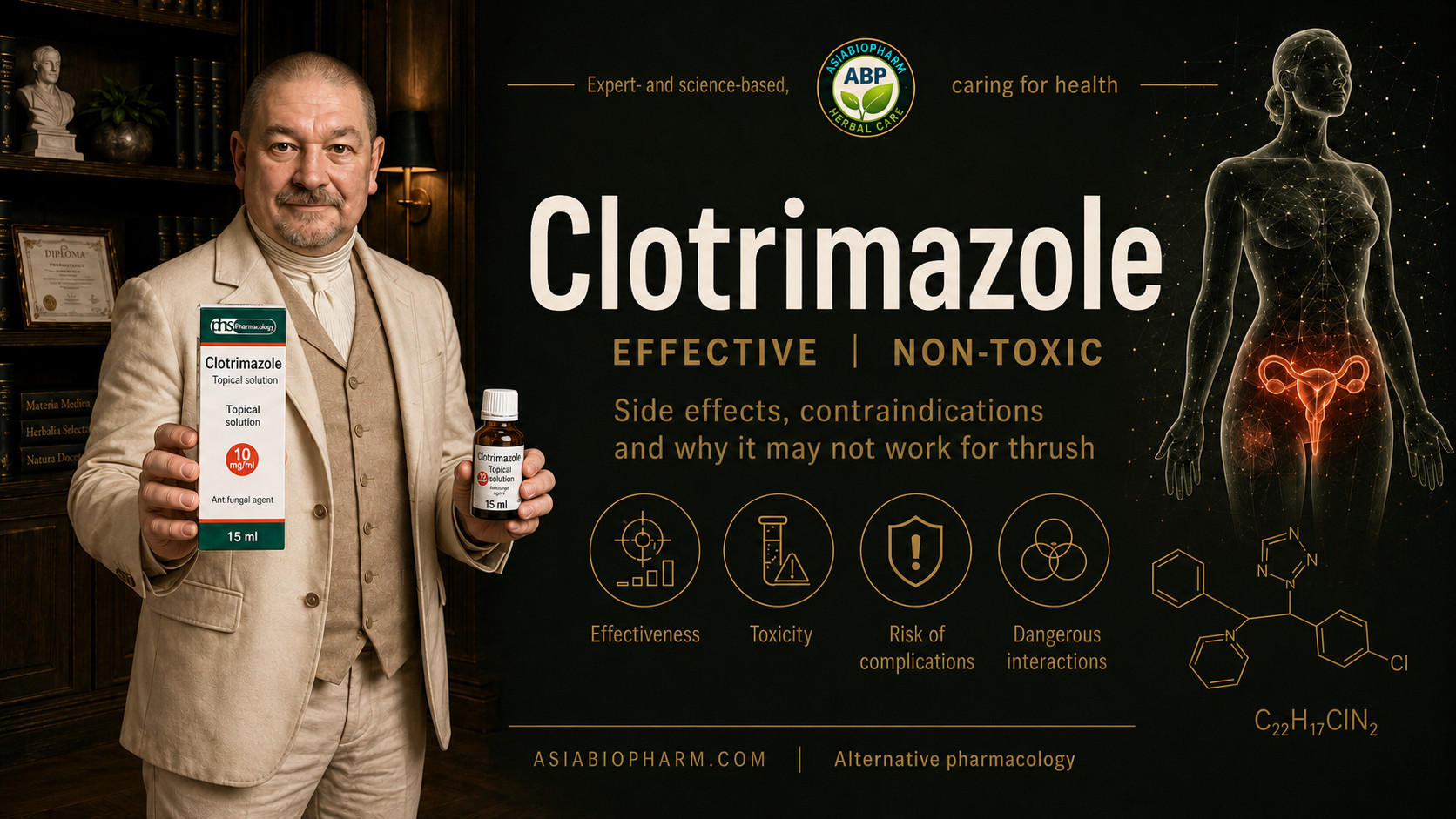
EFFECTIVE | NON-TOXIC
Names under which clotrimazole is available: The International Nonproprietary Name is clotrimazole; the Latin spelling is clotrimazole. The active ingredient is used predominantly in its non-salt form. The main dosage forms are cream, ointment, solution, spray, and powder for topical use, vaginal cream, vaginal tablets and suppositories, and lozenges for the treatment of oral candidiasis. In pharmacies, the drug is available under the names Clotrimazole, Canesten, Candide, Candide-B6, Lotrimin AF, and Mycelex. Combination products may contain clotrimazole together with betamethasone, hydrocortisone, gentamicin, or other components. These products include Candid B, Triderm, Akriderm GK, Candiderm, and a number of regional equivalents. They should not be considered ordinary clotrimazole products: the glucocorticosteroid component can cause skin atrophy, mask infection, promote secondary infection, and, when used for prolonged periods or over large areas, suppress adrenal function.
Why clotrimazole is considered harmless and where the real risk begins: The main danger of self-treatment with clotrimazole is not severe systemic toxicity but treatment without a confirmed diagnosis. Itching, burning, and discharge are often automatically assumed to be thrush, although similar symptoms occur with bacterial vaginosis, trichomoniasis, contact dermatitis, genital herpes, cervical inflammation, and other conditions. As a result, clotrimazole either has no effect or temporarily reduces some symptoms while delaying the correct diagnosis. Repeated self-treatment is particularly risky when symptoms return soon after a course of therapy: this may indicate an incorrect diagnosis, complicated candidiasis, Candida non-albicans infection, diabetes mellitus, or immunodeficiency. The CDC recommends clinical evaluation if symptoms persist after over-the-counter treatment or recur within less than two months.
Side effects after starting treatment: Common reactions to topical clotrimazole include burning, stinging, itching, redness, and skin irritation. Clinically significant reactions include swelling, peeling, blistering, oozing, urticaria, and contact dermatitis. Vaginal use may temporarily increase burning, itching, and irritation and may also cause soreness and swelling of the mucosa. These reactions can occur after the first application or increase over several days. Life-threatening anaphylaxis is rare, but swelling of the tongue or throat, difficulty breathing, generalized urticaria, sudden severe weakness, and impaired consciousness require emergency medical care.
Side effects with prolonged and repeated use: Topical clotrimazole does not cause drug dependence, withdrawal syndrome, or the typical cumulative toxicity affecting the liver, kidneys, or heart. However, repeated courses without proper diagnosis can perpetuate chronic irritation, contact dermatitis, mucosal soreness, and disruption of the skin barrier. The absence of marked early reactions does not mean that treatment is appropriate: the drug may be applied for months to a condition that is not fungal in origin. Repeated exposure to azole antifungals also creates selective pressure and may contribute to reduced fungal susceptibility, particularly in recurrent candidiasis and Candida non-albicans infections. When clotrimazole lozenges are used for oral candidiasis, systemic reactions and elevated liver enzyme activity may occur, so their toxicological profile cannot be considered identical to that of a topical cream.
Contraindications and higher-risk groups: An absolute contraindication is hypersensitivity to clotrimazole or to the excipients of the specific formulation. A topical solution must not be inserted into the vagina, applied to the eyes, or used to treat the oral cavity. Self-treatment is particularly inadvisable during a first episode of severe vaginal itching, in the presence of foul-smelling discharge, fever, chills, nausea, or pain in the lower abdomen, back, or shoulder. These symptoms may indicate a condition unrelated to uncomplicated candidiasis. Medical evaluation is necessary during pregnancy, with frequent recurrences, diabetes mellitus, HIV infection, other forms of immunosuppression, and after repeated courses of antibiotics.
Dangerous interactions: Systemic drug interactions with topical and vaginal clotrimazole are limited because absorption is low. Its interaction with latex condoms and diaphragms is clinically significant: the oily base of some vaginal formulations can damage latex and reduce the reliability of barrier contraception. During treatment, tampons, douching, spermicides, and other vaginal products should not be used simultaneously unless specifically indicated, because they can increase irritation and make treatment response more difficult to assess. Alcohol does not cause a characteristic toxic reaction with topical clotrimazole, but it must not be used to treat mucous membranes. Uncontrolled combination of clotrimazole with potent topical glucocorticosteroids is strongly discouraged: a steroid quickly reduces itching and redness but can mask infection and, with prolonged use, cause skin atrophy, secondary infection, and systemic hormonal effects.
Patient errors: The most common mistake is to regard any white discharge, itching, or burning as proof of candidiasis. Another mistake is using a topical solution or cream intravaginally, increasing the amount of medication when a rapid effect is not achieved, shortening the intervals between applications, using several azole products at the same time, or stopping treatment immediately after symptoms improve. If only the skin of the vulva is affected, a topical cream may be sufficient, but in vaginal candidiasis it does not replace an appropriate intravaginal formulation. Repeatedly using short courses without microscopy and culture is equally risky. Over-the-counter availability creates a false sense of safety, but another package of clotrimazole is not a substitute for diagnosis.
Overdose and poisoning: A toxic single dose of topical clotrimazole has not been established because clinically significant systemic poisoning is unlikely with normal topical use. Excessive application does not improve efficacy but increases the likelihood of burning, swelling, skin erosion, contact dermatitis, and pain. Accidental ingestion may cause nausea, vomiting, abdominal pain, and diarrhea. There is no specific antidote; treatment is symptomatic. Vomiting should not be induced, and gastric lavage should not be performed without medical supervision. Special assessment is required if a combination product has been swallowed, because its toxicity may be determined by the glucocorticosteroid, antibiotic, or another component rather than by clotrimazole alone.
Safe integrative alternative: There is no single plant-based substitute suitable for every form of candidiasis. An alternative should be selected according to the site of infection, the condition of the mucosa, the severity of inflammation, and the suspected pathogen.
For mild, laboratory-confirmed vulvovaginal candidiasis, Mouth Gel KLO for mucous membranes may be considered. Its mucoadhesive formulation prolongs contact with the mucosa, while the plant-based components provide a combination of antifungal, anti-inflammatory, astringent, and reparative effects. According to the manufacturer’s description, the product is used for candidiasis of mucous membranes, including vaginal candidiasis. Complete substitution is most appropriate in mild, stable cases; during pregnancy, severe inflammation, immunodeficiency, and frequent recurrences, the decision should be made after medical evaluation.
In recurrent candidiasis of the skin and mucous membranes, Azadirachta indica may be included as part of a comprehensive approach. Its pharmacological potential is associated with limonoids, flavonoids, and other compounds with antifungal and anti-inflammatory activity. Azadirachta should be regarded as an additional component rather than an automatic substitute for a topical antifungal. The risk of individual intolerance, gastrointestinal reactions, effects on glycemia, and restrictions during pregnancy must be taken into account.
For candidiasis of the skin, groin and interdigital folds, intertrigo, and dermatomycoses accompanied by maceration, Antifungal Spray is used. It contains Zingiber cassumunar, Citrus hystrix, Cuscuta reflexa, and a mineral component derived from cuttlefish shell. The combination provides antifungal, anti-inflammatory, drying, and reparative effects. The product is intended primarily for the skin; its essential-oil components may irritate sensitive mucous membranes.
For dense, chronic, and infiltrated fungal skin lesions, ABP-153-D may be used. Dimethyl sulfoxide enhances penetration of the active components through the skin, making the product suitable for deeper skin lesions. At the same time, it is not intended for uncontrolled application into the vagina, mouth, nose, pharynx, or external auditory canal.
For onychomycosis, a specialized Nail Fungus Treatment is used. It contains not only plant-based components but also ketoconazole, miconazole, and nitric acid, so it is not a completely plant-based substitute for clotrimazole. The product is intended for the nail plate and nail bed and should not be applied to mucous membranes.
For oral candidiasis, Mouth Gel KLO for mucous membranes and Thai FD Oral Powder may be used. The gel is suitable for widespread mucosal involvement, glossitis, and candidal lesions, while the powder is intended for localized erosions, ulcerative defects, angular lesions, and damaged areas of the mucosa.
For candidal and mixed fungal-bacterial infections of the nose, nasopharynx, pharynx, and external ear, ABP-153 is used. The product is administered intranasally, used to lubricate the pharyngeal mucosa, and applied to the external auditory canal. It may be considered for fungal rhinitis, nasopharyngeal candidiasis, fungal pharyngitis, otomycosis, candidiasis of the external auditory canal, and mixed infections of the ENT region. Before use in the ear, perforation of the tympanic membrane and middle-ear involvement must be excluded. In invasive fungal sinusitis, facial swelling, visual impairment, high fever, or neurological symptoms, local therapy does not replace specialized treatment.
Actual effectiveness of clotrimazole and medical errors: Clotrimazole is effective in uncomplicated vulvovaginal candidiasis, cutaneous candidiasis, athlete’s foot, tinea cruris, dermatophytosis of glabrous skin, and certain forms of oral candidiasis. It disrupts ergosterol synthesis and damages the membranes of susceptible fungi. In confirmed uncomplicated vaginal candidiasis, topical azoles produce symptom relief and negative culture results in approximately 80–90% of patients who complete the full course of treatment.
Clotrimazole does not treat bacterial vaginosis, trichomoniasis, gonorrhea, chlamydia, herpes, contact dermatitis, or pelvic inflammatory diseases. It also does not eliminate the causes of recurrent candidiasis: diabetes mellitus, immunodeficiency, repeated courses of antibiotics, hormonal factors, and chronic mucosal damage. In trichomoniasis, topical clotrimazole has low efficacy and is not recommended.
If the drug does not work, possible explanations include an incorrect diagnosis, an unsuitable dosage form, premature discontinuation of treatment, irregular use, Candida glabrata, another non-albicans species, or reduced susceptibility to azoles. Typical medical errors include prescribing treatment based only on symptoms, failing to perform microscopy in recurrent cases, repeatedly using short courses without culture testing, and using glucocorticosteroid combinations without appropriate indications.
Safety monitoring during treatment: During a short course of topical or vaginal clotrimazole, routine laboratory monitoring of liver, kidney, and blood parameters is generally not required. Local reactions should be monitored: increasing burning, marked erythema, swelling, blisters, oozing, erosions, urticaria, or spreading rash require discontinuation of the drug.
If there is no improvement with vaginal use, if symptoms persist after completing the course, or if they quickly recur, repeat diagnostic evaluation is necessary. Foul odor, purulent or bloody discharge, fever, chills, vomiting, or pain in the lower abdomen, back, or shoulder are not typical of ordinary candidiasis and may indicate another condition. Waiting and repeating self-treatment can lead to progression of inflammation and delay necessary therapy.
Emergency medical care is required in cases of difficulty breathing, swelling of the face, lips, tongue, or throat, generalized urticaria, severe weakness, or impaired consciousness. With combination products containing betamethasone, additional monitoring is needed for skin thinning, striae, secondary infection, hyperglycemia, and signs of adrenal suppression.
Proper discontinuation of clotrimazole: Clotrimazole does not cause drug dependence and does not require gradual dose reduction. In the event of an allergic reaction, severe irritation, or suspected incorrect diagnosis, it should be discontinued immediately. However, treatment should not be stopped simply because itching decreases after the first few applications: premature discontinuation increases the risk that the infection will persist and symptoms will quickly return.
A missed dose should not be compensated for by using twice the amount of the drug. Recurrence of symptoms after a completed course requires repeat evaluation, identification of the Candida species, and, if necessary, susceptibility testing for antifungal agents. Combinations with potent topical glucocorticosteroids require a separate approach: after prolonged use, rebound inflammation and signs of a previously masked infection may occur.
A rational approach to treatment: Clotrimazole is appropriate when a susceptible superficial fungal infection has been confirmed and a rapid, predictable topical antifungal effect is required. Its systemic toxicity with topical and vaginal use is low, but self-treatment without diagnosis, repeated courses, and an inappropriate dosage form can make therapy ineffective or irritating.
In mild and stable cases, an integrative alternative can be selected according to the site involved: Mouth Gel KLO for mucous membranes, Antifungal Spray for the skin and skin folds, ABP-153-D for deeper skin lesions, Nail Fungus Treatment for onychomycosis, ABP-153 for the nasal cavity, pharynx, and external ear, and Azadirachta indica as an additional component in recurrent candidiasis.
In severe vulvovaginitis, pregnancy, immunodeficiency, decompensated diabetes mellitus, esophageal involvement, invasive fungal infection, severe pain, high fever, or widespread inflammation, integrative products should not delay necessary antifungal therapy. The goal of a rational approach is not to reject an effective medication, but to avoid blind treatment, unnecessary repeated courses, and unjustified steroid combinations.
If you have questions about the topic of this article, you can ask a clinical pharmacologist in the comments or schedule an appointment.
0 comments