
Budesonide — Why It Is Dangerous, Side Effects and Adrenal Suppression
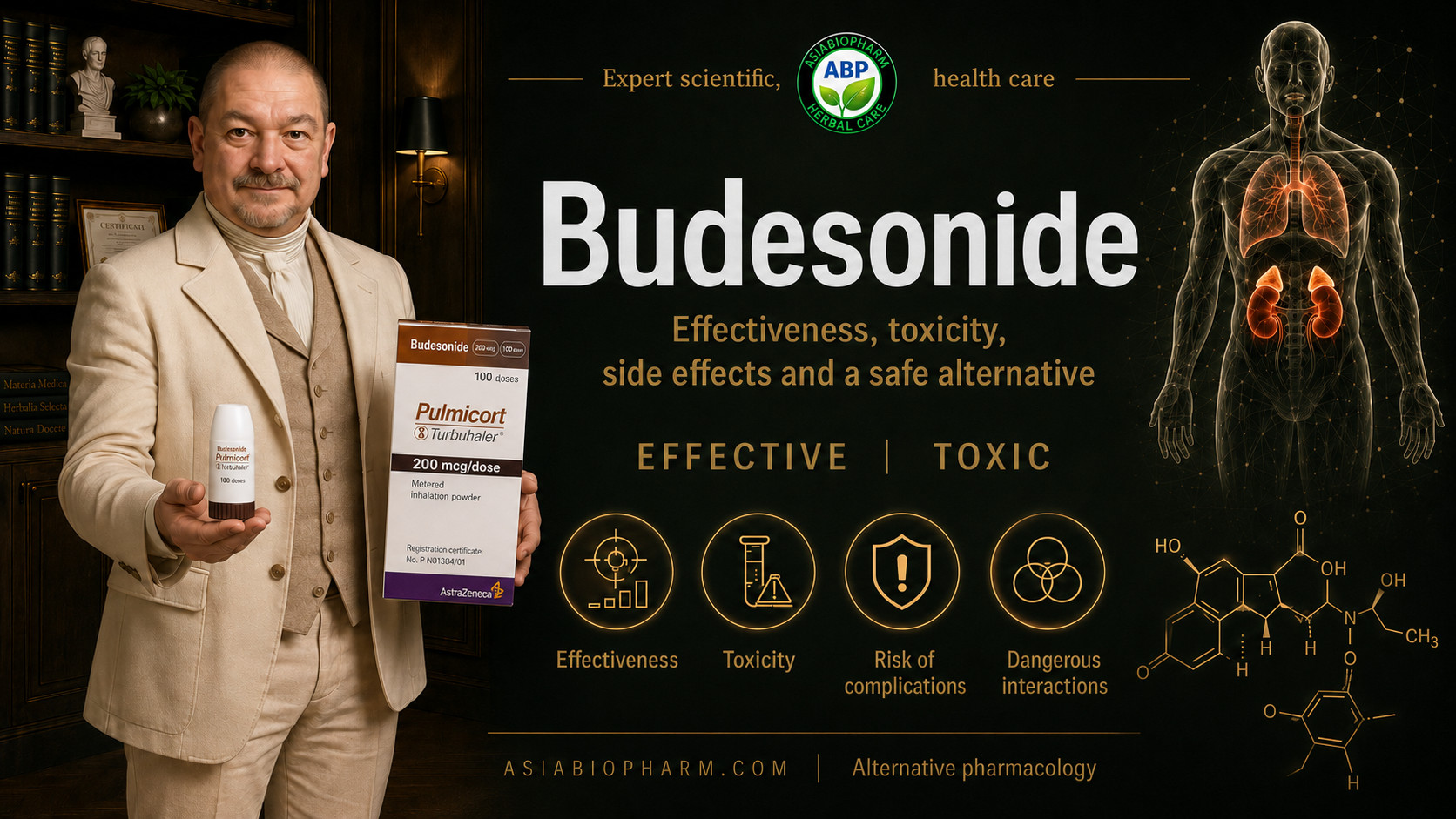
EFFECTIVE | TOXIC
Names Under Which Budesonide Is Available
The international nonproprietary name is budesonide; in Russian, it is known as будесонид. The variants Budesonid and Budesonida are also found in documents and prescribing information. The drug is available as an inhalation powder and aerosol, a nebuliser suspension, a nasal spray, enteric-coated capsules, prolonged-release or modified-release tablets, rectal foam and suspension, as well as a viscous oral suspension for the treatment of eosinophilic oesophagitis. Common brand names include Pulmicort, Budenit Steri-Neb, Benacort, Tafen Nasal, Rhinocort, Entocort, Budenofalk, Cortiment, Uceris, Ortikos, Tarpeyo, Jorveza and Eohilia. Combination products contain budesonide together with formoterol — Symbicort, DuoResp Spiromax, Bufomix Easyhaler, Brainacord and their equivalents; with glycopyrronium and formoterol — Breztri Aerosphere and Trixeo Aerosphere; with albuterol — Airsupra. Using several such products at the same time may cause the total glucocorticosteroid dose to increase unnoticed.
Why Budesonide Is Considered Harmless and Where the Real Risk Begins
Budesonide is often perceived as a “local hormone” that acts only in the bronchi, nose or intestines and barely enters the bloodstream. This is a dangerous oversimplification. Part of an inhaled dose is absorbed through the lungs, while another part is swallowed; oral and rectal formulations also produce systemic exposure. At high doses, during prolonged treatment, in impaired liver function or when CYP3A4 is inhibited, the drug concentration may rise enough to cause the typical systemic effects of glucocorticosteroids: hypercortisolism, suppression of the hypothalamic-pituitary-adrenal axis, reduced bone density, growth retardation, ophthalmic complications and increased susceptibility to infections. Even official prescribing information emphasises that the lower systemic activity of budesonide compared with prednisolone does not mean that systemic toxicity is absent.
Side Effects During the First Hours and Days of Treatment
After inhalation, the most common effects are throat irritation, dryness of the mucous membranes, cough, hoarseness and dysphonia. Deposition of the drug in the oropharynx suppresses local immunity and creates conditions for oral and pharyngeal candidiasis. Paradoxical bronchospasm may occur — a sudden worsening of wheezing and shortness of breath immediately after inhalation; in this situation, repeating the dose is dangerous. Nasal budesonide may cause dryness, burning, crusting and nosebleeds, and less commonly ulceration of the mucosa or damage to the nasal septum. Oral formulations may be accompanied by nausea, abdominal pain, dyspepsia, headache, oedema, mood changes and sleep disturbances. Oral formulations that are swallowed for eosinophilic oesophagitis are particularly associated with candidiasis of the mouth and oesophagus. Life-threatening reactions are rare but include angioedema, anaphylaxis, severe bronchospasm and developing adrenal insufficiency.
What Happens With Long-Term and Repeated Use
During prolonged treatment, toxicity is determined not only by the nominal dose, but also by the delivery method, inhalation technique, the total exposure from different budesonide formulations and drug interactions. Gradual suppression of cortisol secretion may remain without specific symptoms for a long time. Pathological fatigue, muscle weakness, reduced appetite, nausea, weight loss, orthostatic hypotension and poor tolerance of infections, injuries or surgery may then develop. Severe cortisol deficiency may cause an Addisonian crisis with vomiting, dehydration, hypoglycaemia, marked hypotension, impaired consciousness and circulatory collapse. Cushingoid changes, elevated glucose levels, thinning of the skin, easy bruising, reduced bone mineral density, cataracts, glaucoma and slowed linear growth in children have also been described. After the drug is discontinued, recovery of adrenal function may take months, while loss of bone mass or ophthalmic changes are not always completely reversible.
Contraindications and High-Risk Groups
Budesonide is contraindicated in patients with hypersensitivity to the active substance or to components of the particular dosage form. Inhaled formulations are not intended for the immediate relief of a severe attack of breathlessness, status asthmaticus or rapidly worsening respiratory failure. Patients who have recently received systemic glucocorticosteroids require particular monitoring: switching to an inhaled drug may reveal pre-existing adrenal suppression and trigger a crisis. The risk of systemic toxicity is higher in liver disease because the metabolic clearance of budesonide is reduced; it is also higher in osteoporosis, glaucoma, cataracts, diabetes mellitus, severe infections, tuberculosis and recurrent fungal infections. In children, dose-dependent growth retardation must be taken into account. The immunosuppressive effect may worsen untreated infections and mask their signs. In Crohn’s disease, systemic exposure and cortisol suppression may be greater in children than in adults.
Dangerous Drug Interactions
Budesonide is metabolised mainly by the CYP3A4 isoenzyme. Strong inhibitors of this enzyme can increase its concentration many times over and effectively turn local treatment into systemic steroid therapy. Combinations with ketoconazole, itraconazole, posaconazole, voriconazole, clarithromycin, certain HIV protease inhibitors and cobicistat-containing medicines are highly undesirable. For oral budesonide, ketoconazole increased systemic exposure by approximately eightfold, while grapefruit juice increased it by approximately twofold. Cases of iatrogenic Cushing’s syndrome and secondary adrenal insufficiency have been described when inhaled budesonide was combined with itraconazole. CYP3A4 inducers — rifampicin, carbamazepine, phenytoin, phenobarbital and St John’s wort — may, conversely, reduce the concentration and effectiveness of the drug. Simultaneous use of other inhaled, nasal, topical or systemic glucocorticosteroids increases the total hormonal burden. Alcohol does not cause a specific acute interaction with inhaled budesonide, but during oral therapy and in gastrointestinal disorders it may aggravate mucosal irritation and make adverse reactions more difficult to assess.
Patient Errors That Increase the Risk of Complications
The most common mistake is independently increasing the number of inhalations when shortness of breath occurs, even though budesonide is not a rapid-acting bronchodilator. Equally dangerous are using several budesonide-containing medicines under different brand names, using inhaled and nasal formulations at the same time without calculating the total dose, continuing treatment for a long time without reassessing the minimum effective dose, and stopping the drug abruptly after a prolonged course. Failure to rinse the mouth and incorrect inhalation technique increase deposition of the drug in the oropharynx and the risk of candidiasis without ensuring adequate delivery to the bronchi. Patients often ignore weakness, nausea, low blood pressure and weight loss, assuming that they are consequences of infection or overwork, although these may be signs of cortisol deficiency. A separate problem is combining budesonide with azole antifungal drugs without checking for interactions.
Budesonide Overdose and Poisoning
For inhaled budesonide, a single toxic dose has not been established, and acute overdose usually does not cause immediate severe poisoning. This creates a false sense of safety. The main danger is repeated dose excess over days and weeks, during which hypercortisolism and adrenal suppression gradually develop. Oedema, increased blood pressure and glucose levels, muscle weakness, psychiatric disturbances and Cushingoid changes may occur, followed by secondary adrenal insufficiency after abrupt discontinuation. Acute toxicity from oral formulations is also usually limited, but chronic dose excess, severe hepatic impairment or concomitant use of CYP3A4 inhibitors can sharply increase systemic exposure. There is no specific antidote. If a clinically significant overdose is suspected, the patient’s clinical condition, morning cortisol level, electrolytes and glucose are assessed, and an adrenocorticotropic hormone stimulation test is performed if necessary. In the presence of vomiting, marked weakness, hypotension, confusion, hypoglycaemia or collapse, an adrenal crisis must be ruled out and emergency treatment started without waiting for confirmation from all laboratory results.
A Safe Integrative Alternative to Budesonide
A replacement for budesonide must be selected according to the disease and dosage form, not merely by the name of the active substance. In type 2 bronchial asthma, the most targeted option is the herbal product “Type 2 Bronchial Asthma” based on Clerodendrum serratum. Its pharmacological direction is associated with mast-cell stabilisation, reduced IgE production and modulation of the Th2-profile cytokines IL-4, IL-5 and IL-13. Unlike budesonide, the product does not activate glucocorticoid receptors and therefore should not cause the suppression of the hypothalamic-pituitary-adrenal axis that is characteristic of corticosteroids. However, the speed, predictability and level of evidence for its action do not allow it to be regarded as an emergency substitute for an inhaled steroid in uncontrolled asthma, frequent nocturnal symptoms, a fall in peak expiratory flow or worsening respiratory failure.
An additional component for allergic bronchial hyperreactivity may be Nigella sativa. Its main pharmacologically active compound is considered to be thymoquinone, for which anti-inflammatory, antioxidant and antiallergic mechanisms have been described. Nigella sativa may supplement the basic regimen when the disease is stable, but it does not replace a rapid-acting medicine during bronchospasm and should not be used as a reason for the uncontrolled discontinuation of inhaled treatment.
When asthma is accompanied by widespread allergic manifestations, the “Allergy Mixture” may be used. It is most appropriate when respiratory allergy, increased mucosal reactivity, skin manifestations and systemic allergic inflammation occur together. When this complex, Nigella sativa and other multi-component products are prescribed simultaneously, their composition must be checked: unnecessary duplication of anti-inflammatory herbs increases the complexity of the regimen but does not guarantee a stronger clinical effect.
In allergic rhinitis and chronic rhinosinusitis, the most logical systemic alternative is the “Rhinitis and Rhinosinusitis Mixture”. ABP-153 may be used for local effects on the nasal mucosa. This regimen is aimed at reducing inflammation, oedema and hypersecretion without continuous glucocorticosteroid exposure of the mucosa. It is most appropriate for mild or stable allergic rhinitis and rhinosinusitis. In severe nasal polyposis, marked obstruction of the sinus ostia, bacterial complications or inadequate control of bronchial asthma, independently replacing budesonide requires clinical assessment.
Curcuma longa and Scutellaria baicalensis may be used as additional anti-inflammatory components in chronic allergic disease. Centella asiatica is not the primary replacement for budesonide in this regimen: its pharmacological profile is more closely associated with tissue repair, microcirculation and connective-tissue processes. Using all the listed products simultaneously is not advisable. For asthma, priority should be given to the specialised Clerodendrum serratum-based product, with the possible addition of Nigella sativa; for rhinitis, the disease-specific oral mixture and topical ABP-153 are more appropriate.
The Real Effectiveness of Budesonide and Prescribing Errors
Budesonide is genuinely effective as an anti-inflammatory drug. The inhaled formulation reduces airway inflammation and hyperreactivity, decreases the frequency of asthma symptoms and the risk of exacerbations, but it does not relieve an acute bronchospasm that has already developed. The nasal formulation reduces congestion, sneezing, itching and rhinorrhoea in allergic rhinitis. Intestinal formulations can induce remission in certain forms of Crohn’s disease, ulcerative colitis and microscopic colitis, but they are not a universal treatment for all inflammatory bowel diseases. Budesonide suppresses the inflammatory response, but it does not eliminate the allergen, infection, anatomical obstruction of the sinuses, an occupational asthma trigger or the cause of intestinal inflammation.
A typical prescribing error is the use of budesonide without precisely establishing the diagnosis and disease phenotype. In chronic cough, the drug is sometimes prescribed without spirometry, assessment of reversibility of bronchial obstruction, or exclusion of gastro-oesophageal reflux, infection or drug-induced cough. In rhinitis, a bacterial process, fungal infection, septal deformity or rhinitis medicamentosa may be overlooked. Other errors include failure to calculate the total burden from inhaled, nasal, topical and oral formulations, unjustified continuation of a high dose after control has been achieved, failure to assess drug interactions, and continuation of treatment despite signs of systemic steroid toxicity.
Safety Monitoring During Treatment
When low inhaled or nasal doses are used for a short period, most adults do not require special laboratory monitoring. Treatment effectiveness, inhalation technique, the frequency of rapid-acting medicine use, the condition of the oral and nasal mucosa, and the development of hoarseness, candidiasis, nosebleeds or paradoxical bronchospasm should be assessed. Growth should be monitored in children receiving long-term therapy. During prolonged use of high doses, when several glucocorticosteroid formulations are combined, in liver disease or when strong CYP3A4 inhibitors are used, signs of hypercortisolism and adrenal insufficiency should be assessed. Official prescribing information directly warns that systemic hypercortisolism and adrenal suppression may occur even with inhaled use.
Morning cortisol may be used as an initial screening marker, but a normal or borderline result does not always completely exclude impaired adrenal reserve. When there is clinical suspicion, a stimulation test with synthetic ACTH is required, and the results should be interpreted by a specialist. Emergency warning signs include worsening weakness, repeated vomiting, a marked fall in blood pressure, dehydration, hypoglycaemia, confusion, fainting or collapse. The appearance of these symptoms during infection, surgery or trauma, or after abrupt discontinuation of prolonged therapy, is particularly dangerous because they may indicate an adrenal crisis.
Anaphylaxis, swelling of the face or larynx, a sudden worsening of bronchospasm after inhalation, severe breathing difficulty, a widespread skin reaction, marked visual disturbances, persistent oesophageal candidiasis or signs of a severe infection require immediate discontinuation and medical assessment. Waiting in such situations is dangerous because the glucocorticosteroid may simultaneously reduce inflammatory manifestations and mask progression of the infectious process.
Correct Discontinuation of Budesonide
After short-term use of low-dose nasal or inhaled budesonide, the drug can usually be stopped without a special multistage tapering regimen. However, the return of nasal congestion, cough, wheezing or nocturnal attacks is not a classic withdrawal syndrome — it is more often a manifestation of inadequately controlled underlying disease.
After prolonged treatment with high doses, use of oral formulations or confirmed adrenal suppression, abrupt discontinuation is dangerous. Marked weakness, muscle and joint pain, nausea, reduced appetite, hypotension, hypoglycaemia and exacerbation of the disease may occur. For intestinal formulations, official instructions provide for gradual dose reduction after certain treatment courses; when switching from a systemic glucocorticosteroid to budesonide, the previous steroid must also be reduced slowly.
The rate of withdrawal is determined by the dose, duration of treatment, dosage form, disease activity and preservation of adrenal function. During dose reduction, symptoms of asthma, rhinitis or intestinal inflammation must be monitored at the same time. It may be appropriate to introduce a herbal product before budesonide has been fully discontinued in order to assess tolerability and clinical response, but it cannot immediately restore suppressed cortisol secretion and is not a treatment for adrenal crisis.
A Rational Approach to Treatment
Budesonide is justified when rapid and predictable suppression of inflammation is required: in persistent bronchial asthma, severe allergic rhinitis, active inflammatory bowel disease or another confirmed indication. Its advantage is high local activity and lower systemic exposure compared with many traditional systemic glucocorticosteroids. However, lower toxicity does not mean that toxicity is absent: prolonged high doses, drug interactions and the combined use of several formulations can lead to clinically significant hypercortisolism and adrenal suppression.
In mild or stable allergic disease, reducing the steroid burden and switching to specialised herbal products may be considered. In type 2 asthma, the basis of such a regimen may be “Type 2 Bronchial Asthma”, with Nigella sativa added when clinically necessary. In allergic rhinitis, the “Rhinitis and Rhinosinusitis Mixture” may be used orally and ABP-153 locally. For widespread allergic manifestations, the “Allergy Mixture” may be used. The aim of this approach is not the formal rejection of an effective drug, but a reduction in the total glucocorticosteroid burden and the risks of candidiasis, mucosal atrophy, systemic toxicity and adrenal suppression.
In severe, unstable or poorly controlled asthma, herbal products should not become an independent emergency replacement for budesonide. Disease control must first be restored and life-threatening bronchial obstruction ruled out; only then should dose reduction be planned. Combined use is possible during the transition period when there are no contraindications or duplicated ingredients.
If you have questions about this article, you may ask a clinical pharmacologist in the comments or book an appointment via this link.
0 comments