
Benzydamine — How Dangerous It Is, Side Effects and Contraindications
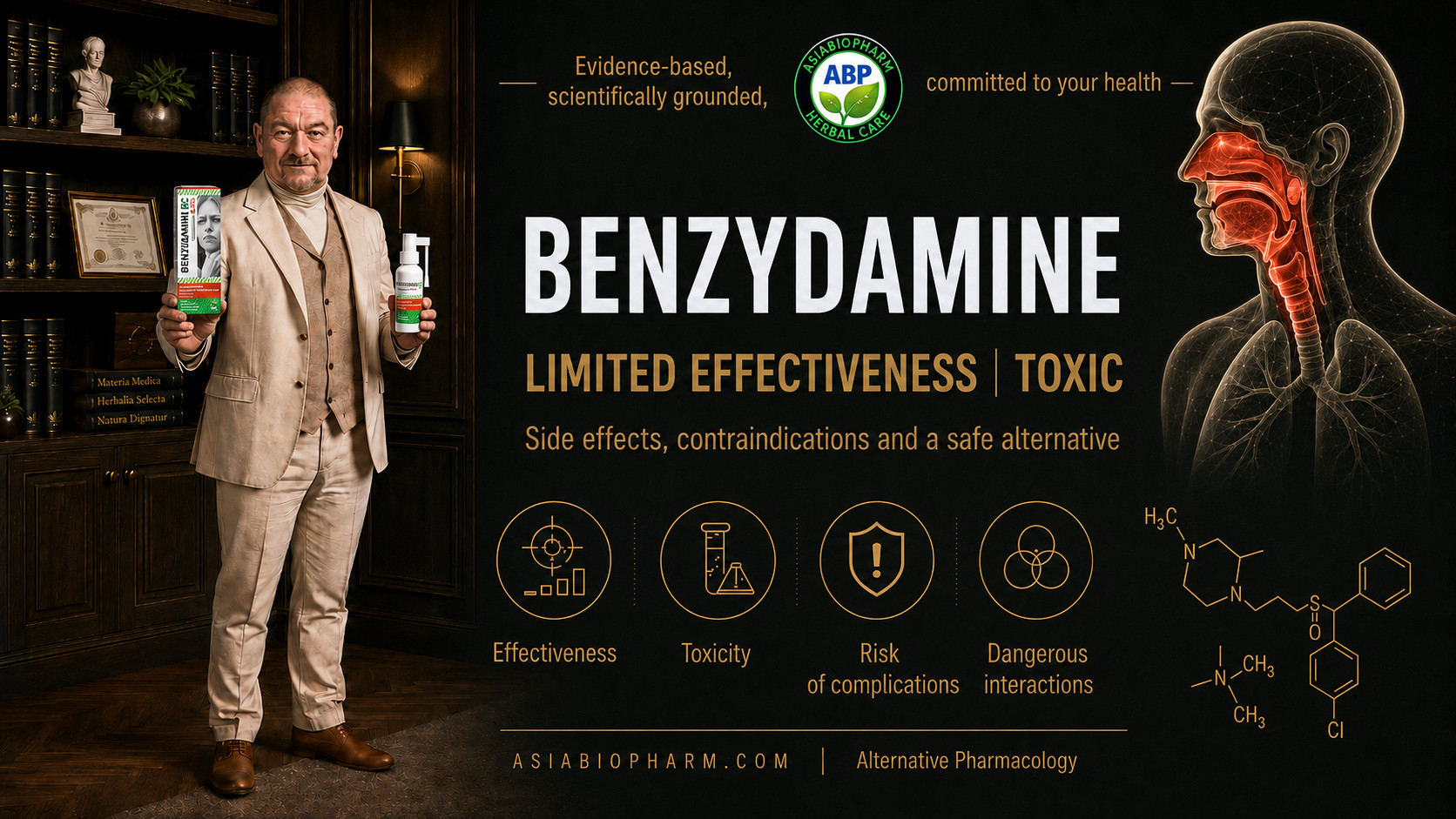
LIMITED EFFECTIVENESS | TOXIC
Names Under Which Benzydamine Is Available
The international nonproprietary name is benzydamine; the Latin name is benzydamine. Benzydamine hydrochloride is predominantly used in medicinal products. The main dosage forms include 0.15% and 0.30% oral and throat sprays, gargling solutions, 3 mg tablets or lozenges for dissolution, and, less commonly, vaginal solutions and topical formulations. Trade names include Tantum Verde, Tantum Verde Forte, Tantum Rosa, Angidak, Angidak Forte, Oralsept, Tenflex, T-sept, Pharyngospray, Difflam, Tantum Verde, Zyx, and other regional brands. Combination products may contain benzydamine together with cetylpyridinium chloride, chlorhexidine, lidocaine, or other local antiseptics and anaesthetics. Using several benzydamine sprays, lozenges, and solutions at the same time can result in hidden dose duplication, even though the packaging and trade names appear different.
Why Benzydamine Is Considered Harmless and Where the Real Risk Begins
Benzydamine is often perceived as an ordinary spray “for a red throat” because it is sold without a prescription, is applied locally, and quickly causes numbness of the mucous membrane. This numbness creates a misleading impression of treatment: the pain decreases, while a bacterial infection, severe tonsillitis, an abscess, a fungal lesion, gastro-oesophageal reflux, or a tumour process may continue to develop. The drug acts mainly symptomatically — it reduces local pain, swelling, and irritation but does not eliminate most causes of the condition. The risk begins with frequent spraying, swallowing the solution, exceeding the recommended duration of treatment, combining several benzydamine products, and using the spray instead of obtaining a diagnosis when pain or difficulty swallowing persists. In patients with bronchial asthma, the drug may provoke bronchospasm, while in people with hypersensitivity it may cause angioedema or anaphylaxis.
Side Effects After the First Dose and a Short Course
The most characteristic reactions are burning, tingling, dryness, and numbness of the tongue, gums, throat, or the entire treated mucous membrane. These effects are associated not only with irritation but also with the local anaesthetic action of benzydamine. Numbness may interfere with the normal perception of food temperature and consistency, increase the risk of biting the mucous membrane, and make it more difficult to recognise increasing swelling. Altered taste, throat irritation, coughing, nausea after swallowing the solution, irritation of the oesophagus, skin rash, itching, urticaria, and photosensitivity may occur. Life-threatening reactions include bronchospasm, laryngospasm, angioedema, and an anaphylactic reaction accompanied by swelling of the tongue and larynx, chest tightness, wheezing, dizziness, and a fall in blood pressure. Such reactions may occur after the first use and do not require accumulation of the drug in the body.
Consequences of Long-Term and Repeated Use
Typical cumulative hepatotoxicity, nephrotoxicity, or gastrointestinal toxicity characteristic of systemic NSAIDs has not been established for topical benzydamine. It is therefore incorrect to mechanically attribute ulcer bleeding or chronic liver injury to it. However, prolonged use creates other problems. Repeated anaesthesia of the mucous membrane masks persistent inflammation, trauma, an ulcerative defect, or progression of an infection. Frequent exposure to alcohol, propylene glycol, flavourings, parabens, and the active substance itself may maintain irritation, dryness, and contact sensitisation. A patient may develop a behavioural habit of repeatedly spraying the product whenever discomfort occurs without determining the cause of the symptom. There is no convincing evidence of drug dependence or a physiological withdrawal syndrome with therapeutic topical use, but non-medical use of large doses of benzydamine for psychoactive effects has been described. The absence of severe reactions during the first few days does not justify using it for weeks or months: persistent throat pain requires identification of the cause rather than continuous suppression of sensation.
Contraindications and High-Risk Groups
A direct contraindication is hypersensitivity to benzydamine or to the excipients of a specific product. Benzydamine is undesirable in people who have reacted to acetylsalicylic acid or other NSAIDs because such patients have a higher probability of cross-hypersensitivity. The drug presents a particular risk in people with bronchial asthma or a history of bronchospasm: spraying the throat may trigger acute narrowing of the bronchi. In cases of severe throat swelling, difficulty breathing, drooling, inability to swallow, suspected peritonsillar abscess, or epiglottitis, a local anaesthetic may mask deterioration and delay emergency care. Lozenges are contraindicated in young children because of the risk of aspiration; age restrictions for sprays and solutions depend on the dosage form and national instructions. Pregnant women should not use the drug unless necessary: there are insufficient data on the safety of local exposure, so the lowest possible dose and the shortest possible course are recommended. During breastfeeding, use is permitted only after a justified medical decision.
Dangerous Interactions and Combinations
No clinically significant systemic drug interactions have been established for topical benzydamine when it is used at the recommended doses. This does not mean that every combination is rational. Simultaneous use of several benzydamine-containing products — for example, a spray, lozenges, and a solution sold under different trade names — increases the total dose and the likelihood of swallowing the drug. Combining it with other local anaesthetics, including lidocaine, intensifies numbness and may make swallowing more difficult to control. Simultaneous use of irritating alcohol-based solutions, concentrated antiseptics, and aerosols increases the likelihood of dryness, burning, and damage to the mucous membrane. In people allergic to aspirin or other NSAIDs, combining benzydamine with systemic NSAIDs is particularly undesirable, not because of a pharmacokinetic interaction but because of a general tendency towards hypersensitivity reactions. Alcohol has no proven specific interaction with a therapeutic topical dose. However, ingestion of large amounts of benzydamine together with alcohol has been described in intoxication cases and may complicate assessment of agitation, confusion, and psychotic symptoms.
The Main Mistakes Made by Patients
The main mistake is to regard the disappearance of pain as proof of recovery. After spraying, the mucous membrane becomes numb, so the patient continues using the drug even though the inflammation persists or becomes worse. Common mistakes include shortening the intervals between doses, using Tantum Verde Forte according to the dosing schedule for the ordinary spray, sucking lozenges while also gargling with a solution and spraying the throat, spraying directly during inhalation and before meals, and allowing a young child to use the bottle without adult supervision. Attempting to treat purulent tonsillitis, severe one-sided pain, prolonged hoarseness, candidiasis, a chemical burn, or reflux-related throat injury with benzydamine without diagnostic evaluation is dangerous. A gargling solution must not be swallowed, and a vaginal formulation must not be taken orally: accidental ingestion of concentrated products has caused severe intoxication, especially in children.
Benzydamine Overdose and Poisoning
Systemic overdose is unlikely when benzydamine is used correctly as a topical treatment. A toxicologically dangerous situation occurs mainly after swallowing large amounts of solution, the contents of several bottles, or a large number of lozenges. According to current prescribing information, intoxication is expected after oral intake of more than 300 mg of benzydamine; published cases of non-medical use have involved doses of approximately 500–1500 mg. Early symptoms include nausea, vomiting, abdominal pain, heartburn, and irritation of the oesophagus. As absorption progresses, dizziness, anxiety, psychomotor agitation, irritability, sweating, tremor, impaired coordination, visual hallucinations, delirium, and psychosis may develop; severe poisoning may cause seizures and reduced consciousness. Peak concentration after ingestion is reached in approximately 2–4 hours, so an initially satisfactory condition does not exclude a subsequent increase in neurotoxicity. There is no specific antidote. Observation, maintenance of breathing and haemodynamic stability, correction of fluids and electrolytes, and symptomatic treatment are required. If a child accidentally swallows the drug or develops agitation, hallucinations, ataxia, repeated vomiting, or seizures, it is not safe to wait at home.
A Safe Integrative Alternative to Benzydamine
For the treatment of inflammation, swelling, and soreness of the oropharyngeal mucosa, the most well-founded combination is Scrophularia ningpoensis, Clinacanthus nutans, and Sphaeranthus indicus. This is not an attempt to find a single plant that formally resembles a synthetic molecule, but a functional replacement for its main effects. Scrophularia ningpoensis is directed at inflammation of the mucous membrane of the throat, tonsils, and lymphoid tissue; iridoid glycosides, phenylpropanoids, and other constituents of the taxon may suppress NF-κB-dependent production of pro-inflammatory cytokines and reduce inflammatory swelling. Clinacanthus nutans complements the formula with antiviral, antibacterial, anti-inflammatory, and immunoregulatory activity and is therefore particularly appropriate for inflammatory, erosive, and herpetic lesions of the mucous membrane. Sphaeranthus indicus provides peripheral analgesic activity and additional suppression of exudative inflammation; its extracts have shown marked activity in models of pain and inflammatory oedema. Unlike benzydamine, this combination does not cause pharmacological numbness of the throat and does not create the false impression that the cause of the disease has been eliminated. It is not required to reproduce the immediate local anaesthetic effect of the synthetic drug: its purpose is to reduce the inflammation itself rather than merely switch off pain sensation temporarily.
When there is a pronounced bacterial or fungal component, it is reasonable to supplement the formula with Vernonia cinerea or Cryptolepis buchananii. In acute pharyngitis or tonsillitis accompanied by fever, body aches, and a systemic inflammatory response, it is rational to combine the local formula with the anti-inflammatory Five Roots mixture, which provides systemic anti-inflammatory, antipyretic, and analgesic effects. Sahastara is less precise for this purpose: it is more strongly directed at muscular, joint, and visceral pain, while its pungent and irritating ingredients make it less suitable for an inflamed mucous membrane. In mild uncomplicated pharyngitis, stomatitis, aphthous lesions, or throat irritation, the herbal combination may be used instead of benzydamine. In the presence of high fever, purulent coating, one-sided enlargement of a tonsil, difficulty opening the mouth, increasing swelling, impaired breathing, or inability to swallow, it must not replace diagnostic assessment and emergency treatment.
The Real Effectiveness of Benzydamine and Prescribing Errors
Benzydamine can indeed rapidly reduce local pain, burning, swelling, and discomfort in pharyngitis, tonsillitis, stomatitis, aphthous ulcers, after dental procedures, and in some forms of oral mucositis. Its advantage is rapid penetration into inflamed mucosa and the combination of anti-inflammatory activity with short-term local anaesthesia. In studies, benzydamine gargling reduced postoperative sore throat after intubation and decreased the severity of radiation-induced mucositis. However, the drug remains symptomatic: it does not reliably eradicate the causative organism in bacterial tonsillitis, eliminate a fungal infection, treat gastro-oesophageal reflux, drain an abscess, or correct chronic trauma to the mucous membrane. The evidence base for ordinary uncomplicated sore throat is considerably more modest than the advertising impression created by the widespread presence of brightly coloured bottles in pharmacies. Rapid numbness is a pharmacological effect, not proof of recovery.
A medical error is to prescribe benzydamine without examination for prolonged, recurrent, or one-sided pain, as well as to use it as the only treatment for purulent tonsillitis, candidiasis, severe stomatitis, a deep ulcerative defect, or suspected peritonsillar abscess. It is irrational to recommend it automatically to every patient with a “red throat” without clarifying the duration of symptoms, the presence of fever, difficulty swallowing or breathing, enlarged lymph nodes, and any previous reaction to NSAIDs. A separate error is prescribing the drug to a person with bronchial asthma or aspirin-induced bronchospasm without warning about a possible respiratory reaction. Another common practice is to prolong treatment because the patient “feels better after each spray.” If relief ends at the same time as the numbness, this is not proof that another spray is needed, but a reason to determine why the inflammation persists.
Safety Monitoring During Treatment
During a short course of topical benzydamine, routine laboratory monitoring of liver function, kidney function, or blood counts is usually not required because systemic absorption is low when the drug is used correctly. Monitoring should be clinical. After the first use, the severity of burning, numbness, coughing, hoarseness, difficulty swallowing, and difficulty breathing should be assessed. Mild short-lived tingling may occur, but increasing burning, marked swelling, generalised urticaria, or worsening breathing requires immediate discontinuation. If pain and inflammation do not decrease within a few days, become worse, or rapidly return after each dose, symptoms should no longer be masked. Examination of the oropharynx and clarification of the cause are required.
Emergency signs include swelling of the lips, tongue, face, or larynx, wheezing, an attack of suffocation, inability to swallow saliva, sudden weakness, a fall in blood pressure, and altered consciousness. After ingestion of a significant amount of the drug, repeated vomiting, pronounced agitation, impaired coordination, tremor, hallucinations, confusion, and seizures are dangerous. In such situations, one must not wait for the drug’s effect to wear off or attempt to “neutralise” it with food, sorbents, or homemade solutions. In children, intoxication develops after a smaller absolute amount, and the first psychoneurological manifestations may be mistaken for fear, irritability, or fever-related agitation.
Correct Discontinuation of Benzydamine
Benzydamine can be stopped immediately: gradual reduction in the number of sprays or the concentration is not required. No physiological withdrawal syndrome has been established with therapeutic topical use. The return of pain after discontinuation does not mean “withdrawal” or dependence of the mucous membrane on the spray, but persistence of the underlying inflammatory, infectious, traumatic, or reflux-related process. Continuing treatment solely to reproduce numbness is incorrect because it makes assessment of the course of the disease more difficult.
After prolonged uncontrolled use, a subjective habit of treating the throat whenever even minor discomfort occurs may develop. In this case, the drug should also be stopped immediately, and further management should be directed towards identifying the cause of the symptoms and restoring the mucous membrane. A herbal alternative may be introduced without a pharmacological “washout period” if there is no individual intolerance or significant contraindication. However, switching to herbal products must not become a new form of indefinite self-treatment: chronic hoarseness, an ulcer, a lump, bleeding, or pain lasting more than two to three weeks requires an in-person examination.
A Rational Approach to Treatment
Benzydamine is justified when rapid short-term pain relief is required after a dental procedure, intubation, or surgery, or in cases of marked mucosal inflammation when temporary local analgesia genuinely makes swallowing easier. It should be used for a limited course, at the established dose, and only after excluding conditions in which pain relief may mask dangerous deterioration. It is not suitable for continuous treatment of recurrent pharyngitis, stomatitis, or throat irritation.
For mild and moderate uncomplicated inflammation of the mucous membrane, preference may be given to a combination of Scrophularia ningpoensis, Clinacanthus nutans, and Sphaeranthus indicus. Such a formula acts on inflammatory mediators, swelling, the infectious component, and pain without necessarily switching off mucosal sensation. In the presence of a systemic inflammatory response, the Five Roots mixture may be added, while Vernonia cinerea or Cryptolepis buchananii may be used when there is a fungal or pronounced microbial component. The purpose of substitution is not to reject the synthetic drug on principle, but to avoid using a local anaesthetic spray where the inflammatory process can be controlled more physiologically and with a lower risk of irritation, sensitisation, bronchospasm, and toxic overdose.
If you have questions about the subject of this article, you may ask a clinical pharmacologist in the comments or book an appointment via the following link: https://asiabiopharm.com/konsultaciii/
0 comments