
Benzocaine — Methemoglobinemia, Hypoxia, and the Risks of Local Anesthesia
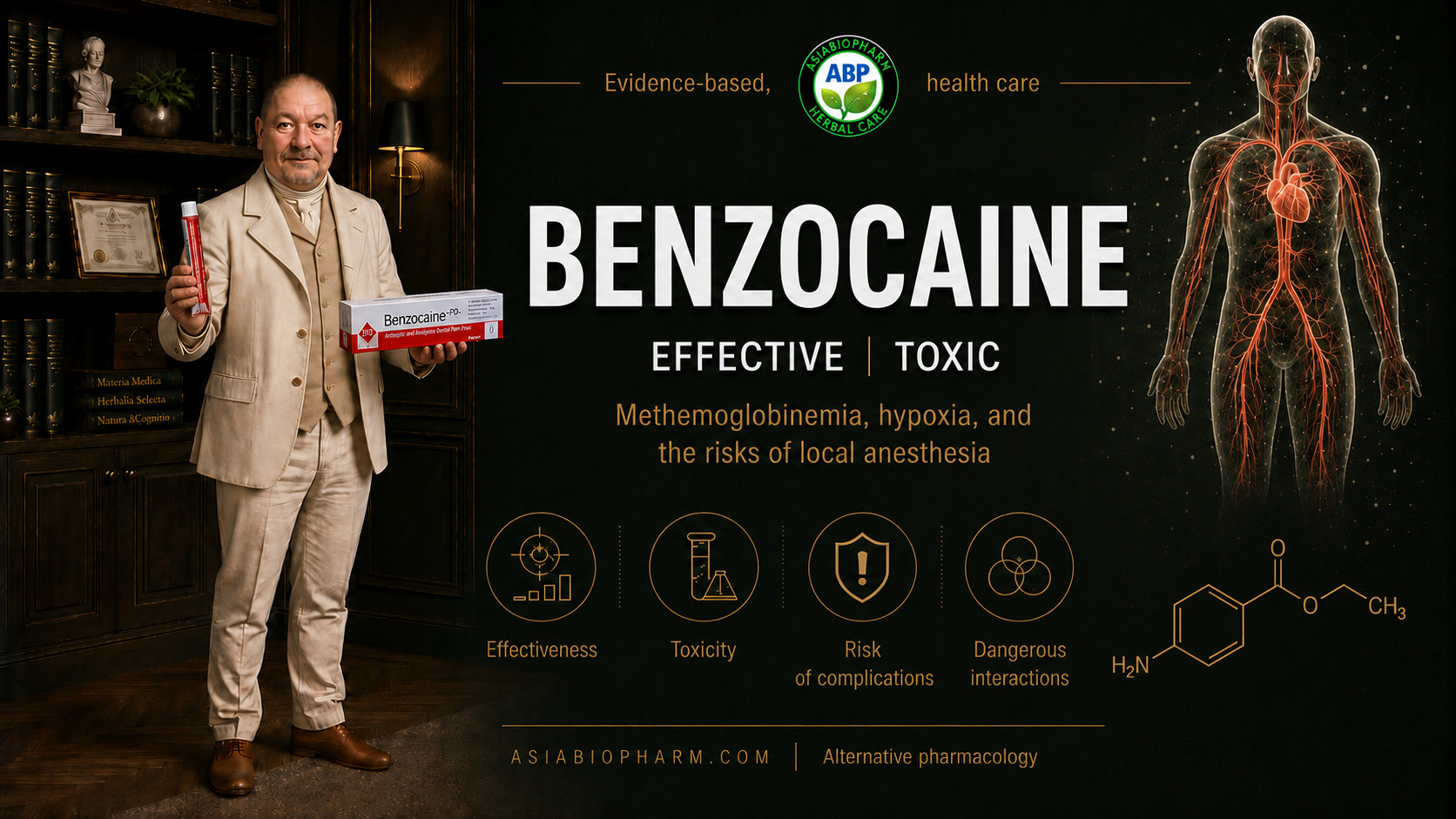
EFFECTIVE | TOXIC
Names of Benzocaine and Products with Hidden Duplication
The international nonproprietary name is benzocaine, Benzocaine. In Russian-language instructions, pharmacy catalogs, and medical records, the drug is also referred to as anesthesin. Latin and chemical variants include Benzocainum, Benzocain, ethyl 4-aminobenzoate, ethyl p-aminobenzoate, and the ethyl ester of 4-aminobenzoic acid. The main dosage forms are gel, ointment, cream, paste, solution, aerosol, spray, lozenges, rectal suppositories, and combination topical products.
Common brand names used in different countries include Anbesol, Orajel, HurriCaine, Topex, Orabase, Cepacol, and certain formulations of Chloraseptic. The composition of each specific product must be checked separately because products with and without benzocaine may be marketed under the same brand name.
In the Russian-speaking pharmaceutical market, benzocaine is included in Anestezol, Almagel A, Bellalgin, Menovazin, and a range of combination products for hemorrhoids, sore throat, dental pain, and skin irritation. Simultaneous use of gum gel, throat lozenges, rectal suppositories, and a topical solution may result in hidden duplication of benzocaine, even though the brand names of the products appear completely different.
Why Benzocaine Is Considered Harmless and Where the Real Risk Begins
Benzocaine creates a convincing impression of safety: it is applied only to the skin or mucous membranes, anesthesia develops rapidly, and many formulations are sold without a prescription. However, local administration does not mean exclusively local action. Some of the substance is absorbed, and benzocaine and the oxidative processes associated with its metabolism can convert the iron in hemoglobin from the divalent Fe²⁺ form to the trivalent Fe³⁺ form. This produces methemoglobin, which cannot transport oxygen normally.
As a result, the patient develops tissue hypoxia despite normal airflow into the lungs. A dangerous reaction may occur after a single application, including in a person who previously used benzocaine without complications. The first symptoms — weakness, headache, dizziness, tachycardia, and shortness of breath — are nonspecific and may be mistakenly attributed to fatigue, anxiety, or manifestations of the underlying condition.
Repeated application, shorter intervals between doses, use of several benzocaine-containing products, and treatment of damaged mucosa increase the risk. The FDA has received numerous reports of benzocaine-associated methemoglobinemia, including severe and fatal cases.
Adverse Effects After the First Dose and a Short Course
Common local reactions include burning, tingling, dryness, irritation, redness, and excessive loss of sensation at the application site. When used on the mucosa of the mouth or throat, pronounced numbness may impair swallowing, increase the likelihood of biting the tongue or cheek, and create a risk of aspirating food or liquid.
Clinically significant reactions include contact dermatitis, localized swelling, urticaria, and allergic reactions. Benzocaine is an ester-type local anesthetic and is structurally related to para-aminobenzoic acid, so sensitization may be accompanied by cross-reactivity with other ester anesthetics.
The most dangerous early complication is methemoglobinemia. The skin, lips, and nail beds become gray, cyanotic, or bluish. Shortness of breath, tachycardia, headache, weakness, and dizziness develop. Oxygen therapy may fail to resolve cyanosis because the problem is not impaired lung ventilation but disrupted oxygen transport by hemoglobin.
Severe poisoning may cause confusion, arterial hypotension, myocardial ischemia, cardiac arrhythmias, seizures, coma, and circulatory arrest.
Risks of Long-Term and Repeated Use
Benzocaine is not typically associated with cumulative hepatotoxicity, nephrotoxicity, or hormonal toxicity. Its long-term risks are primarily related to repeated oxidative stress on hemoglobin, mucosal damage, allergic sensitization, and masking of the disease causing the pain.
Repeated application to an inflamed, traumatized, or ulcerated surface increases absorption. When an aerosol is used, the actual dose often remains unknown because the patient does not measure the duration of spraying, and part of the product is swallowed or inhaled.
Contact allergy may develop after a period of apparently normal tolerance. Thereafter, even a small amount of benzocaine may cause severe dermatitis, swelling, or a generalized allergic reaction.
Prolonged suppression of dental pain, sore throat, anorectal pain, or painful mucosal ulcers does not treat infection, pulpitis, periodontitis, an abscess, an anal fissure, or a neoplastic disease. Benzocaine reduces the symptom while simultaneously delaying diagnosis.
Tolerance, drug dependence, and a pharmacological withdrawal syndrome are not characteristic of benzocaine. However, once the anesthetic effect ends, the original pain rapidly returns, which the patient may mistakenly perceive as the development of dependence. Instructions for oral formulations generally do not recommend use for longer than seven days without medical evaluation.
Contraindications and High-Risk Groups
Benzocaine is contraindicated in patients with a confirmed allergy to benzocaine, para-aminobenzoic acid, or other ester-type local anesthetics, including procaine. Repeated use after an episode of methemoglobinemia is unacceptable without specialist medical evaluation.
Over-the-counter oral benzocaine products should not be used in children younger than two years or for the relief of teething pain. Infants have greater relative exposure per kilogram of body weight and lower activity of the enzyme systems that reduce methemoglobin.
Benzocaine is particularly dangerous in congenital methemoglobinemia, glucose-6-phosphate dehydrogenase deficiency, severe anemia, ischemic heart disease, heart failure, cardiac arrhythmias, and chronic lung disease. In such patients, even a moderate reduction in the oxygen-carrying capacity of the blood is tolerated much more poorly.
The risk increases when benzocaine is applied to large, inflamed, infected, ulcerated, or traumatized surfaces. During pregnancy and breastfeeding, self-administration of benzocaine is not justified. The product must not be applied to the nipple before feeding because of the risk of exposing the infant to the substance.
Dangerous Drug Combinations
Benzocaine should not be combined with other substances capable of oxidizing hemoglobin. These include dapsone, nitrates, nitrites, nitrofurantoin, phenazopyridine, primaquine, certain sulfonamides, prilocaine, and other local anesthetics associated with methemoglobinemia. Combined use creates an additive risk even when each product is used at a standard dose.
Using several benzocaine-containing products results in hidden duplication of the active ingredient. A patient may simultaneously use a dental pain remedy, throat lozenges, rectal suppositories, and a topical solution without realizing that the same substance is being received from different sources.
Patients with benzocaine allergy may have cross-sensitivity to other ester-type local anesthetics and compounds metabolized to para-aminobenzoic acid.
No specific pharmacokinetic interaction between benzocaine and alcohol has been established. However, alcohol damages mucous membranes, increases their permeability, aggravates local irritation, and makes it more difficult to recognize weakness, dizziness, and impaired consciousness. Applying benzocaine to mucosa damaged by alcohol is highly undesirable.
No clinically significant direct interaction with food, caffeine, or nicotine has been demonstrated. This does not eliminate the need to consider additive effects with medicinal and chemical oxidizers of hemoglobin.
Patient Errors
The most dangerous mistake is assuming that a local anesthetic can be applied every time the pain returns. Repeated applications, shorter intervals, application of a thick layer, and treatment of a large surface area increase systemic absorption and oxidative stress on hemoglobin.
Sprays are particularly difficult to dose independently. The duration of spraying is rarely controlled, the actual amount of the substance remains unknown, and part of the aerosol enters the airways or is swallowed.
Using benzocaine for teething in infants is a dangerous mistake. The therapeutic benefit in this situation is limited, whereas the risk of methemoglobinemia is disproportionately high.
Another common mistake is treating dental pain, sore throat, hemorrhoids, or oral ulcers with benzocaine for many days. Pain relief creates the illusion of treatment while the underlying disease continues to progress.
A patient may mistake blue discoloration of the lips for exposure to cold, and tachycardia and shortness of breath for a panic attack. Over-the-counter availability, the familiar name “Anesthesin,” and the absence of complications during previous use do not confirm the safety of the next dose.
Benzocaine Overdose and Poisoning
There is no reliable universal toxic dose of benzocaine that allows a clear distinction between safe and dangerous use. Methemoglobinemia has been reported after a single application and with the use of recommended amounts.
The risk depends on the concentration of the product, the treatment area, the condition of the mucosa, the dosage form, repeated application, age, body weight, coexisting anemia, heart and lung disease, and concurrent use of other hemoglobin oxidizers.
After ingestion, heavy application, or use of a high-concentration aerosol, symptoms may develop within minutes or several hours. Headache, weakness, dizziness, palpitations, and shortness of breath appear first. The skin and mucous membranes then become gray or cyanotic and respond poorly to oxygen therapy.
As the methemoglobin concentration rises, confusion, myocardial ischemia, hypotension, arrhythmias, seizures, coma, and death may occur. Standard pulse oximetry may show persistent readings of approximately 85% and fail to reflect the true severity of hypoxia. The diagnosis is confirmed by co-oximetry.
Symptomatic methemoglobinemia requires immediate hospitalization. The main specific treatment is intravenous methylene blue administered under medical supervision. In glucose-6-phosphate dehydrogenase deficiency, methylene blue may be insufficiently effective and may worsen hemolysis, so treatment must be managed by a toxicologist or critical care specialist.
Waiting for pronounced cyanosis is unsafe. Delay prolongs tissue hypoxia and increases the risk of neurological and cardiovascular complications.
A Safe Integrative Alternative to Benzocaine
For topical anesthesia of the oral mucosa and short-term relief of dental pain, the most well-founded alternative is a local combination of Acmella oleracea standardized for spilanthol and Syzygium aromaticum standardized for eugenol.
Spilanthol rapidly produces tingling, reduced pain sensitivity, and numbness of the mucosa. Its action is associated with modulation of peripheral nociceptive transmission and the activity of ion channels in sensory neurons. Eugenol complements this effect through its action on voltage-gated sodium channels and TRPV1 and also exhibits anti-inflammatory and antimicrobial activity.
In a clinical study, clove gel significantly reduced pain from mucosal needle puncture compared with placebo. No statistically significant difference was found between clove gel and 20% benzocaine.
Clinical and pharmaceutical studies of local anesthesia of the oral mucosa are available for Acmella oleracea. In one study, an Acmella preparation reduced pain during needle insertion and did not differ statistically in effect from 20% benzocaine.
Mucoadhesive films and topical formulations of Acmella oleracea have been developed that can retain the standardized extract on the mucosa and prolong contact between spilanthol and the painful area. However, the evidence base for a finished combination of Acmella and Syzygium remains less extensive than the data for each component separately.
This substitution is most rational for aphthous lesions, gum irritation, superficial mucosal pain, preparation for certain dental procedures, and short-term relief of dental pain before examination by a dentist.
The combination does not provide pulpal, infiltration, or nerve block anesthesia and does not treat pulpitis, periodontitis, an abscess, or any other disease causing the pain. Even plant-based topical products must not be applied without limitation: concentrated eugenol from Syzygium aromaticum may irritate and damage the mucosa, while Acmella, as a member of the Asteraceae family, may cause contact allergy.
For more pronounced systemic or chronic pain, Tetrodocain — Tetrodocain Injection may be considered. Its active component is highly purified tetrodotoxin isolated from the tissues of pufferfish. Tetrodotoxin blocks TTX-sensitive voltage-gated sodium channels, including NaV1.7, and interrupts the transmission of pain impulses.
Tetrodocain must not be described as a safe natural analogue of lidocaine or benzocaine. It is a highly active zoological neurotoxin with an extremely narrow therapeutic range. The presence of 120 mouse units of tetrodotoxin in a 1 ml ampoule emphasizes the need for precise dosing, professional administration, respiratory monitoring, and readiness to provide respiratory support. The drug is suitable only for strictly controlled professional use.
For chronic localized neuropathic pain, high-concentration topical formulations of capsaicin from Capsicum annuum may serve as a functional alternative to local anesthetics. Capsaicin does not block impulse conduction immediately. It activates TRPV1-positive nociceptors and then causes prolonged functional desensitization. This mechanism is used in postherpetic, diabetic, and other forms of localized peripheral neuropathic pain.
Neosaxitoxin is an investigational natural platform for prolonged local anesthesia. It blocks sodium channels and can provide long-lasting analgesia, but systemic distribution is associated with the risk of paresthesia, motor block, neuromuscular weakness, and respiratory depression. Clinical development is limited by the need for extremely precise dosing.
The Actual Effectiveness of Benzocaine and Prescribing Errors
Benzocaine is genuinely effective as a topical local anesthetic. It reduces the sensitivity of the skin and mucous membranes and can decrease pain during needle puncture, oral irritation, minor skin injuries, and anorectal discomfort.
The effect develops rapidly but remains superficial and short-lived. Benzocaine does not penetrate deeply enough to provide reliable pulpal, infiltration, or nerve block anesthesia. It does not eliminate infection, inflammation, nerve damage, or another cause of pain.
In dental studies, 20% benzocaine was superior to placebo for certain types of needle insertion, although the magnitude of the effect depended on the mucosal site, application time, and procedural technique.
A typical medical error is to use benzocaine as a universal solution for any oral pain without determining its origin. Repeated anesthesia in pulpitis, an abscess, an ulcerative lesion, or a neoplastic process merely delays diagnosis.
It is unjustified to prescribe benzocaine to young children, recommend prolonged use, treat a large area of damaged mucosa, or combine several benzocaine-containing products.
A separate problem involves aerosol formulations used before endoscopic and dental procedures. The actual dose depends on the duration of spraying, while the additional benefit of topical anesthesia does not always justify the risk of methemoglobinemia. Local numbness is a pharmacological effect, not evidence that the disease has been treated.
Safety Monitoring During Use
When benzocaine is applied briefly to a small area of intact tissue, routine laboratory testing is generally not required. The frequency of application, duration of use, treatment area, condition of the mucosa, and concurrent use of other hemoglobin oxidizers must be monitored.
If pain persists, worsens, or returns for several consecutive days, its cause must be established rather than increasing the amount of anesthetic.
Pale, gray, or cyanotic discoloration of the skin, lips, and nail beds, sudden weakness, headache, dizziness, tachycardia, shortness of breath, confusion, and decreased pulse oximetry readings that respond poorly to oxygen require immediate discontinuation and urgent medical evaluation.
These symptoms may occur within minutes or several hours after application. Suspected methemoglobinemia is confirmed by co-oximetry. Standard pulse oximetry may produce misleading results.
Delay is dangerous because it allows tissue hypoxia to continue and may lead to myocardial ischemia, arrhythmias, seizures, coma, and circulatory arrest.
Swelling of the lips, tongue, or larynx, generalized urticaria, wheezing, and a sudden drop in blood pressure may indicate a systemic allergic reaction. Severe burning, ulceration, or increasing mucosal swelling require immediate discontinuation.
When an aerosol is used professionally, the concentration, spraying duration, and total amount of the product must be recorded, especially in patients with anemia, cardiopulmonary disease, or concurrent use of medications capable of causing methemoglobinemia.
Proper Discontinuation of Benzocaine
Benzocaine may be stopped immediately. Gradual dose reduction is not required because the drug does not cause physical dependence, a pharmacological withdrawal syndrome, or rebound neuronal hyperexcitability.
Once the anesthetic effect ends, the original pain or sensitivity returns if the disease, injury, or inflammation persists. The return of symptoms must not be considered a reason for immediate reapplication.
After prolonged self-administration, discontinuing benzocaine may reveal pain that the drug had masked for several days or weeks. In this situation, pulpitis, a dental abscess, pharyngeal infection, a nonhealing ulcerative lesion, an anal fissure, and other diseases must be excluded.
After methemoglobinemia or an allergic reaction, benzocaine must not be used again until medical evaluation has been completed. Successful use in the past does not exclude a recurrent and more severe complication.
A Rational Approach to Local Anesthesia
Benzocaine is justified when rapid and short-lasting superficial anesthesia of a small area is required and the patient does not belong to a high-risk group.
Its advantages are rapid onset of action and predictable reduction of superficial sensitivity. Its limitations include the shallow depth of anesthesia, short duration of effect, the possibility of allergic sensitization, and the rare but potentially fatal risk of methemoglobinemia.
For uncomplicated mucosal pain and superficial dental procedures, a standardized combination of Acmella oleracea and Syzygium aromaticum may address a comparable therapeutic need without the oxidative transformation of hemoglobin characteristic of benzocaine.
The concentrations of spilanthol and eugenol, dosage form, exposure time, and condition of the mucosa must be standardized. In the presence of a purulent process, severe dental pain, trauma, the need for surgery, or deep anesthesia, the plant-based formula does not replace diagnosis or professional anesthesia.
Tetrodocain is acceptable only as a specialized toxin-containing drug under strict professional supervision. Capsaicin should be considered for localized neuropathic pain rather than acute mucosal pain. Neosaxitoxin remains an investigational pharmacological technology.
A rational choice does not consist of mechanically replacing a synthetic substance with any natural compound, but of selecting an agent appropriate to the type of pain, the required depth of anesthesia, and the acceptable toxicological risk.
If you have questions about the subject of this article, you can ask a clinical pharmacologist in the comments or book an appointment using the following link: https://asiabiopharm.com/konsultaciii/
0 comments