
Beclometasone — Why This Hormonal Drug Is Dangerous and Why It Does Not Relieve an Asthma Attack
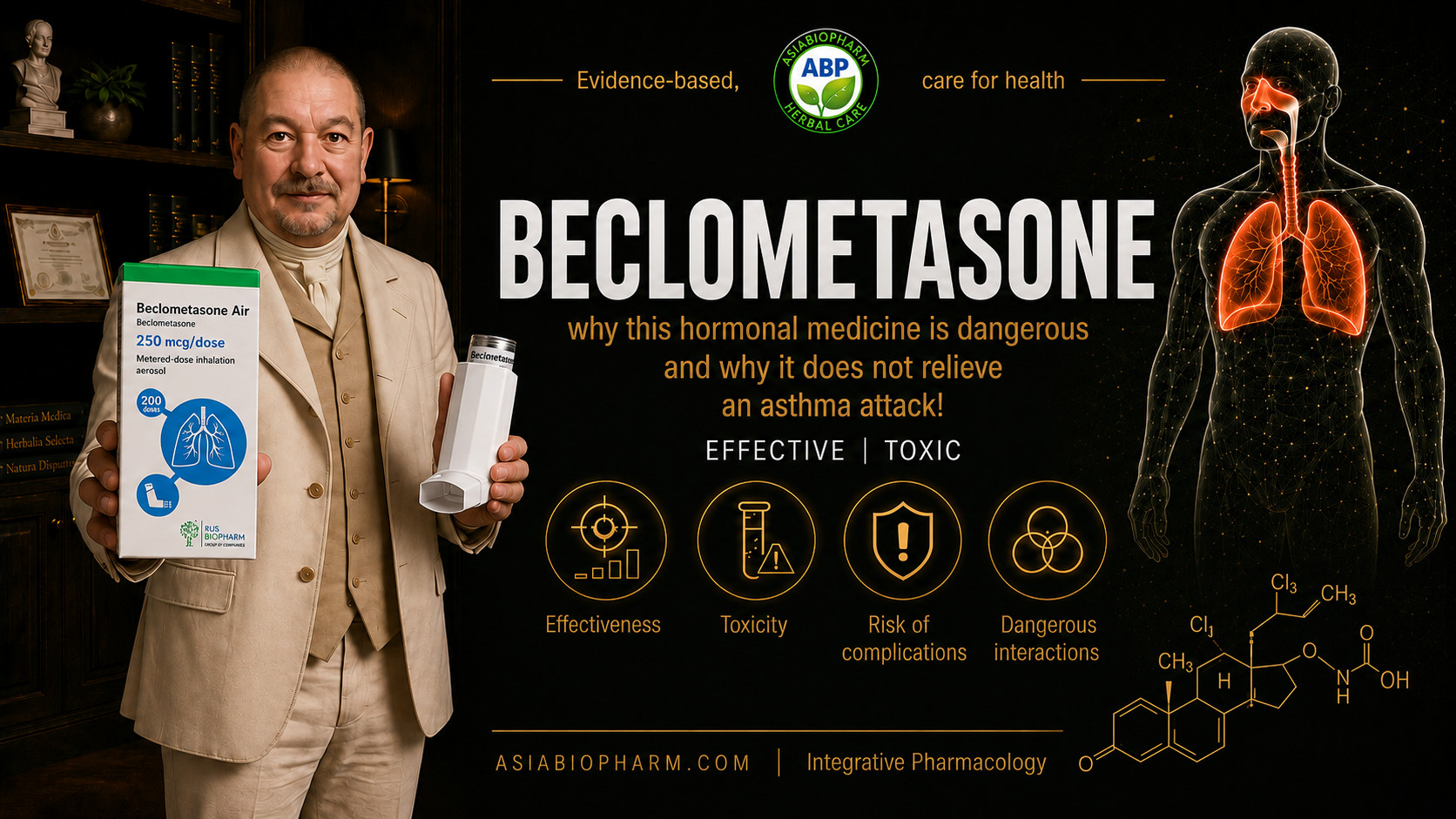
EFFECTIVE | TOXIC
Names Under Which Beclometasone Is Available
The international nonproprietary name is beclometasone, with the Latin variants beclometasone and beclomethasone. Pharmaceutical formulations usually contain beclometasone dipropionate or beclomethasone dipropionate; it is a prodrug that is converted into the active metabolite beclometasone-17-monopropionate. The main forms are a metered-dose inhalation aerosol, a dry powder inhaler, and a nasal spray or aerosol. Brand names include QVAR, QVAR RediHaler, QNASL, Beconase, Becotide, Clenil Modulite, and Soprobec. Combination products include beclometasone + formoterol — Fostair/Foster; beclometasone + formoterol + glycopyrronium — Trimbow. Simultaneous use of a single-agent product and such combinations results in hidden cumulative exposure to the glucocorticosteroid.
Why Beclometasone Is Considered Harmless and Where the Real Risk Begins
The main everyday mistake is to regard an inhaler or nasal spray as a medicine that acts exclusively on the mucous membrane. Part of the dose is absorbed systemically, and high doses, prolonged use, incorrect technique, and the combination of several steroid products may suppress the hypothalamic-pituitary-adrenal axis. Beclometasone does not dilate the bronchi and cannot rapidly relieve an attack that has already begun: attempts to repeat inhalations instead of using the emergency bronchodilator specified in the treatment plan may cause a dangerous delay in receiving help. A false sense of safety is reinforced by the absence of immediate systemic symptoms, although candidiasis, dysphonia, growth suppression, reduced bone mineral density, cataracts, and adrenal suppression develop gradually.
Adverse Effects During the First Hours and Days of Use
Common reactions to inhaled beclometasone include oropharyngeal irritation, cough, pharyngitis, hoarseness, and unpleasant sensations in the mouth; local suppression of immune defence promotes the development of oropharyngeal candidiasis. The nasal form may cause dryness and irritation of the mucosa, nosebleeds, erosions, and ulceration. A clinically significant reaction is paradoxical bronchospasm: wheezing, chest tightness, and shortness of breath worsen immediately after inhalation. This is not an “adjustment period” but a reason to discontinue the medicine and relieve the bronchospasm immediately. Life-threatening reactions are rare but include anaphylaxis, angioedema, and severe bronchospasm.
Consequences of Prolonged and Repeated Use
With use lasting several months, both local and systemic glucocorticoid effects accumulate. The inhaled form may suppress cortisol secretion, especially when the dose is exceeded, several steroids are used, or the patient is switched from systemic glucocorticosteroids. Hypercortisolism, adrenal insufficiency, reduced bone mineral density, cataracts, increased intraocular pressure, glaucoma, and reduced growth velocity in children may occur. Nasal administration may lead to chronic erosions, ulcers, candidiasis, and perforation of the nasal septum. Most local reactions are reversible after treatment is adjusted, but bone loss, impaired growth, cataracts, and damage to the nasal septum may have long-lasting or irreversible consequences. Tolerance and drug dependence are not characteristic of beclometasone; however, prolonged adrenal suppression creates physiological dependence on an external glucocorticosteroid.
Contraindications and High-Risk Groups
Inhaled beclometasone is contraindicated as the primary treatment for status asthmaticus and other acute attacks requiring intensive treatment, as well as in patients with hypersensitivity to any component of the medicine. Its use is particularly dangerous in patients with active or latent respiratory tuberculosis, untreated fungal, bacterial, parasitic, or viral infections, and ocular herpes: its immunosuppressive action may activate or aggravate an infection. Children, patients with osteoporosis, glaucoma, cataracts, prolonged previous prednisolone use, and other signs of adrenal suppression are at increased risk of systemic complications. The nasal form must not be used until the mucosa has healed following surgery, trauma, an ulcer, or severe erosion of the nasal septum.
Dangerous Drug Combinations
Combining beclometasone with potent CYP3A inhibitors, including ritonavir and cobicistat, without specialised monitoring is highly undesirable: although the metabolism of beclometasone is less dependent on CYP3A than that of some other inhaled steroids, increased systemic glucocorticoid effects cannot be ruled out. The combination requires monitoring for signs of Cushing’s syndrome and adrenal insufficiency. Simultaneous use of oral, injectable, nasal, inhaled, and topical glucocorticosteroids increases the total steroid burden. Fostair/Foster and Trimbow pose a separate risk because they already contain beclometasone: adding QVAR, Becotide, or another single-agent product may inadvertently double the dose. No specific pharmacokinetic interaction with food, caffeine, or alcohol has been established, but alcohol does not reduce bronchial inflammation or compensate for the absence of a rapid bronchodilator effect. Reliable data on the safety of combining beclometasone with numerous dietary supplements and herbal products are insufficient.
Patient Errors When Using Beclometasone
The most dangerous mistake is using beclometasone as an emergency medicine when shortness of breath is worsening. Improvement may begin only after one day, usually becomes noticeable within one to two weeks, and reaches its maximum after three to four weeks. Therefore, repeated inhalations during an attack increase the steroid dose but do not relieve acute bronchospasm. Other errors include irregular use, increasing the dose before assessing the result, incorrect inhalation technique, failure to rinse the mouth, directing the nasal spray towards the septum, continuing to use an empty canister after the dose counter reaches zero, and simultaneously taking several beclometasone-containing products. Abrupt self-discontinuation after prolonged high-dose treatment may lead to loss of asthma control and the appearance of symptoms caused by suppressed adrenal function.
Beclometasone Overdose and Poisoning
No universal single toxic dose has been established for beclometasone, and official prescribing information does not describe typical acute poisoning with symptoms developing in a predictable hour-by-hour pattern. A single excessive inhaled or nasal dose usually does not cause immediate severe intoxication, which makes the danger easy to underestimate. The main overdose scenario is chronic: exceeding the number of inhalations over weeks or months, using several steroid medicines simultaneously, or switching incorrectly from systemic glucocorticosteroids. Signs of hypercortisolism and adrenal suppression develop gradually; during an infection, surgery, trauma, vomiting, or severe dehydration, hidden insufficiency may progress to an adrenal crisis with profound weakness, vomiting, arterial hypotension, impaired consciousness, and collapse. There is no specific antidote. A high dose used for a prolonged period must not be stopped abruptly: adrenal function must be assessed, and the steroid burden must be reduced gradually.
Safe Integrative Alternative
An integrative substitute for beclometasone depends on the dosage form and the clinical objective. In allergic or chronic uncomplicated rhinitis, ABP-153, which contains a complex of herbal components with anti-inflammatory, secretolytic, and local antimicrobial effects, may be considered as the main local alternative. Its use may be justified when the disease is stable and there is no severe obstruction, respiratory failure, or need for urgent bronchodilator treatment. ABP-153 must not be regarded as a medicine for relieving an asthma attack, and its effectiveness on the nasal mucosa must not automatically be assumed to apply to the bronchi. Boswellia serrata and Curcuma longa may be used for oral anti-inflammatory support. Boswellic acids inhibit the 5-lipoxygenase pathway and leukotriene formation, while curcuminoids act on NF-κB, cyclooxygenase, and cytokine-mediated mechanisms of inflammation. These products may complement the treatment of mild or stable inflammatory disease of the respiratory tract, but evidence that they are equivalent to inhaled glucocorticosteroids in preventing severe exacerbations is insufficient. In uncontrolled asthma, nocturnal attacks, reduced peak expiratory flow, or frequent need for an emergency inhaler, replacing beclometasone without medical supervision is unacceptable: current recommendations continue to regard anti-inflammatory inhaled therapy as the basis of asthma control.
For topical use in limited, non-infected skin inflammation, an ointment made from dry extracts of Nigella sativa and Scutellaria baicalensis may be used: 5 g of each extract, 70 g of coconut oil, 15 g of beeswax, and 5 g of lanolin per 100 g of finished ointment. The final concentration of the extracts is 10%. A more reparative formulation contains 4 g of Nigella sativa, 4 g of Scutellaria baicalensis, and 2 g of Centella asiatica, together with 70 g of coconut oil, 15 g of beeswax, and 5 g of lanolin. The originally stated ratio of 4 + 4 + 3 g produces an 11% concentration, so the amount of Centella should be reduced to 2 g to obtain an exact 10% formulation. The ointment is applied in a thin layer to a limited area of intact, non-infected skin after a patch test. It is not intended for the eyelids, mucous membranes, deep erosions, open wounds, or purulent lesions.
After prolonged steroid use, Rehmannia glutinosa, Schisandra chinensis, Astragalus propinquus, and, where appropriate, Silybum marianum may be considered. They should be positioned as adaptive, metabolic, immunoregulatory, and hepatoprotective support, but not as proven treatment for steroid-induced adrenal insufficiency. They do not replace gradual glucocorticosteroid withdrawal, morning cortisol measurement, a synthetic ACTH stimulation test, or replacement therapy when suppression of the hypothalamic-pituitary-adrenal axis has been confirmed.
The Real Effectiveness of Beclometasone and Prescribing Errors
Beclometasone is genuinely effective as a controller anti-inflammatory medicine in bronchial asthma and as a topical medicine for allergic rhinitis. With regular use, it reduces mucosal inflammation, bronchial hyperresponsiveness, the frequency of daytime and night-time symptoms, and the risk of exacerbations. However, it has no direct rapid bronchodilator effect and cannot relieve established bronchospasm. Initial improvements in control may appear after several days, while the full effect develops gradually. Using a standard beclometasone inhaler instead of an emergency medicine during an attack is roughly like trying to extinguish a fire with a fire-prevention plan: the document is useful, but it does not put out the flames. The medicine suppresses inflammation but does not remove the allergen, infection, occupational exposure, smoking, gastro-oesophageal reflux, or another condition that is sustaining the symptoms.
Common prescribing errors include prescribing the medicine without confirming the diagnosis or assessing lung function, failing to check inhalation technique, mechanically increasing the dose instead of investigating the causes of poor control, ignoring the simultaneous use of nasal, topical, and systemic steroids, and failing to provide an emergency action plan. Beclometasone should not be prescribed as the only treatment for a patient with acute attacks on the assumption that the word “inhaler” automatically means a bronchodilator. Modern asthma treatment strategy includes anti-inflammatory therapy, but the choice of a particular inhaler and regimen must take into account disease severity, exacerbation risk, and the presence of a rapid bronchodilator component.
Safety Monitoring During Treatment
At standard low and medium inhaled doses, attention should primarily be paid to the condition of the oropharynx, the voice, the frequency of attacks, the need for an emergency bronchodilator, and correct inhalation technique. After each dose, the mouth should be rinsed with water without swallowing it, as this reduces deposition of the medicine on the mucosa and lowers the risk of candidiasis. White patches, burning, soreness in the mouth, persistent hoarseness, or cough require examination and reassessment of the administration technique. With the nasal form, nosebleeds, soreness, ulcers, and damage to the nasal septum should be monitored.
During prolonged treatment with high doses, the use of several steroid formulations, transition from prednisolone, or the appearance of unexplained weakness, the risk of adrenal suppression must be assessed. Morning cortisol is used as an initial indicator, and if the result is uncertain, an ACTH stimulation test is performed. Growth velocity should be monitored in children, and bone mineral density should be assessed in patients with risk factors. Visual disturbances require ophthalmological examination to exclude cataracts, glaucoma, and other steroid-associated complications. Systemic absorption increases with high doses and prolonged treatment.
Paradoxical worsening of shortness of breath immediately after administration, swelling of the face or larynx, generalised urticaria, a sharp fall in blood pressure, or impaired consciousness require immediate discontinuation of the next inhalation and emergency medical assessment. Profound weakness, repeated vomiting, hypotension, confusion, or collapse during an infection, surgery, trauma, or after abrupt withdrawal of prolonged steroid therapy may indicate acute adrenal insufficiency. Waiting in such cases is dangerous because refractory hypotension and circulatory collapse may develop.
Proper Withdrawal of Beclometasone
After short-term use of standard low doses, a special gradual withdrawal schedule is usually not required. However, stopping treatment may lead to the return of inflammation and loss of disease control. In bronchial asthma, the disappearance of symptoms does not mean that bronchial hyperresponsiveness has resolved. Therefore, self-discontinuation often results in the recurrence of nocturnal symptoms, increased need for an emergency inhaler, and a new exacerbation.
After prolonged high-dose therapy, combined use of several glucocorticosteroids, or a recent transition from systemic steroids, the dose should be reduced gradually. Particular caution is required in patients with signs of adrenal suppression. Abrupt discontinuation may present with weakness, nausea, vomiting, dizziness, low blood pressure, and inability to respond adequately to infectious or surgical stress. Recovery of hypothalamic-pituitary-adrenal axis function may take weeks or months. When suppression has been confirmed, an individual dose-reduction plan and separate instructions for fever, surgery, or trauma are required.
Transition to ABP-153, Boswellia serrata, Curcuma longa, or adaptogenic herbs must not involve immediate discontinuation of beclometasone in a patient whose asthma is controlled by it. Herbal support should be introduced step by step, and the steroid burden should be reduced only after assessing symptoms, peak expiratory flow, the need for emergency medication, and the risk of exacerbation.
A Rational Approach to Treatment
Beclometasone is justified when it is necessary to predictably suppress allergic or eosinophilic inflammation of the respiratory tract and reduce the risk of asthma exacerbations. Its toxicological burden increases with high doses, many years of use, incorrect technique, and hidden duplication of several steroid formulations. The optimal strategy is not unconditional rejection of the medicine, but the use of the lowest effective dose, regular reassessment of the diagnosis and inhalation technique, elimination of triggers, and timely evaluation of systemic complications.
In mild stable rhinitis, the nasal form may be replaced with ABP-153. Boswellia serrata and Curcuma longa may be used additionally to reduce chronic inflammatory activity. Topical ointments containing Nigella sativa, Scutellaria baicalensis, and Centella asiatica are intended only for limited, non-infected skin inflammation. Rehmannia glutinosa, Schisandra chinensis, Astragalus propinquus, and Silybum marianum may support the recovery period, but they do not replace endocrinological assessment and treatment of adrenal insufficiency.
In severe, unstable, or uncontrolled asthma, a synthetic anti-inflammatory medicine remains necessary. Integrative therapies may reduce the additional pharmacological burden, but they must not delay treatment capable of preventing hospitalisation, respiratory failure, and life-threatening exacerbations.
If you have any questions about the topic of this article, you can ask a clinical pharmacologist in the comments or book an appointment using the following link: https://asiabiopharm.com/konsultaciii/
0 comments