
Atopic dermatitis of the external ear — dryness, cracks, itching, and recurrent inflammation of the ear canal
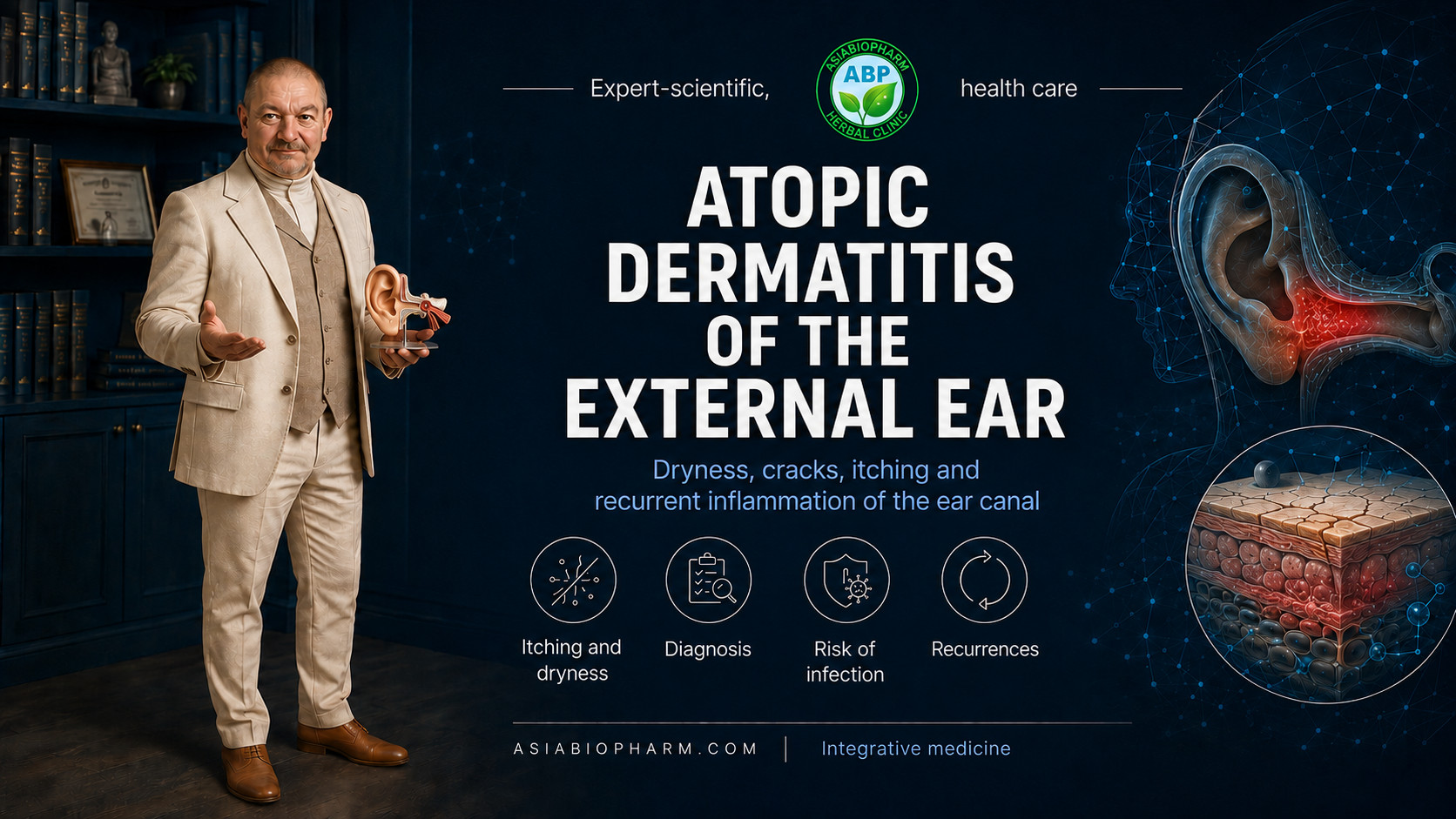
Atopic dermatitis of the external ear is a chronic recurrent inflammation of the skin of the auricle, the fold behind the ear, the entrance to the external auditory canal, and its skin lining. The main manifestations are persistent itching, pronounced dryness, flaking, redness, a feeling of tightness, small painful cracks, and excoriations from scratching. During a flare-up, the skin may swell, become weepy, and develop crusts; the discharge is usually clear or serous, but when infection develops it may become cloudy, yellowish, greenish, or acquire an unpleasant odor. The condition is not contagious: its mechanism is associated with congenital or acquired impairment of the epidermal barrier, moisture loss, increased skin sensitivity, and immune-mediated inflammation. Flare-ups may be triggered by water, high humidity, sweat, heat, cold dry air, shampoos, hair dyes, cosmetics, headphones, earplugs, hearing aids, metal jewelry, frequent ear cleaning, and trauma from cotton swabs. In children, ear involvement is often combined with atopic dermatitis of the face, neck, and flexural surfaces; in adults, localized recurrences associated with occupational, cosmetic, and contact irritants are more common; in older people, itching becomes more pronounced because of age-related skin dryness, reduced earwax production, and constant use of hearing aids. A flare-up may last from several days to several weeks, and if triggering factors persist, the inflammation may become almost constant.
How to determine whether you have atopic dermatitis of the external ear. The most characteristic pattern is a combination of bilateral itching or itching that periodically shifts from one ear to the other, fine dry scaling, redness, cracks at the entrance to the ear canal, and recurrent flare-ups after contact with water, cosmetics, headphones, or other irritants. Dry skin, eczema of the hands, face, neck, elbow or knee flexures, seasonal rhinitis, bronchial asthma, or atopic diseases in close relatives are often present at the same time. You can examine only the auricle and the entrance to the ear canal yourself under good lighting: you must not insert a cotton swab, endoscope, hairpin, or any other object into the canal. The diagnosis is confirmed by an otorhinolaryngologist and a dermatologist based on skin examination, otoscopy, and medical history. If there is weeping, crusting, purulent discharge, or lack of response to treatment, microscopy and culture of the discharge are performed to rule out a bacterial or fungal process. If the symptoms are associated with a hearing aid, headphones, cosmetics, hair dye, or previously used ear drops, patch testing may be required. Marked pain when pressing on the tragus, rapidly increasing swelling, and purulent discharge are more characteristic of infectious otitis externa; black, white, or gray masses and intense deep itching require exclusion of otomycosis; dense silvery scales and similar lesions on the scalp, elbows, or knees warrant evaluation for psoriasis.
Red flags. Immediate examination by an otorhinolaryngologist is necessary if pain is severe or rapidly worsening, especially if it interferes with sleep or spreads to the temple, jaw, or neck: this may indicate pronounced infectious otitis externa or extension of inflammation beyond the skin of the ear canal. Urgent medical attention is required for purulent, bloody, or foul-smelling discharge, high fever, rapidly increasing swelling of the auricle, redness of the skin around the ear, tenderness over the mastoid area, sudden hearing loss, dizziness, impaired balance, facial muscle weakness, or facial asymmetry. In people with diabetes mellitus, immunodeficiency, those receiving cancer treatment, those with severe wasting, and older adults, intense deep pain even with relatively minor external changes requires urgent exclusion of necrotizing otitis externa. Emergency medical services must be called if swelling of the lips, tongue, or larynx, difficulty breathing, generalized urticaria, a drop in blood pressure, or confusion occurs — such symptoms may be manifestations of a systemic allergic reaction. A young child should be examined by a doctor promptly if there is refusal to eat, continuous crying, fever, lethargy, pronounced swelling, or discharge from the ear. During pregnancy, ear medications should not be started without medical supervision, especially if the condition of the tympanic membrane is unknown.
Initial self-care methods for atopic dermatitis of the external ear. Until medical examination, scratching and mechanical cleaning of the ear canal should be stopped, and in-ear headphones, earplugs, and hearing aids should temporarily be avoided if removing the hearing aid does not create safety or communication problems. The ear should be kept dry: while showering, only the entrance to the ear canal may be covered with a clean cotton ball lightly coated with plain petroleum jelly, without pushing it inside; the cotton ball should be removed immediately after washing. Swimming, sauna use, prolonged exposure to humid environments, and a directed flow of hot air should be avoided until the inflammation resolves. The auricle may be gently rinsed with warm water without soap and patted dry with a soft cloth; water must not be poured into the ear canal. A thin layer of a simple emollient without fragrances, essential oils, alcohol, menthol, camphor, or plant allergens may be applied to visibly dry skin of the auricle and the fold behind the ear. No creams, oils, or solutions should be introduced into the deeper parts of the ear canal without otoscopy. For pronounced itching, a cool dry compress may be applied through a clean cloth for five to ten minutes several times a day; ice should not be applied directly to the skin. It is preferable to keep indoor air cool, ventilate rooms regularly, and avoid overheating and sweating; in a dry climate, moderate humidity of approximately 40–60% is acceptable. A special “hypoallergenic diet” is not required in the absence of an established food allergy. Nutrition should remain complete; only foods that have previously been documented to cause itching, urticaria, or exacerbation of dermatitis should be excluded. Fluid intake should be normal and guided by thirst, without forced increases; restrictions depend on diseases of the heart, kidneys, and endocrine system. Hydrogen peroxide, alcohol, vinegar, boric acid, chlorhexidine, iodine, essential oils, plant juices, concentrated saline solutions, or antibiotics left over from previous treatment must not be instilled into the ear. Pain, swelling, the character of discharge, body temperature, and changes in hearing should be monitored daily. If there is no noticeable improvement within two to three days, if another flare-up occurs, or if the inflammation spreads, examination by an otorhinolaryngologist and dermatologist is required.
Stages and possible progression of atopic dermatitis of the external ear. This condition has no infectious latent or prodromal period. Between flare-ups, the skin may appear almost normal while remaining dry and sensitive. An initial flare-up presents with itching, tightness, and fine scaling; erythema, swelling, cracks, excoriations, and sometimes serous weeping then develop. With a prolonged course, the skin thickens, becomes rough, skin markings become more pronounced, chronic painful fissures develop, and a persistent itch–scratch cycle forms. Recurrences are promoted by continued contact with irritants and allergens, trauma from cotton swabs, frequent removal of earwax, a humid climate, sweating, swimming, use of hearing aids and headphones, chronic stress, concomitant atopic dermatitis, seborrheic dermatitis, or psoriasis. A damaged skin barrier facilitates bacterial and fungal growth. Possible complications include secondary otitis externa, folliculitis, impetigo, painful swelling of the ear canal, accumulation of scales and earwax with temporary hearing loss, contact sensitization to components of ear drops, and chronic inflammation. Allergy is particularly often caused by certain topical antibiotics, preservatives, and ingredients in products that the patient repeatedly uses without medical supervision.
Integrative methods for treating atopic dermatitis of the external ear
Integrative therapy should take into account the form of inflammation, the condition of the skin barrier, the presence of fissures, weeping, abnormal discharge, secondary infection, and the integrity of the tympanic membrane. In a dry atopic process, the main goals are to reduce itching and inflammation, restore the lipid layer of the skin, minimize trauma, and prevent bacterial or fungal complications. If pus, an unpleasant odor, pronounced pain, severe swelling, or hearing loss develops, otoscopy and identification of the causative organism are required first. Uncontrolled simultaneous use of several ear oils, antiseptics, and herbal products increases the risk of contact dermatitis and makes it more difficult to assess treatment effectiveness.
ABP-153 Oil Infusion is the priority topical formulation for superficial dry inflammation of the external auditory canal, scaling, itching, and localized impairment of the epidermal barrier. It is considered only in the absence of active suppuration, pronounced weeping, and tympanic membrane perforation. The oil base reduces moisture loss and mechanical irritation, while the plant components provide anti-inflammatory, antipruritic, and reparative effects.
The presence of menthol, camphor, borneol, clove, eucalyptus, and other biologically active components in ABP-153 requires consideration of individual sensitivity. If burning, redness, swelling, or itching becomes more intense, topical application should be discontinued. ABP-153 should not be introduced into the ear canal simultaneously with other oils, antiseptic drops, or topical glucocorticosteroids unless the sequence of application has been specifically coordinated. The penetrating version ABP-153D is not required for superficial dry dermatitis because there is no need for deep transdermal delivery.
Nigella sativa may be used in several clinically distinct forms. The oil-based ear formulation corresponds to dry itchy inflammation and may be considered as an alternative to ABP-153, but it should not automatically be used simultaneously with it. The ointment form is suitable for the auricle, the fold behind the ear, and visible skin at the entrance to the ear canal when dryness, scaling, and fissures are present. Ointment should not be introduced into the deeper parts of the ear canal.
Dry extract of Nigella sativa is intended exclusively for oral administration and may be considered when ear dermatitis is combined with widespread atopic disease, allergic rhinitis, or bronchial hyperreactivity. Possible adverse effects include dyspepsia, diarrhea, reduced blood pressure and blood glucose levels, headache, and allergic reactions. Interactions with antihypertensive agents, glucose-lowering medications, anticoagulants, and antiplatelet agents must be taken into account. Topical forms are contraindicated in cases of individual intolerance, purulent discharge, suspected damage to the tympanic membrane, and worsening inflammation after application.
Scutellaria baicalensis in the form of a dry extract for oral administration may be used as the main systemic herbal component in recurrent atopic inflammation, pronounced itching, and a combination of skin manifestations with allergic diseases. Baicalin, baicalein, and wogonin participate in the regulation of pro-inflammatory signaling pathways and the release of mediators of allergic inflammation.
Systemic use of Scutellaria baicalensis requires caution in arterial hypotension, pronounced weakness, liver disease, and during simultaneous use of sedatives, hypnotics, anxiolytics, and other agents that depress the central nervous system. Possible effects include drowsiness, psychomotor slowing, dizziness, reduced blood pressure, and allergic reactions. An ear formulation of Scutellaria baicalensis should not be added to ABP-153 or the oil form of Nigella sativa without a separate clinical indication, because this duplicates topical therapy and increases the risk of irritation.
Curcuma longa in the form of a dry extract for oral administration may serve as an additional systemic anti-inflammatory component in widespread or frequently recurrent atopic dermatitis. For a small isolated lesion of the external ear, its clinical priority is lower than that of topical barrier therapy.
Curcuma longa should be combined cautiously with anticoagulants, antiplatelet agents, and other medications that increase the risk of bleeding. It is contraindicated in biliary obstruction and requires separate assessment in gallstone disease, acute pancreatitis, pronounced digestive disorders, and a tendency to bleed. Dyspepsia, heartburn, nausea, and loose stools may occur.
Five Root Compound anti-inflammatory mixture may be considered as an additional systemic formulation in pronounced inflammation, swelling, soreness, and widespread skin exacerbation. In moderate localized dryness and itching without significant swelling, there is no need for it. It does not replace topical therapy, restoration of the skin barrier, or elimination of irritants.
The main limitation for Five Root Compound is hypersensitivity to plant components. When several systemic herbal preparations are used simultaneously, duplication of anti-inflammatory effects should be avoided and chemically synthesized medications already being taken by the patient must be taken into account.
Jindu ear drops are not part of the basic treatment of noninfected atopic dermatitis. They may be used only in confirmed or reasonably suspected secondary microbial or fungal inflammation accompanied by weeping, abnormal discharge, and a change in odor. The presence of chlorhexidine and active plant components increases the importance of confirming the integrity of the tympanic membrane beforehand.
Jindu ear drops are contraindicated in tympanic membrane perforation, the presence of a tympanostomy tube, pronounced weeping dermatitis, and allergy to their components. In a dry noninfected atopic process, prophylactic use of antiseptic drops may increase irritation, dryness, and damage to the skin barrier.
Coptis chinensis is a reserve component for secondary bacterial or fungal complications and should not automatically be included in treatment of pure atopic inflammation. The dry extract is administered orally. Use of an ear formulation requires prior otoscopy and confirmation of a specific clinical indication.
On dry sensitive skin, Coptis chinensis may cause burning, redness, and increased scaling. Berberine-containing components may alter the activity of CYP3A4, CYP2D6, CYP2C9, and P-glycoprotein and interact with glucose-lowering, antihypertensive, antiarrhythmic, anticoagulant, immunosuppressive, and other medications. Systemic use therefore requires a clinical pharmacological assessment of the entire treatment regimen.
The advantage of a rationally selected integrative regimen is the possibility of reducing the need for prolonged use of topical glucocorticosteroids, antiseptics, and antibiotics. This may reduce the risk of skin atrophy, suppression of local immunity, disruption of the local microbiota, fungal complications, contact sensitization, and drug resistance.
Plant origin does not mean that adverse reactions are completely absent. The skin of the external auditory canal is thin, poorly ventilated, and particularly sensitive to essential oil components, preservatives, and combinations of several products. Therefore, one main topical formulation should be selected at a time, while additional preparations should be prescribed only for a separate clinical indication.
Antipyretic Compound is not used for uncomplicated atopic dermatitis of the external ear because the condition itself does not cause fever. Elevated body temperature, chills, and systemic intoxication require evaluation for a bacterial complication, extensive otitis externa, or another infectious process.
Aromatic Cooling Oil Sukaya must not be used inside the ear canal and must not be applied to fissures, erosions, weeping areas, or actively inflamed atopic skin. Menthol, propylene glycol, and aromatic components may cause intense burning, contact irritation, and worsening inflammation.
What you need to know about standard protocols of modern medicine
The basis of standard treatment for atopic dermatitis of the external ear is elimination of contact irritants and allergens, restoration of the epidermal barrier, and controlled suppression of inflammation. Before prescribing any ear solutions, drops, ointments, or oil-based products, the physician should examine the external auditory canal and the tympanic membrane. A medication that is relatively safe for the skin of the auricle may, if it passes through a perforation into the middle ear, cause pronounced inflammation, vestibular disturbances, damage to the auditory system, and irreversible hearing loss.
Topical glucocorticosteroids — hydrocortisone, desonide, mometasone, betamethasone, and other drugs in this class — are used to rapidly reduce itching, hyperemia, swelling, and eczematous inflammation. On the thin skin of the external ear, low-potency corticosteroids are generally used for limited courses because even topical administration may cause burning, pain, dryness, increased irritation, skin atrophy, telangiectasia, hypopigmentation, striae, and delayed healing of fissures. With prolonged or repeated use, the skin becomes thinner, is more easily traumatized, loses barrier function, and becomes more susceptible to bacterial and fungal infection.
Glucocorticosteroids suppress the local immune response and can rapidly reduce the external manifestations of infection without eliminating its cause. This may mask purulent otitis externa, otomycosis, or herpetic lesions and create a false impression of improvement while the pathogen continues to multiply. Use of combination drops containing a corticosteroid component without a confirmed diagnosis increases the risk of chronic infection, fungal superinfection, and a steroid-modified clinical presentation. Corticosteroid medications should not be started without medical supervision in the presence of purulent discharge, an unpleasant odor, herpetic vesicles, pronounced weeping, an unknown condition of the tympanic membrane, or allergy to product components.
Systemic absorption of topical corticosteroids is generally limited when a small area is treated, but it increases sharply in children, in the presence of erosions or weeping, when the skin barrier is damaged, when potent preparations are used, and with prolonged treatment. Possible consequences include suppression of the hypothalamic-pituitary-adrenal axis, reduced endogenous cortisol production, growth retardation in children, hyperglycemia, signs of hypercortisolism, increased intraocular pressure, and worsening of glaucoma. After prolonged use of a potent corticosteroid, abrupt discontinuation may be accompanied by reactive worsening of inflammation, burning, redness, and itching.
Pimecrolimus and tacrolimus are used as steroid-sparing calcineurin inhibitors in chronic or frequently recurrent disease. They do not cause the typical steroid-related atrophy of the skin, but they often provoke intense burning, warmth, tingling, itching, erythema, and soreness, particularly during the first days of treatment. On damaged skin, these unpleasant sensations may be pronounced and lead to discontinuation of therapy. Folliculitis, reactivation of herpes infection, and development of a bacterial or fungal process are possible because of local suppression of the immune response.
Tacrolimus and pimecrolimus should not be applied to clearly infected, purulent, weeping, or herpes-affected skin without medical assessment. Introducing these medications deep into the ear canal without otoscopy is unacceptable. Systemic absorption is usually low but may increase with severe impairment of the skin barrier, widespread dermatitis, and pronounced immunodeficiency. Prolonged uncontrolled use of topical immunomodulators is undesirable because of chronic suppression of local immune defenses. A reliable percentage for complete recovery and absence of recurrence over a two-year period has not been established for these medications.
Emollients and barrier moisturizing products reduce dryness, decrease water loss, and support epidermal repair. Neutral formulations without fragrances, alcohol, essential oils, lanolin, or other common contact allergens are preferable for the auricle. Even neutral products may cause contact dermatitis due to preservatives, emulsifiers, or base ingredients. When introduced deep into the ear canal, oily products may obstruct it, retain moisture and discharge, cause skin maceration, and create an environment favorable for bacterial and fungal growth. In the presence of pain, discharge, an unpleasant odor, or suspected perforation, self-directed use of emollients inside the ear canal is unacceptable.
Antibacterial ear medications are prescribed only for confirmed or clinically probable secondary bacterial infection. They do not treat atopic inflammation and should not be used prophylactically. Neomycin relatively often causes contact sensitization with increased itching, swelling, weeping, and redness, which may mistakenly be interpreted as worsening of the underlying dermatitis. Repeated use increases the likelihood of persistent allergy to aminoglycosides.
Neomycin, gentamicin, framycetin, and other aminoglycoside antibiotics must not be used without confirmation that the tympanic membrane is intact. If they enter the middle ear, they can damage the hair cells of the cochlea and vestibular apparatus, causing irreversible hearing loss, tinnitus, dizziness, impaired coordination, and balance disorders. Prolonged or repeated use of topical antibiotics disrupts the microbiota of the ear canal, promotes fungal growth, and selects resistant bacteria. Systemic antibiotics are not required for localized dermatitis and are used only when bacterial infection spreads beyond the external auditory canal.
Antifungal medications — clotrimazole, miconazole, and other antifungal agents — are used only in confirmed or clinically probable otomycosis. They may cause burning, pain, swelling, contact dermatitis, and additional damage to the inflamed skin barrier. Self-treatment before mycological testing may alter the clinical picture and reduce the diagnostic value of laboratory studies. When a fungal process is combined with eczema, fungal debris must be removed, infection suppressed, and the skin barrier restored at the same time; use of a corticosteroid alone without an antifungal agent may markedly worsen otomycosis.
Oral antihistamines are sometimes prescribed to reduce nighttime itching and improve sleep, but they do not eliminate the underlying inflammation or damage to the skin barrier. First-generation sedating antihistamines — diphenhydramine, chloropyramine, hydroxyzine, and similar medications — may cause drowsiness, cognitive slowing, impaired memory and reaction speed, dryness of mucous membranes, thickening of bronchial secretions, constipation, urinary retention, and impaired accommodation.
In older people, sedating antihistamines increase the risk of confusion, delirium, falls, and fractures. Some medications can prolong the QT interval and provoke dangerous cardiac arrhythmias. The risk is particularly high in angle-closure glaucoma, prostatic hyperplasia, cardiac arrhythmias, and when these medications are combined with alcohol, opioids, hypnotics, benzodiazepines, and other agents that suppress the central nervous system and respiration.
In widespread severe atopic dermatitis, phototherapy, cyclosporine, methotrexate, systemic glucocorticosteroids, biologic agents, or JAK inhibitors may be considered. Isolated dermatitis of the external ear alone does not usually justify such systemic immunosuppression. Phototherapy may cause burns, photoaging, pigmentary changes, and, with a high cumulative exposure, an increased risk of skin tumors.
Cyclosporine may cause nephrotoxicity, arterial hypertension, hyperkalemia, tremor, hypertrichosis, gingival hyperplasia, infections, and an increased risk of lymphoproliferative disorders. Methotrexate may damage the liver, suppress bone marrow hematopoiesis, cause leukopenia, thrombocytopenia, ulcerative stomatitis, pneumonitis, severe infections, and teratogenic effects. Systemic glucocorticosteroids create risks of hyperglycemia, adrenal suppression, osteoporosis, infections, cataracts, glaucoma, and pronounced rebound exacerbation after discontinuation.
Biologic medications may cause injection-site reactions, conjunctivitis, herpetic complications, eosinophilia, and alterations in the immune response. JAK inhibitors are associated with a risk of severe infections, reactivation of herpes zoster, anemia, leukopenia, changes in liver enzymes and lipid metabolism, venous and arterial thrombosis, cardiovascular complications, and certain malignancies. Their use requires monitoring of blood parameters, liver and kidney function, lipids, and infection status.
A reliable percentage for complete cure specifically of atopic dermatitis of the external ear and absence of recurrence over a two-year period has not been established for standard treatment protocols. Most chemically synthesized medications temporarily suppress inflammation and itching but do not eliminate an individual tendency toward skin barrier dysfunction, allergic sensitization, and recurrent flare-ups.
Complex and prolonged use of topical corticosteroids, calcineurin inhibitors, antibiotics, antiseptics, antifungal agents, and sedating antihistamines may simultaneously cause skin atrophy and chemical damage, suppression of local immunity, contact sensitization, disruption of the microbiota, fungal superinfection, drug resistance, ototoxicity, and systemic neurological complications. Alternative integrative approaches based on individually selected herbal formulations make it possible to target inflammation, itching, and restoration of the skin barrier and generally do not have the same aggressive systemic and local damaging effects as prolonged combined use of chemically synthesized medications.
Why dosages and duration of treatment are not specified in the article
The same form of atopic dermatitis of the external ear may differ substantially from one person to another in the activity of inflammation, depth of fissures, severity of dryness, presence of weeping, secondary bacterial or fungal infection, and condition of the tympanic membrane. In one patient, the condition may be limited to the auricle; in another, it may extend into the ear canal and be combined with allergic rhinitis, bronchial asthma, widespread eczema, or contact allergy to medication components.
To select the dosage, frequency of use, and duration of treatment, it is necessary to assess the current phase of the disease, the duration and frequency of flare-ups, the degree of skin barrier damage, the presence of discharge, hearing status, previous ear diseases, age, body weight, liver and kidney function, blood pressure, and the condition of the cardiovascular, nervous, endocrine, and immune systems. Pregnancy, breastfeeding, childhood and older age, as well as currently used antiallergic, sedative, anticoagulant, glucose-lowering, antihypertensive, and other medications are considered separately.
A universal regimen may be insufficient in active infected inflammation or excessive for a small dry lesion. Applying oils too frequently may cause maceration, obstruction of the ear canal, and increased irritation. Unjustified use of antiseptics damages the microbiota and perpetuates dryness. Prolonged use of anti-inflammatory agents without monitoring may mask infection and alter the clinical picture.
Therefore, the article describes possible therapeutic approaches but does not replace an individualized clinical pharmacological assessment. If necessary, you may ask a short question in the comments to this article, and in more complex cases you may schedule a consultation with a clinical pharmacologist specializing in integrative medicine using the link https://asiabiopharm.com/konsultaciii
0 comments